Network Slicing and NSSF: The Backbone of 5G Service Differentiation
The advent of 5G technology has transformed the telecommunications landscape, offering unprecedented speed, capacity, and low latency. A critical aspect of this transformation is network slicing, which enables service providers to create virtual end-to-end networks tailored for specific services. These slices can coexist within the same infrastructure, optimizing performance and catering to various service requirements.
At the heart of this innovation lies the Network Slice Selection Function (NSSF), a key component responsible for managing and selecting appropriate network slices. The NSSF plays a pivotal role in maintaining the efficiency and reliability of 5G networks, offering various essential functions:
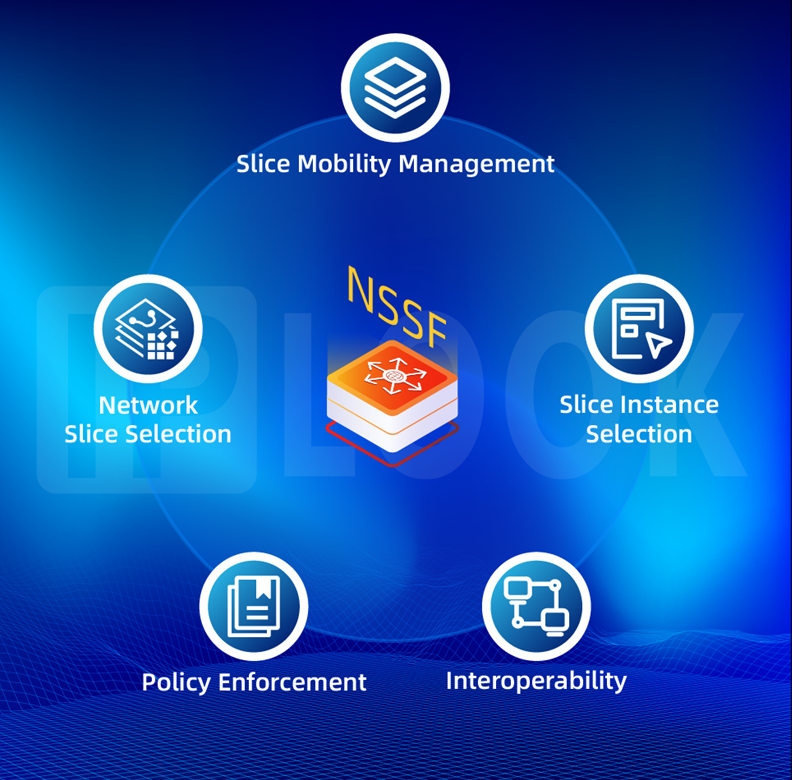
Core Functions of 5G NSSF
· Network Slice Selection: By evaluating service requirements such as latency, throughput, reliability, and security, the NSSF determines the most suitable network slice for allocation. This ensures that each application receives the optimal resources and performance necessary for seamless operation. Whether it’s high-bandwidth eMBB services, massive-connection mMTC applications, or ultra-low-latency URLLC scenarios, the NSSF matches services to the right slice.
· Slice Instance Selection: In cases where multiple instances of a network slice are available, the NSSF selects the ideal slice instance considering factors like location, resources, and load balancing. This guarantees optimal resource allocation, avoids congestion, and maintains high network performance even during peak usage.
· Policy Enforcement: The NSSF enforces policy rules defined by network operators or service providers, ensuring compliance with predefined quality of service (QoS) standards, security measures, and resource utilization guidelines. This function is vital for maintaining service level agreements (SLAs) and delivering consistent performance across different user groups and vertical industries.
· Slice Mobility Management: As users move between access points, the NSSF facilitates seamless handover of network slices, maintaining uninterrupted service continuity. This feature is crucial for supporting mobile applications (e.g., autonomous driving, remote healthcare) and ensuring a smooth user experience without service drops or performance degradation.
· Interoperability: Acting as a central entity in the Service-Based Architecture (SBA), the NSSF enables smooth interaction between different network functions (e.g., AMF, SMF, PCF) and elements involved in network slicing. This seamless interoperability ensures efficient operation, coordinated resource management, and end-to-end slice lifecycle control within the network.
The Indispensable Role of NSSF in 5G Ecosystem
By intelligently managing and selecting appropriate network slices, the NSSF enables service providers to deliver tailored, high-performance services that meet the diverse needs of their customers. With its ability to optimize resource allocation, enforce policy rules, and support seamless connectivity, the NSSF is an indispensable component of the 5G ecosystem—empowering operators to maximize infrastructure value, serve vertical industries, and drive new business innovations.