Our High-Performing Core Network
Fully virtualizable on VMware, K8S, Docker and OpenStack containers
Cell Broadcast Centre (CBC)
The Cell Broadcast Centre (CBC) is a critical component in mobile communication networks, responsible for managing and distributing cell broadcast messages. By enabling large-scale, real-time information dissemination across cellular networks, it provides the capability to deliver critical information, alerts, and notifications to a broad user base.
The CBC is widely utilized in fields such as natural disaster warnings (e.g., earthquakes, fires, tsunamis), emergency broadcasts, targeted information services, and public safety communications. It primarily supports the broadcast of text-based messages to selected geographic areas.
Key Benefits

Fast Nationwide Alert Delivery
Enables the rapid distribution of emergency alerts to millions of mobile subscribers across wide geographic areas.

3GPP-Compliant Public Warning System
Fully compliant with 3GPP standards for Public Warning System (PWS) and ETWS.

Accurate Geographic Broadcast
Supports cell-level and tracking area level targeting for location-based alerts.

Carrier-Grade Reliability
High availability architecture with reliable SCTP communication and redundancy mechanisms.

Flexible Deployment
Supports deployment on COTS hardware, NFV platforms, and cloud infrastructure.
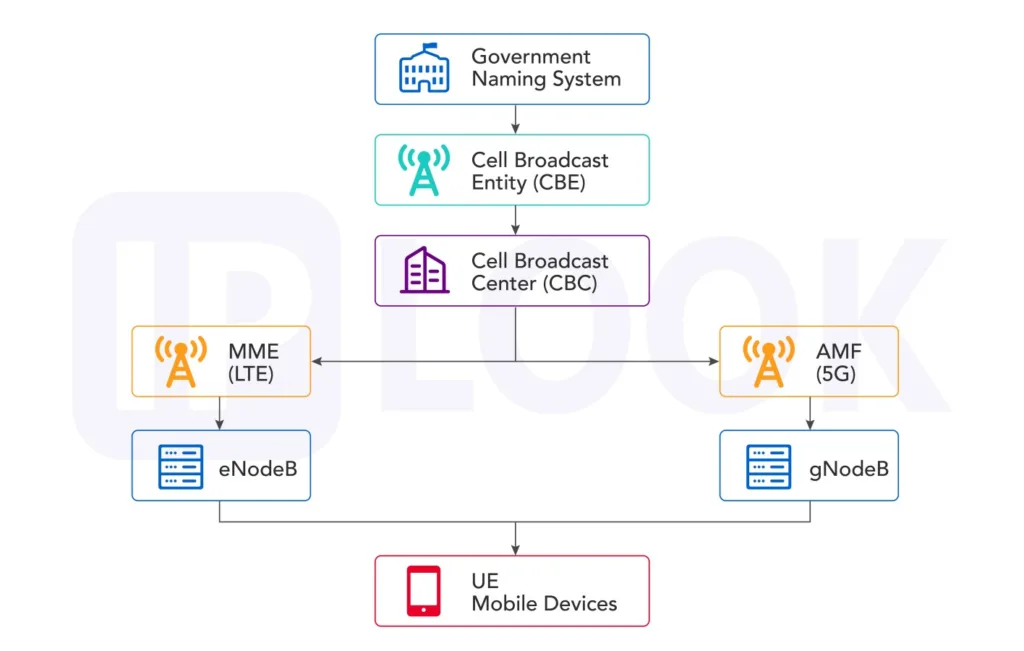
IPLOOK's Reliable and Standards-Compliant Cell Broadcast Centre
- The Cell Broadcast Centre (CBC) functions as the central control element responsible for managing and distributing cell broadcast messages in the mobile network.
- In a typical deployment:
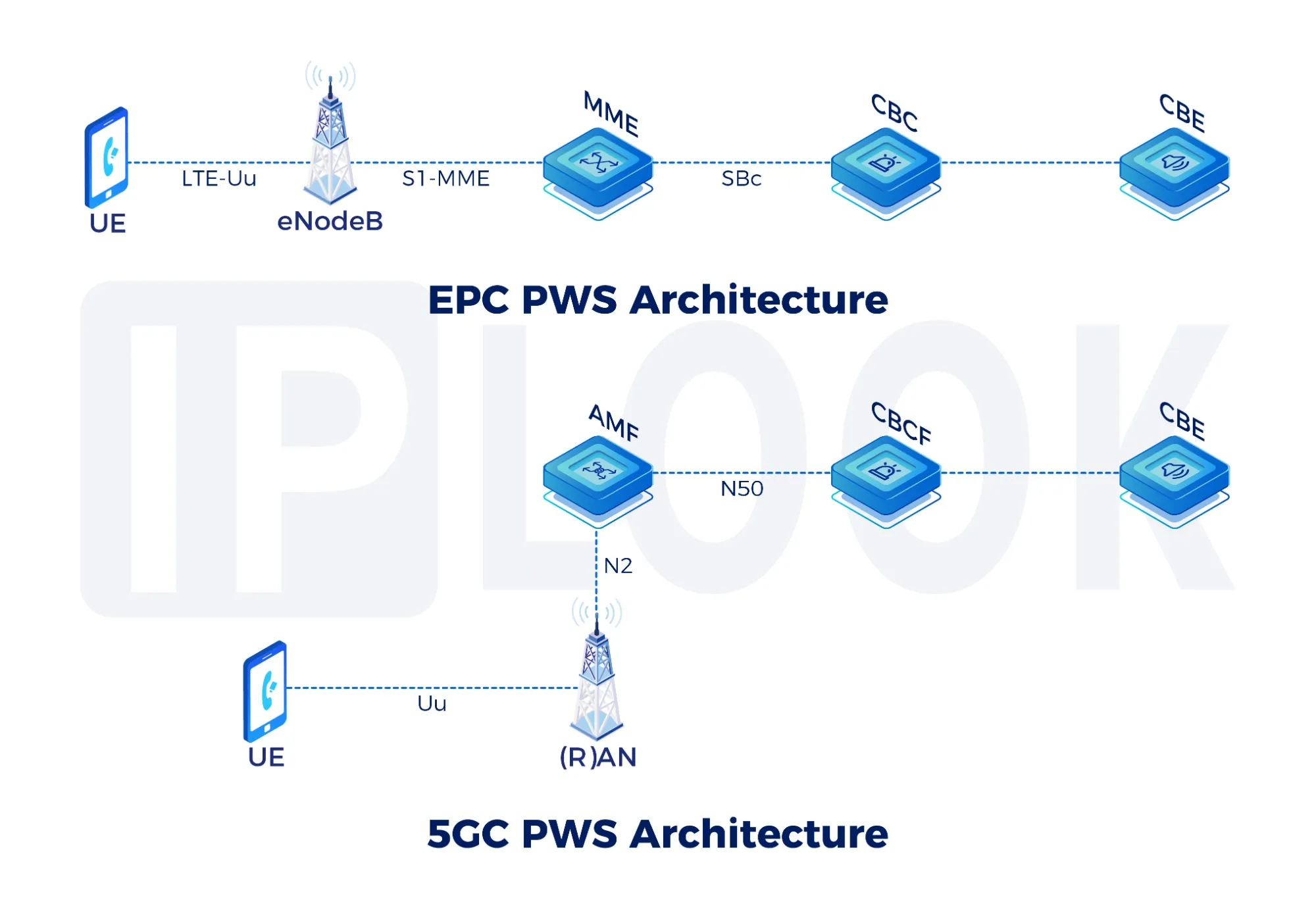
- Emergency alert messages generated by government or warning agencies are delivered to the Cell Broadcast Entity (CBE). The CBC receives the message from the CBE, processes it, determines the target broadcast area, and sends the broadcast request to the mobile core network.
- Core network nodes such as the MME in LTE networks or the AMF in 5G networks forward the broadcast message to base stations. The base stations then broadcast the alert to all user devices located within the selected geographic area.
- This architecture ensures rapid and large-scale dissemination of emergency information across the cellular network.
Feature List
Warning Information Distribution & Management
- Emergency Tagging: Distinguishes regular messages from urgent alerts.
- Source Integration: Receives alerts from government warning agencies.
- Multi-network Support: Supports 4G (via MME) and 5G (via AMF) networks to broadcast public warning messages (e.g., earthquakes, tsunamis) to UEs in specified areas.
Message Processing
- Message Lifecycle Management: Manages message states: creation, activation, expiration, termination. Supports manual termination or automatic expiration via timers. Serial Number Assignment: Generates unique IDs based on message type (ETWS/non-ETWS) and geographic scope.
- Message Content Handling: Pads messages to fixed lengths (compliant with 3GPP TS 23.038). Supports modification or deletion of base station-stored messages.
Geographic Area Calculation
- Area Mapping: Converts OAM-configured geographic data (TAI, ECGI lists) to 3GPP-defined area IDs (e.g., cell ID, emergency area ID).
- Dynamic Adjustment: Re-broadcasts active messages in specific TAI ranges based on base station Restart Indications.
Time Control Mechanism
- Precision Scheduling: Configures message start/stop times and repeat intervals.
- Dynamic Adjustment: Re-broadcasts active messages in specific TAI ranges based on base station Restart Indications.
- Timer Management: Controls message validity (ETWS remains active permanently; non-ETWS expires via timers). Retransmission: Sets retry timers for unresponsive requests (e.g., Write-Replace Warning, Stop PWS). Link Maintenance: SCTP heartbeat intervals, reconnection timers, unreachable address detection.
Interface & Configuration Management
- Flexible Configuration:
- SCTP Parameters: Customizable initial/max/min RTO, retransmission attempts, heartbeat intervals.
- MME Pool Setup: Supports IPv4/IPv6 dual-stack, multi-PLMN IDs, TAI list associations.
- Global Parameters: Manages emergency area ID/cell ID profiles and OMC IDs.
- Northbound API: RESTful interfaces for CRUD operations, returning structured JSON results.
Scalability & Reliability
System Architecture Modules
- CBS-Service:
- Generates serial numbers and manages message lifecycles.
- Invokes Geo Core for area calculation and persists data via DB Agent.
- Core-Manager:
- Manages SCTP connections (multi-MME pool support), encodes/decodes SBc-AP messages, handles retransmissions/timeouts.
- CBE-Manager: Reserved for third-party CBE integration (e.g., SOAP/SAP protocol extensions).
Protocol & Standards Compliance
- Core Protocols: Compliant with 3GPP standards (TS 23.041, 29.168, 36.413), ETWS, and tsunami warning requirements.
- Interface Protocols:
- SBc Interface: Transmits SBc-AP messages between CBC and MME via SCTP.
- Northbound Interface: Uses HTTP/2 for OAM interactions, enabling SCTP/MME pool configurations and global parameter settings.