Our High-Performing Core Network
Fully virtualizable on VMware, K8S, Docker and OpenStack containers
Charging Function(CHF)
Based on the 5G Service-Based Architecture (SBA), the Converged Charging System (CCS) provides real-time billing and monetization capabilities. It integrates the Charging Data Function (CDF) and Charging Gateway Function (CGF) to support online, offline, and convergent charging models, enabling diverse 5G services such as voice, data, IoT, and network slicing for Industry 4.0.
Highlights

Real-Time billing and service monetization platform

Capacity provisioning to improve performance

CDR mediation and vendor/routing control

Voice, video, SMS, data, VAS, IPTV, SDN/NFV, IoT/M2M

Customer management and provisioning

Seamless integration with standardized third-party APIs

Easy-to-use configuration server to quickly manage the entire

Online self-care for easily accessible management
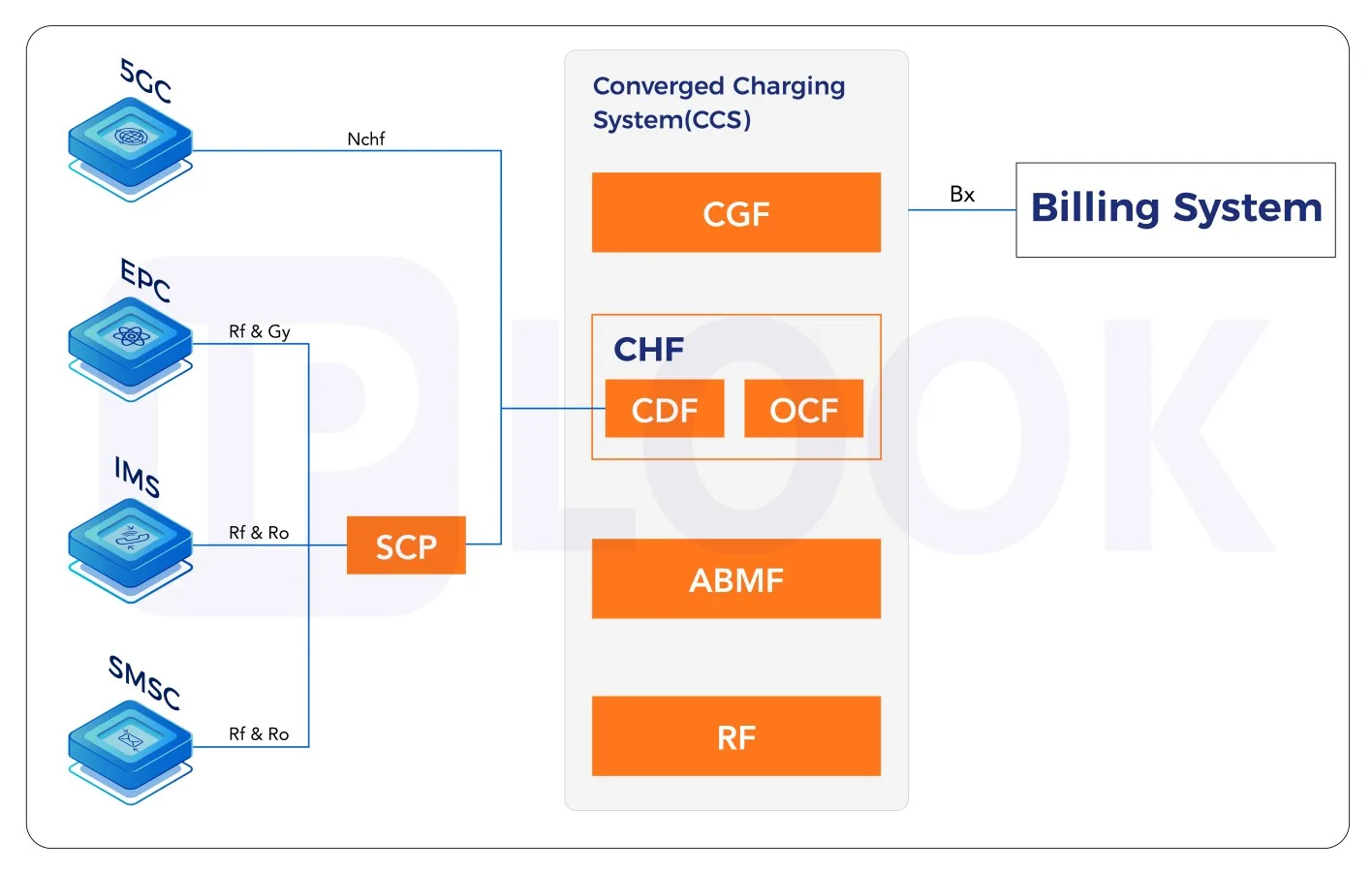
How IPLOOK 5GC Integrates with a Converged Charging System
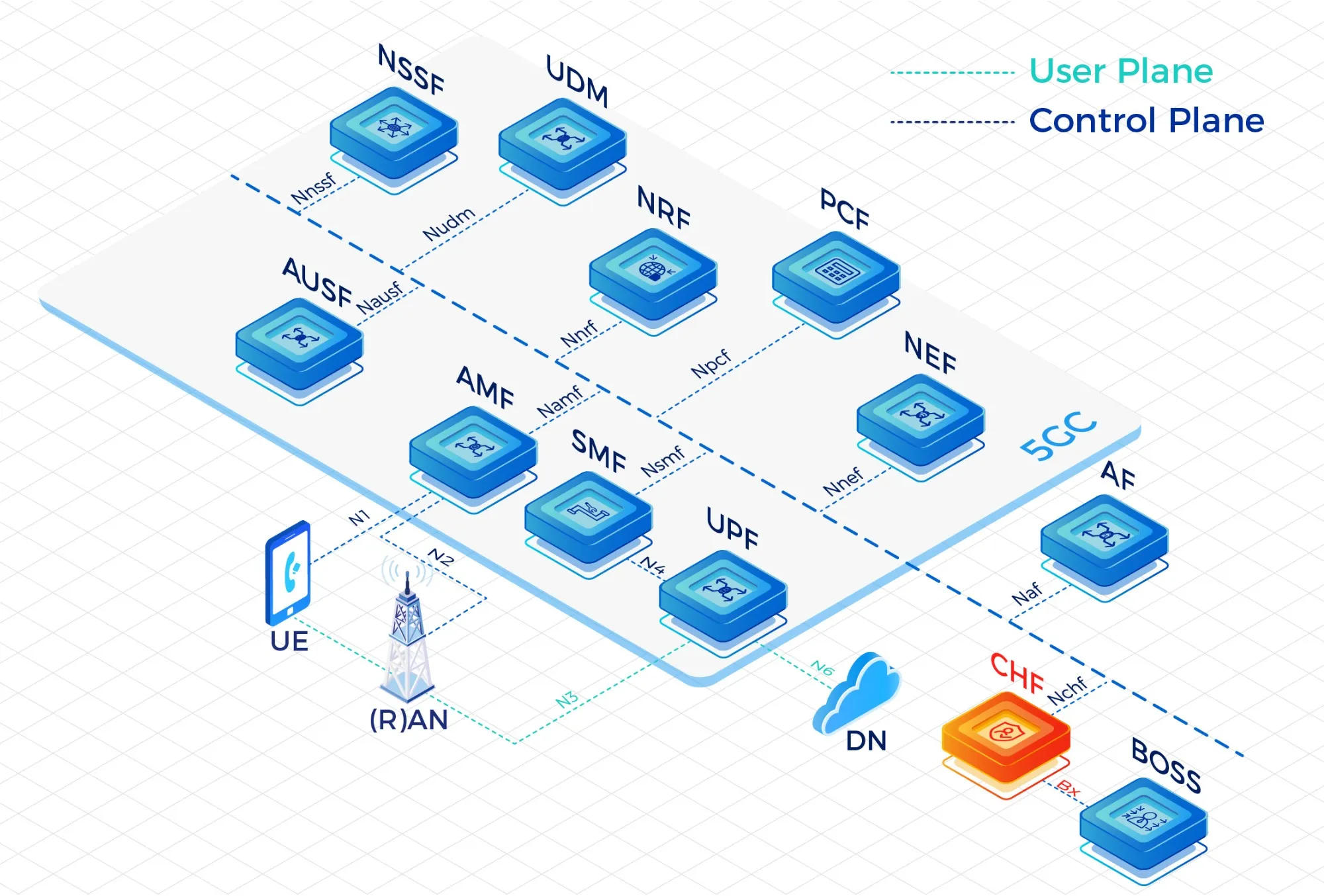
- Charging Function (CHF): Receives Nchf interface messages from the SMF and manages the routing and forwarding of charging requests.
- Charging Data Function (CDF): Collects charging data, generates Charging Data Records (CDRs), and sends them to the Charging Gateway Function (CGF) for processing.
- Charging Gateway Function (CGF): Processes CDRs and generates billing files for the BOSS/Billing System . The CHF also supports charging request and response exchange between the SMF and BOSS.
IPLOOK CHF Video Series: The Backbone of 5G Converged Charging
Part 01: What is CHF & Its Core Role in 5G Converged Charging?
Discover the Charging Function (CHF) as the backbone of 5G CCS (Converged Charging System): combining online (OCF) and offline (CDF) charging, RESTful APIs, and CDR data record generation.
Part 02: CHF Key Procedures – Online Quotas & Offline CDRs
Understand CHF interfaces (Nchf, Rf, Gy/Ro) and dual procedures: real-time quota reservation for online pre-paid usage, and CDR generation for post-paid offline billing systems.
Part 03: Why CHF Matters – Slicing Monetization & Multi-Tenancy
Explore CHF's business value for operators: billing accuracy across eMBB/URLLC slices, private 5G multi-tenancy models, roaming settlement, and regulatory compliance.
Features
Support billing session flow with Nchf_Converged Charging interface
Forwarding Nchf connection messages
Support processing 4G access user billing information
Responsible for generating CHF-CDR tickets
Routing of billing messages through NRF dynamic discovery
Forwarding billing messages to the attributed provincial OCS
Fault/exception scenarios carry corresponding response codes to SMF
Support static configuration based on SUPI (similar to IMSI for 4G) number segment
Provide quota to SMF according to system configuration when BOSS is abnormal
CGF capability

FAQ
What is the Charging Function (CHF) in a 5G network?
The Charging Function (CHF) is a core component of the 5G Service-Based Architecture (SBA) responsible for real-time charging, billing, and monetization of telecom services. It manages charging interactions between network functions such as the SMF and external billing systems, enabling operators to support flexible charging models for 5G services.
What is the difference between CHF, CDF, and CGF?
The CHF handles real-time charging communication and policy coordination with network functions. The Charging Data Function (CDF) collects charging information and generates Charging Data Records (CDRs). The Charging Gateway Function (CGF) processes these CDRs and generates billing files for integration with BOSS/BSS systems.
Which services can IPLOOK’s charging platform support?
The platform supports charging for voice, video, SMS, mobile data, VAS, IPTV, IoT/M2M services, SDN/NFV environments, and advanced 5G services such as network slicing and Industry 4.0 applications.
Does the solution support both online and offline charging?
Yes. IPLOOK’s Converged Charging System (CCS) supports online charging, offline charging, and converged charging models. This enables operators to provide prepaid, postpaid, and hybrid billing services within a unified charging platform.
How does the CHF integrate with the 5G Core Network?
The CHF connects to the 5G Core through the standardized Nchf interface. It receives charging requests from the SMF, routes charging messages, communicates with external billing systems such as BOSS/OCS platforms, and returns charging responses back to network functions.
What scalability and reliability features are included?
The platform supports dynamic routing through NRF discovery, quota management during BOSS failures, scalable capacity provisioning, and fault-handling mechanisms with corresponding response codes. These features ensure reliable charging operations in high-volume telecom environments.
Can the charging platform integrate with third-party systems?
Yes. The solution provides standardized APIs and flexible integration capabilities for BOSS, OCS, CRM, and third-party business systems. This enables operators to integrate billing, customer management, and service monetization into existing operational ecosystems.
What business benefits does the CHF provide to operators?
IPLOOK’s CHF helps operators accelerate monetization of 5G services, improve billing accuracy, support flexible pricing models, simplify customer provisioning, and reduce operational complexity. It also enables telecom providers to launch new revenue-generating services more quickly across consumer, enterprise, and IoT markets.