Our High-Performing Core Network
Fully virtualizable on VMware, K8S, Docker and OpenStack containers
Voice over NR(VoNR)
Voice over New Radio (VoNR) is the IP Multimedia System (IMS) based voice calling services based on 5G access, realizing both voice and data services carried on the 5G network.
The New Radio network communication is the 5G radio access technology and the advanced & updated form of 4G radio access technology.
Request a demo
Download
Key Benefits

100% cloud implementation of IMS core deployment

Convergence of mobile and fixed access networks

Deliver seamless, uninterrupted roaming

Support hypervisor and dynamic lightweight Linux Containers

Simplify managing interconnect network topology

Carrier Grade Reliability Support for multimedia services
IPLOOK's vIMS solution Enable Voice over NR function
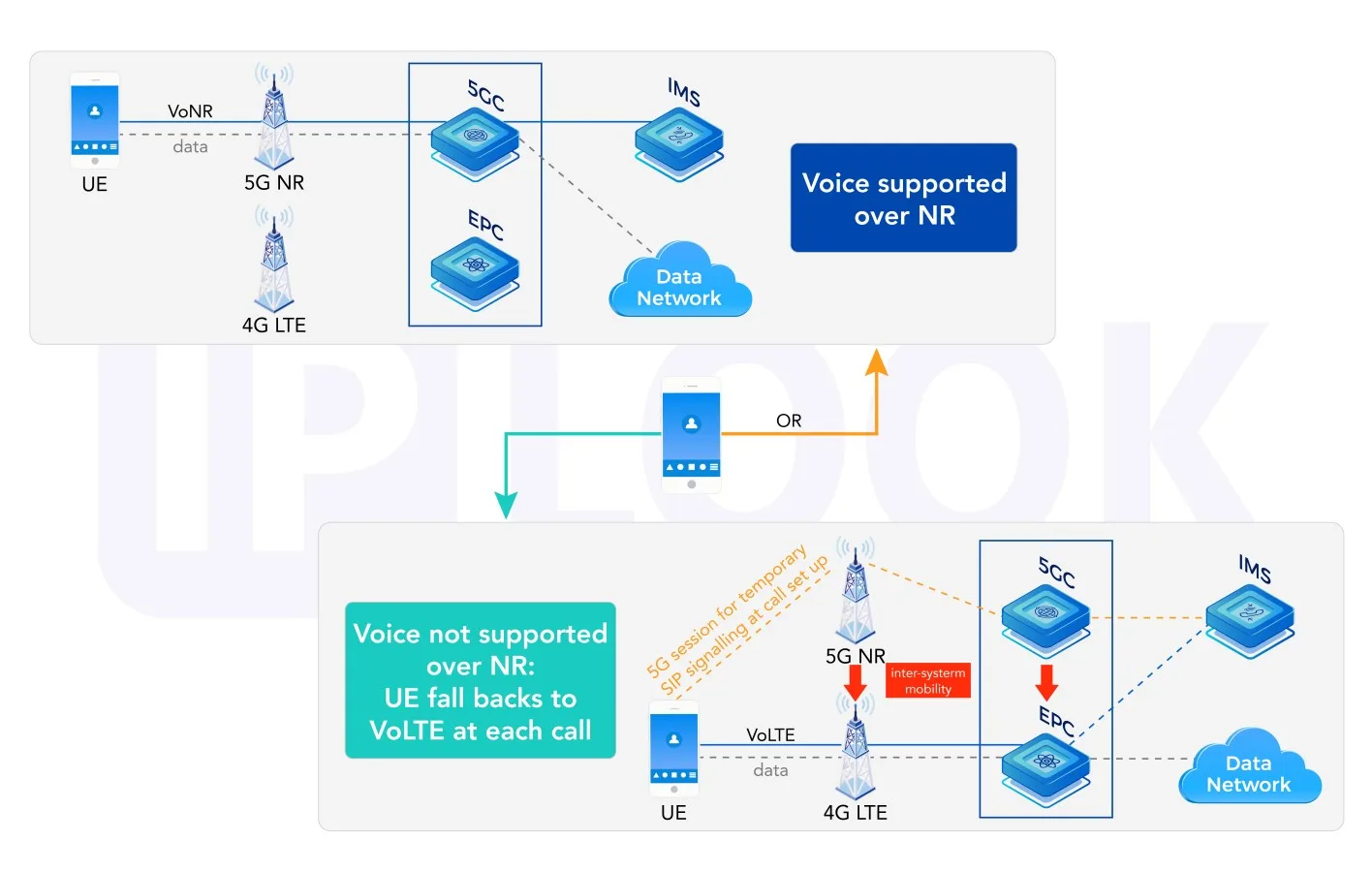
- At the beginning of 5G SA deployment, EPS Fallback becomes the solution on the way of 5G voice evolution due to the small coverage of 5G NR. With the gradual improvement of 5G NR coverage, users will be able to experience higher definition and quality audio and video call services brought by VoNR and enjoy 5G high-speed data Internet service while making calls.
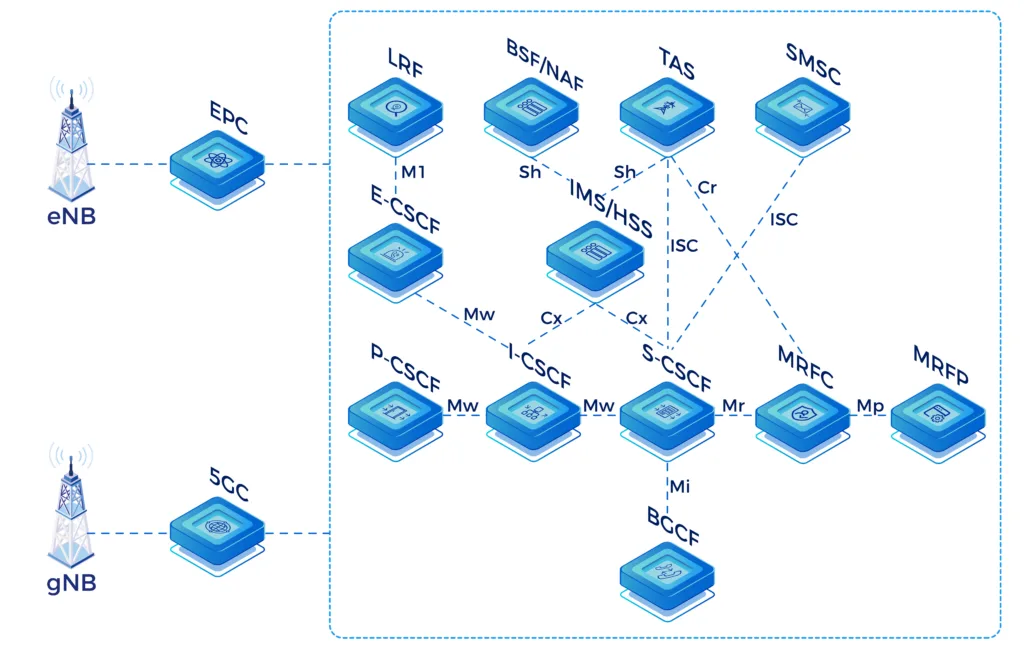
- Both 4G and 5G networks must rely on a core network called IMS, also known as IP Multimedia Subsystem, which enables voice services under packet-switched networks.
Features
Comply to 3GPP R14 Standard
Application Servers
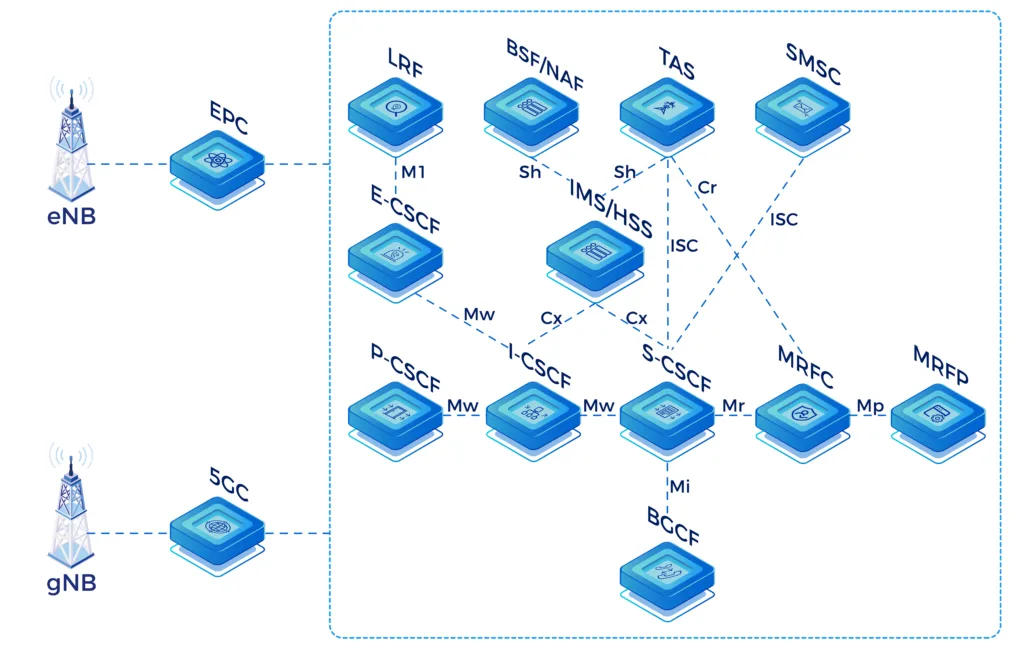
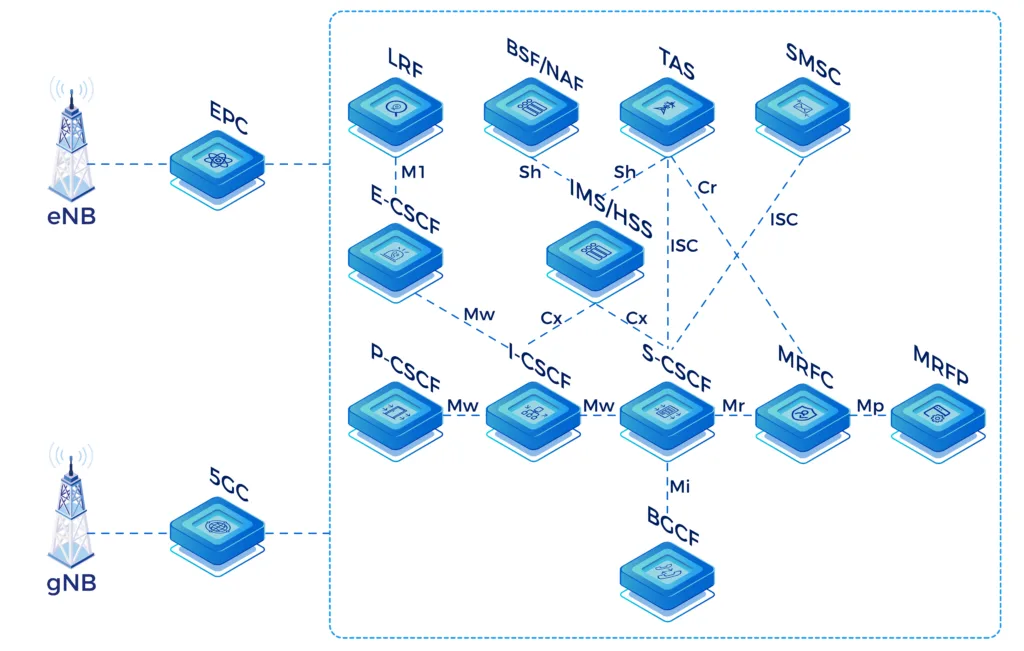
- IP-SM-GW: Provides SMS services for VoLTE and exciting devices and allows interworking towards other networks based on SMPP
- MMTel/TAS: Provides rich supplementary services, e.g., call forwarding and call barring and acts as a conference-factory for VoLTE handsets
- MRF: Provides network announcements and conferencing. Implemented according to RFC4240 (Basic Media Services in SIP) and set up as combined MRF-controller (MRFC) and -processor (MRFP)
- SR-VCC: Enables seamless early or mid-call handover from 4G/5G to 2G/3G and acts as a media-anchor for voice calls
- LI: Provides X1 to X3 interfaces towards the mediation function
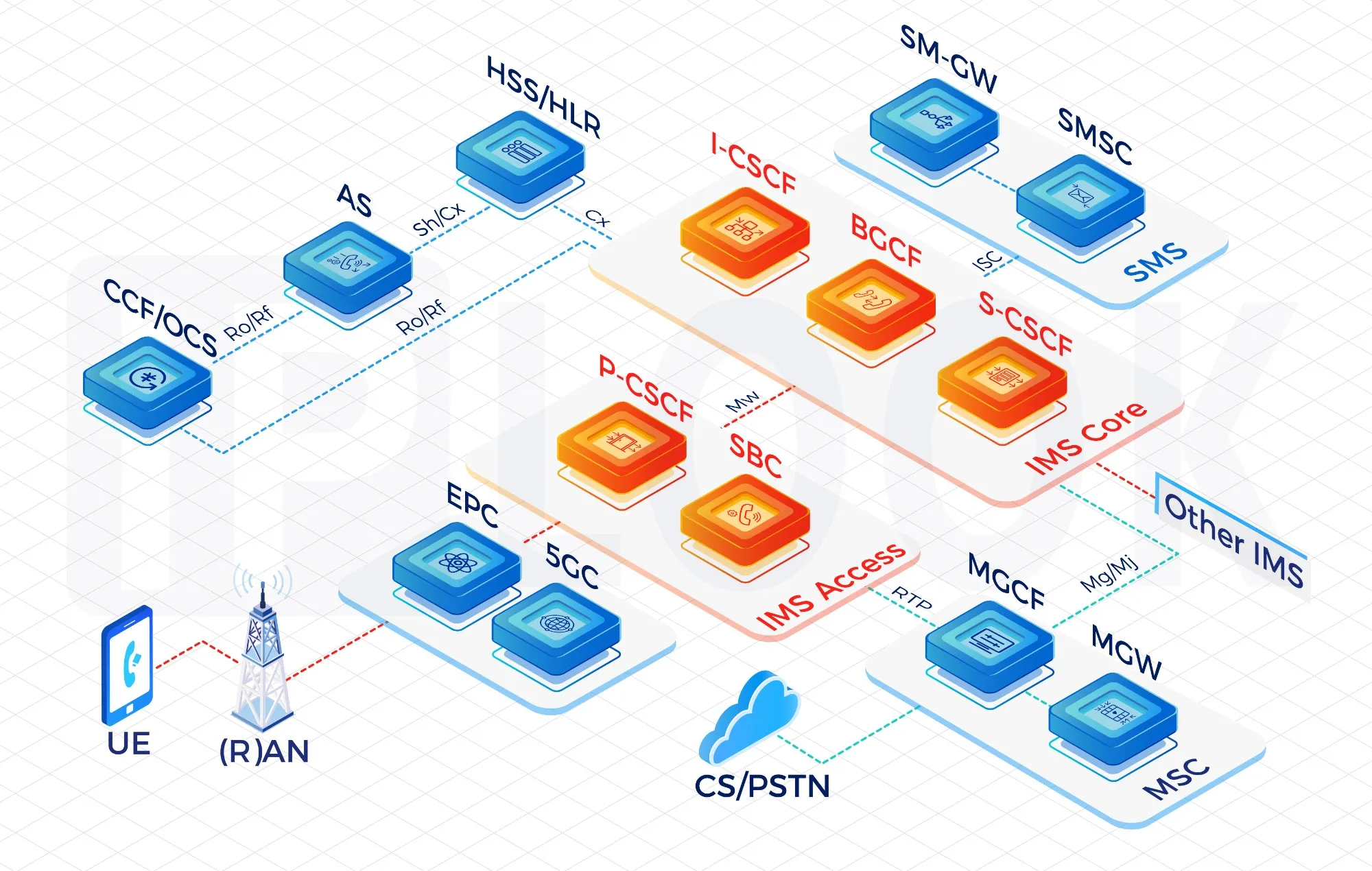
- I-CSCF: Provides full Cx/Dx interface support and selects S-CSCF based on user capabilities and load
Interfaces
- Rx: Between PCRF and P-CSCF
- ENUM: Between S-CSCF and ENUM-DNS server
- Sh: Between AS and HSS
- ISC: Between AS and CSCFs
- Gm: Between SBC/P-CSCF and UE (via EPC/PGW)
- Cx/Dx: Between CSCF and HSS
- Mg/Mj: Between CSCF and MGCF for PSTN-IMS interconnect
- SNMP: Towards Network Management System
- Ro: Between CSCFs and IN/OCS
- Rf: Between CSCFs and CCF
I/S/P-CSCF, BGCF, SBC, AS NE Functions
- I-CSCF: Provides full Cx/Dx interface support and selects S-CSCF based on user capabilities and load
- S-CSCF: Provides flexible application execution using a standards-based ISC interface and allows optional charging integration with standard Ro/Rf interfaces
- P-CSCF: Provides full transcoding support for AMR/AMR-WB based on a separated RTP worker
- BGCF: Adds interworking functions (flexible in- and outbound routing options) and provides topology hiding
Secures the network edge for user access and/or peer network interconnection with topology hiding, Internet Protocol Security encryption (IPSec), Transport Layer Security (TLS), Secure Real-Time Transport Protocol (SRTP) and intrusion protection such as from Distributed Denial of Service (DDoS) attack
Provides SIP signaling control and media anchoring to ensure voice call continuity for calls that traverse LTE and 3G networks
Scale to millions of subscribers per service
Enable the use of HD voice and EVS voice codecs, including transcoding, delivering a better quality of experience (QoE) for end-users compared to over-the-top (OTT) services

FAQ
What is Voice over NR (VoNR)?
Voice over NR (VoNR) is a 5G-native voice service based on the IP Multimedia Subsystem (IMS) architecture. It enables voice calls to be carried entirely over 5G New Radio (NR) networks while simultaneously supporting high-speed 5G data services.
How is VoNR different from VoLTE?
VoLTE operates on 4G LTE networks, while VoNR is designed specifically for 5G Standalone (SA) networks. VoNR provides lower latency, faster call setup times, higher-definition voice quality, and improved network efficiency by utilizing the full capabilities of the 5G core and radio network.
Why is IMS important for VoNR deployment?
IMS serves as the core multimedia platform that enables packet-switched voice services across both 4G and 5G networks. VoNR relies on IMS for call control, SIP signaling, roaming, supplementary services, and multimedia communication capabilities.
What role does EPS Fallback play in early 5G deployments?
In the early stages of 5G SA deployment, limited NR coverage often requires EPS Fallback, which temporarily switches voice calls from 5G to LTE networks for VoLTE services. As 5G coverage expands, operators can gradually transition users to full VoNR services for a fully native 5G voice experience.
What are the deployment advantages of IPLOOK’s VoNR solution?
IPLOOK’s VoNR solution is fully virtualized and cloud-native, supporting deployment on Kubernetes, Docker containers, public clouds, private clouds, and COTS hardware. This enables operators to scale voice services flexibly while reducing infrastructure and operational costs.
Does the solution support roaming and voice continuity?
Yes. The platform supports seamless roaming and voice continuity across 5G, 4G, and legacy networks through IMS features such as SR-VCC, SIP signaling control, and media anchoring. This ensures uninterrupted voice services during mobility and inter-network transitions.
What security and reliability features are included?
The solution includes carrier-grade security and reliability capabilities such as IPSec, TLS, SRTP encryption, SBC protection, topology hiding, and DDoS mitigation. These features help secure IMS signaling and media traffic while ensuring service continuity and network protection.
What business benefits does VoNR bring to operators and enterprises?
VoNR enables operators to deliver premium HD voice and EVS-based communication services, improve user experience, optimize spectrum efficiency, and fully monetize 5G SA investments. It also supports future multimedia services and advanced communication applications across consumer, enterprise, and industrial markets.