
Fixed wireless access (FWA) broadband uses radio signals. It gives fast internet to homes and businesses. It does not need cables. FWA networks use 5G technology. This makes connections fast and reliable. The vendor you pick for a fwa core network is important. It affects how well the network works. It also affects how strong the network is.
- FWA CPE shipments will go up by 26% in 2025.
- North America and India see over 90% growth in 5G CPE shipments.
- Over half of regions will have most FWA CPE units as 5G-enabled.
| Impact Area | Description |
|---|---|
| Network Performance | Good FWA service helps things run well. It also helps send data right away. |
| Reliability | Meeting SLAs keeps the network up and working. It also makes service better. |
| Business Outcomes | Good service and strong networks bring more customers. This helps the business do better. |
FWA helps telecom companies compete with others. Picking the right vendor helps keep strong SLAs. It also helps the network do well for a long time.
Key Takeaways
- Picking the right FWA core network vendor is very important. It helps make sure the internet is fast and works well. FWA broadband is growing quickly. Experts think CPE shipments will go up by 26% by 2025. Vendors should have features like API-based services and very low latency. These help meet different customer needs. Operators need vendors who work well with their current systems. Vendors should also give flexible solutions. Good SLAs from vendors mean the service is reliable. They also help fix problems fast for customers. Benchmarking tools let operators check how vendors perform. This helps them choose the best one. Value-added services can make customers happier. They can also help operators earn more money. Planning for growth is very important. FWA connections are expected to go up a lot by 2029.
FWA Core Network Vendor Attributes
Key Capabilities
FWA core network vendors need to have strong features. These features help fixed wireless access grow. They help telecom operators give good broadband service. The most important things are:
- API-based network services make it easy to connect with other systems.
- Flexibility lets operators use many IoT use cases. This helps them serve homes and businesses.
- Network slicing lets operators make special broadband services for different customers.
- Ultra-low latency, or URLLC, is needed for real-time apps.
- Cloud-native orchestration makes the network simple to manage and grow.
Many big operators already have 5G standalone broadband services. For example, Telia Finland started a 5G SA-based FWA home broadband service in 2022. AT&T also launched FWA services using its 5G SA core. This is part of its ‘Internet Air’ plan. These examples show why advanced network features matter for new broadband.
Differentiators in FWA Market
Top vendors do more than just basic network jobs. They work closely with operators and bring new ideas. The table below shows what makes top vendors different:
| Differentiator | Percentage of Vendors |
|---|---|
| Collaboration with network operators | 60% |
| Strategic partnerships | 40% |
| Innovation in technology | 70% |
| Focus on customer-centric solutions | N/A |
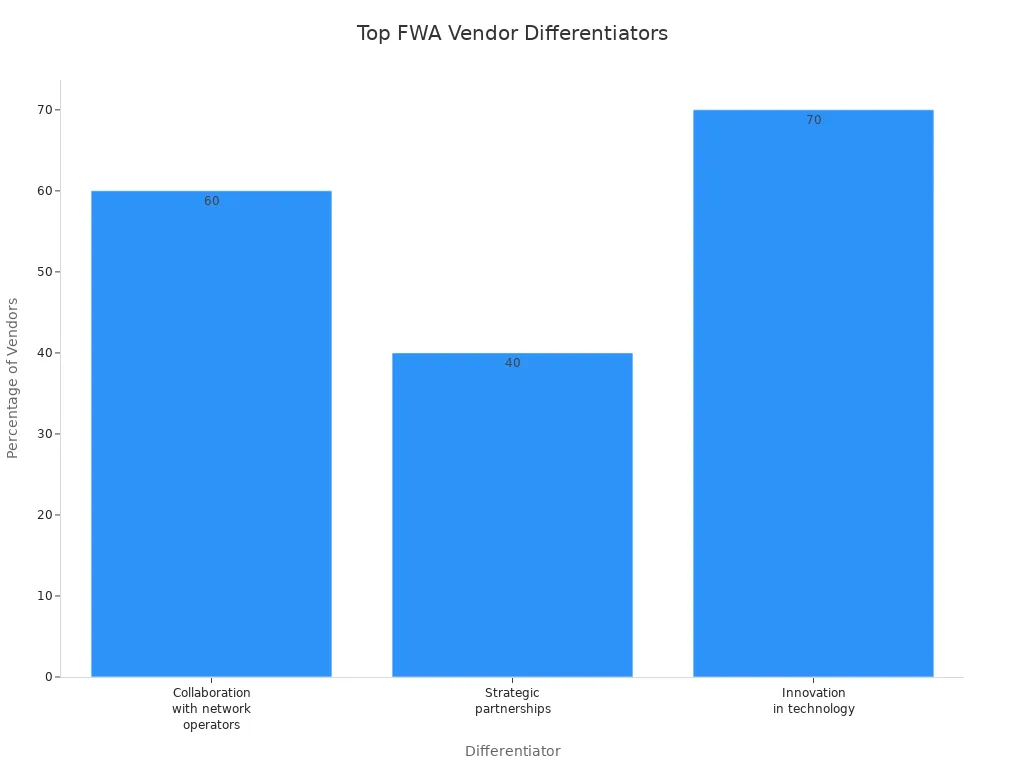
Vendors who invest in new ideas and partnerships help operators give better broadband. They also make it easier to start new FWA services. This helps operators keep up with changes in 5G technology.
Telecom Operator Needs
Telecom operators want vendors who help them build strong and flexible networks. Their main needs are:
- Strategic deployment makes sure the network works with other systems.
- Capital efficiency means getting the best value for their money.
- Seamless integration of FWA with fiber helps broadband work better.
Operators want networks that can grow with their business. They also need solutions for both cities and rural areas. Meeting these needs helps operators stay strong in the fast-changing world of 5G and FWA.
FWA Core Network Evaluation Criteria
Performance & Scalability
Latency & Throughput
Operators need to check how fast data moves. Low latency means there is little delay. This is important for things like video calls and games. High throughput lets more data move at once. This helps many people use the network together. FWA broadband services need these things to work well for homes and businesses.
Benchmarking tools like Spirent help operators test their networks. These tools show if the FWA core network is as fast as promised. They help answer important questions:
| Key Questions for CSPs | Description |
|---|---|
| Minimum and Maximum Performance | Does the service meet the minimum and maximum performance values as advertised? |
| Competitive Comparison | How does the customer experience compare to competitors’ offerings? |
| Network Optimization | What areas of the network require optimization to remain competitive? |
| Third-party Validation | How can CSPs obtain unbiased, third-party validation of their network performance for marketing and operational purposes? |
Vendors like Samsung and ZTE use these tools to show how good their networks are. This helps operators pick the best choice for their needs.
Growth Potential
Scalability means the network can grow when more people join. Operators must plan for more users and more data in the future. They look at how much coverage they have now. They also check if remote places can get service. They see how much more the network can handle before upgrades.
| Criteria | Description |
|---|---|
| Current Coverage | Evaluates the existing state of fixed-line broadband services in the area. |
| Remote Region Availability | Considers the presence of areas with limited or no broadband access. |
| Technology Advancement | Assesses the technological sophistication of the operator’s fixed network. |
| Competitive Landscape | Looks at whether competitors have launched FWA services, influencing market dynamics. |
| Network Utilization and Capacity | Analyzes how many new FWA subscribers can be accommodated before needing upgrades. |
| Line of Sight (LoS) | Considers the visibility to potential customers, crucial for FWA service planning. |
| CPE Modeling | Evaluates the diversity of customer premises equipment (CPE) and its impact on network performance. |
Operators use these points to make sure their FWA can support more people and new services as the market grows.
Security & Compliance
Data Protection
Security is very important for FWA broadband services. Operators must keep customer data safe and protect the network from threats. Vendors need strong rules for governance, risk checks, and training. They also need to watch the network and fix problems fast.
| Compliance Aspect | Description |
|---|---|
| Governance and tone | Leadership commitment, a clear code of conduct, and role-based accountability. |
| Risk assessment | Periodic reviews to focus training on higher-risk activities and update Fraud Prevention Policies. |
| Education and communication | Initial and recurring training, easy-to-access policies, and just-in-time guidance for decisions. |
| Auditing and monitoring | Targeted reviews, data analytics, and techniques to identify outliers and trends. |
| Issue response | Confidential reporting options, prompt investigations, and corrective action plans. |
| Third-party oversight | Due diligence, training expectations for vendors, and evidence of completion across the network. |
| Documentation | Accurate records of training, attestations, investigations, and remediation activities. |
Operators want vendors who can show they protect data and follow industry rules.
Regulatory Standards
Rules shape how operators pick their FWA core network vendors. Vendors must follow rules about spectrum, safety, and privacy. These rules protect users and make sure the market is fair.
| Regulatory Aspect | Impact on Vendor Selection |
|---|---|
| Spectrum Allocation Rules | Vendors must comply with complex rules regarding spectrum allocation, particularly for mid-band and millimeter-wave frequencies essential for FWA deployment. |
| Environmental Impact Assessments | Compliance with guidelines on network infrastructure placement and environmental assessments is mandatory. |
| Public Safety Guidelines | Vendors are required to adhere to public safety regulations, influencing their operational capabilities. |
| Data Privacy Regulations | Compliance with laws like the California Consumer Privacy Act (CCPA) is critical for protecting consumer data. |
| Net Neutrality Principles | These principles affect how FWA services are offered and managed in the market. |
Operators must check that vendors can follow all these rules before starting a new project.
Integration & Interoperability
Broadband Network Compatibility
FWA broadband services must work well with networks already in place. Operators need solutions that fit with their current systems and equipment. Vendors offer flexible choices, like working with Cisco and other FWA equipment. They also help connect with advanced analytics and policy tools.
| Strategy | Description |
|---|---|
| Vendor flexibility | Compatible with Cisco and third-party FWA equipment. |
| Integration options | CSPs can choose between a full-stack IoT-as-a-service solution or integration with Cisco’s Dynamic Policy and Charging add-on. |
| Advanced analytics solutions | Incorporates probe-based monitoring and DataOps processing to deliver a unified view of FBB and FWA services. |
Operators get a full view of how their service is doing. This helps support teams fix problems faster. AI and machine learning tools can find and solve issues quickly.
- Gives a full view of service performance by using data from different network parts.
- Helps support teams manage quality and solve customer problems faster.
- Uses AI/ML to spot problems and find out why they happen.
Multi-Vendor Support
Operators often use equipment from many vendors. FWA needs everyone to work together and share information. Different technical standards and business models can make this hard. Operators must pick vendors who use open standards and can work with others.
- Working together is important for building 5G networks.
- Different technical standards can make it hard to work together.
- Different business models and rules can also make things harder.
Operators who plan for these problems can build a network that is ready for the future. This helps them give better broadband to more people.
SLAs & Support
Service Level Agreements, or SLAs, and support are very important for fixed wireless access. Operators need clear promises from vendors about how the network will work. These promises help operators give good internet to homes and businesses. SLAs talk about things like how often the network works, how fast it is, and how quickly support will help. SLAs also say how fast vendors will fix problems.
Reliability Guarantees
Reliability guarantees show if a vendor can keep the network working well. Operators want vendors who have special features that protect the network and keep it steady. The table below shows some important reliability features:
| Feature | Description |
|---|---|
| Advanced Traffic Management | Uses network intelligence to assign Quality of Service identifiers. This ensures users get the right bandwidth and reliability. |
| Session Management | Handles user sessions on its own. This keeps internet traffic and voice or video services steady. |
| Resource Allocation | Gives out resources based on traffic needs. This helps different services perform well. |
| Scheduling Enhancements | Uses load balancing to stop congestion and make sure everyone gets fair access to network resources. |
| Security Measures | Adds security steps to block harmful traffic. This keeps service quality high. |
Operators notice that FWA users use much more data than mobile users. FWA users can use 20 to 50 times more data. This puts more pressure on the network. By 2029, FWA data could be almost 30% of all mobile network data. Vendors must give strong reliability guarantees to handle this growth and keep the internet steady.
Technical Assistance
Operators need more than just a network. They need support to fix problems fast. Top vendors give many support services to help operators manage their networks and make customers happy:
- Cloud-native scalability and flexibility for new 5G services.
- Multi-domain, multi-layer visibility for end-to-end monitoring of network slices.
- Tailored Quality of Experience (QoE) and Quality of Service (QoS) guarantees for different use cases, including specific latency and throughput levels.
- Comprehensive analytics for a customizable view of 5G slice performance.
- Intelligent and automated troubleshooting for faster problem-solving.
These support services help operators keep their networks working well. They also help operators fix issues quickly. This makes customers happier and helps operators do better in the market.
Cost & ROI
Operators must think about both the costs and the value they get from a fwa core network. The right vendor helps operators control costs and make more money. This is important for doing well in the broadband market for a long time.
Upfront vs. Ongoing Costs
Operators have two main types of costs when they start fixed wireless access. Upfront costs are for buying equipment, building the network, and training workers. Ongoing costs are for fixing things, updating software, and helping customers. Operators must balance these costs to keep the network making money.
- Upfront costs are high, but they are needed to start the network.
- Ongoing costs can get bigger as the network grows.
- Operators should pick vendors who have flexible prices and support.
A good vendor helps operators control both types of costs. This makes it easier to grow the network and give better internet without losing money.
Value-Added Services
Value-added services help operators get more from their FWA investment. These services can be things like Wi-Fi mesh, video streaming, and gaming packages. More than 80% of carriers now offer these services with their 5G FWA plans. This shows that operators want to give customers more choices and better experiences.
| Evidence | Description |
|---|---|
| 80% of carriers | Over 80% of carriers with commercial 5G FWA offer packages that bundle Wi-Fi mesh, video, and gaming services. This boosts ROI and attracts more customers. |
- FWA is an important link between networks and business results.
- These services turn 5G into real value, especially for business customers.
- Operators who offer value-added services can stand out and get more customers.
Operators who pick vendors with strong value-added service options can make their networks better and get more customers. This helps them stay ahead in the fast-changing world of broadband and 5G.
Vendor Comparison & Benchmarking

Picking the right vendor for a fwa core network is very important. Operators must compare vendors to make sure the network works well. They want strong broadband and connections that are ready for the future. Benchmarking and careful checks help operators choose wisely in the fast-moving 5g market.
Benchmarking Process
Operators use benchmarking to see how vendors do in real life. This helps them know which vendor gives the best network for customers. Benchmarking shows if a vendor can support fast broadband and wide coverage.
The benchmarking process has several key steps:
- Test how the network works in cities and country areas.
- Measure latency, throughput, and reliability at busy and quiet times.
- Compare results on different devices and with different operators.
- Use fair testing methods so results are honest.
Operators often use special benchmarking tools to compare vendors. These tools let them test many networks at once. They see how each vendor handles different places. For example, benchmarking shows how a vendor’s network works in crowded cities and faraway towns. This helps operators pick a vendor who can give good connections everywhere.
Frequency band deployment is also important in benchmarking. Using a 60 GHz band can change how the network works. Higher bands like 37 GHz may lose more signal than lower bands like 6 GHz. But higher bands can also cut down on multipath effects. This sometimes makes the signal better and lets users get more data. Operators must think about these things when comparing vendors. The frequency band choice affects coverage and broadband quality.
The table below shows main features and benefits of good benchmarking:
| Feature/Benefit | Description |
|---|---|
| Internal Benchmarking | Regular benchmarking helps operators track network performance and progress. |
| Global Benchmarking | Operators compare networks in different countries using fair tests. |
| Multi-Device Support | Operators can test many networks at once in one drive test. |
| User-Friendly Interface | Non-technical drivers can do advanced network tests easily. |
| ETSI-Compliant Testing | Benchmarking can be done on any network worldwide for fair comparison. |
| Comprehensive Customer Experience Testing | Tests voice quality, apps, and user actions for a full view of customer experience. |
Tip: Operators who use benchmarking tools like Spirent can see how each vendor’s network works. This helps them make smart choices for their broadband and 5g plans.
Evaluation Matrix
An evaluation matrix helps operators compare vendors side by side. This tool lists important points and scores each vendor on performance, coverage, and support. Operators use the matrix to see which vendor fits their needs for fixed wireless access and broadband.
Key points in an evaluation matrix are:
- Network performance (latency, throughput, reliability)
- Coverage in cities and country areas
- Support for different frequency bands and ways to deploy
- Integration with current broadband systems
- Security and following industry rules
- Cost and return on investment
- Value-added services and future growth
Operators give scores to each vendor for every point. They add up the scores to find the best vendor for their network and market. This way, operators do not miss any important details when picking a vendor.
| Criteria | Vendor A | Vendor B | Vendor C |
|---|---|---|---|
| Network Performance | 8 | 7 | 9 |
| Urban Coverage | 9 | 8 | 7 |
| Rural Coverage | 7 | 9 | 8 |
| Frequency Band Support | 8 | 8 | 9 |
| Integration & Interoperability | 9 | 7 | 8 |
| Security & Compliance | 8 | 9 | 8 |
| Cost & ROI | 7 | 8 | 9 |
| Value-Added Services | 8 | 7 | 8 |
| Total Score | 64 | 63 | 66 |
Note: The evaluation matrix gives operators an easy way to compare vendors. It helps them pick a vendor who can give strong broadband and reliable connections now and in the future.
Stakeholder Involvement
Operators must include many groups in the vendor comparison process. Each group has a different view and helps make sure the vendor meets all network and business goals.
Main stakeholders are:
- Network engineers who check technical performance
- Business leaders who look at cost, ROI, and market growth
- Customer support teams who care about service quality and reliability
- Regulatory experts who check industry rules
- IT teams who handle integration with current broadband systems
Including all stakeholders helps operators avoid mistakes and pick a vendor who supports every part of the network. This teamwork leads to better results and stronger broadband services.
Callout: When operators listen to everyone in the company, they build a network that helps business grow and keeps customers happy. This makes sure the vendor can give high-quality fixed wireless access and 5g in any market.
Operators who use a careful benchmarking and evaluation process can make better choices for their fwa core network. They get a clear view of each vendor’s strengths and weaknesses. This helps them give reliable broadband, expand coverage, and meet the rising need for connections in the 5g era.
FWA Deployment Considerations
Implementation Timeline
Operators need to plan carefully before they start. The time it takes to set up an fwa core network depends on many things. Weather, buildings, and trees can change how signals move. This is a big deal for the 60 GHz band. Operators must look at these things before they begin.
A good network design helps more people get service. It also keeps the internet strong. Many operators use a special backhaul setup to make things work better. They try to make new equipment smaller and use less power. But they still want the broadband to be good.
| Key Consideration | Description |
|---|---|
| Environmental Factors | This means buildings, plants, and rain can change how signals move in the 60 GHz band. |
| Network Topology | Using a layered backhaul setup helps the network work better. |
| Infrastructure Requirements | Making equipment smaller and using less power keeps service good. |
If operators follow these steps, they can set goals that make sense. This helps them not fall behind and give good internet to people.
System Integration
System integration is very important for every broadband project. Operators must connect the new fwa core network to what they already have. This means linking it to billing, customer help, and support tools. All parts must work together for things to run smoothly.
Sometimes, different vendors give different equipment. Operators need to check that everything uses open standards and can share data. Planning ahead helps stop problems before they happen. Operators test each part before turning on the service to make sure it works right.
Tip: Operators who work hard on integration have fewer problems and can grow their broadband faster.
Training & Change Management
Operators must get their teams ready for new technology. Training helps workers learn about 5g standalone systems and new ways of working. Checks make sure everyone knows what to do and can handle changes.
After the network is on, operators watch how it works and make it better. They listen to feedback to fix coverage and make users happy. The table below shows important ways to train and manage change:
| Strategy | Description |
|---|---|
| Staff Training | Teach network and support workers about new 5G SA tech and how to do their jobs. |
| Operational Readiness | Check if workers are ready and if processes need updates. |
| Monitoring and Optimization | Watch the network after launch and keep making it better for users. |
Operators who care about training and change build stronger teams. This helps them give better broadband and makes starting the network easier.
Scalability & Future-Proofing

Technology Evolution
Broadband technology changes fast. Adding 5g to fixed wireless access helps operators a lot. This new technology lets networks grow without much extra work or money. Operators can add new features when they need them. They can also make their broadband services bigger as more people use them. The network can work with new devices and apps. This makes fwa a good choice for the future. Operators who pick advanced technology can keep up with changes. They can also stay ahead of other companies.
When technology gets better, operators can upgrade their network easily. They do not have to start over. This saves both time and money.
Subscriber Growth
Subscriber growth affects how operators build their networks. More people want fast and steady internet. Operators must make sure their network can handle more users. The number of fwa connections will keep going up. By 2029, there will be 200 million connections. This will be 30% of all mobile data traffic.
| Year | Projected FWA Connections | Percentage of Mobile Data Traffic |
|---|---|---|
| 2023 | N/A | N/A |
| 2027 | N/A | N/A |
| 2029 | 200 million | 30% |
- In 2023, fwa made $29.5 billion for mobile network operators.
- By 2027, revenue could reach $67.3 billion.
- In the US, fwa is over 90% of new fixed broadband sign-ups.
Operators must plan for more people and more data use. They need a network that can grow as their customer numbers get bigger.
Sustainable Network Planning
Sustainable planning helps operators build networks that last a long time. They must think about energy use, costs, and the environment. Good planning means using less power and finding ways to lower pollution. Operators can use virtual networks to save energy and work better. Using renewable energy also helps make the network cleaner.
| Sustainable Practice | Description |
|---|---|
| Energy Usage & Cost Implications | Learn how energy use affects money and the environment in telecom. |
| Pathways to Emission Reductions | Find new ways to cut down on carbon emissions in the network. |
| Building Sustainable Infrastructure | See how to build telecom networks with the environment in mind. |
| Virtualization for Efficiency | Learn how virtual networks help save energy and work better. |
| Harnessing Renewable Energy | See how renewable energy can power telecom networks. |
| Strategies for E-Waste Management | Find the best ways to cut down on e-waste in telecom. |
| AI-Powered Mobile Networks | Learn how AI helps manage networks and makes them greener. |
| Optimizing RAN Power Management with AI | See how AI can help save power in Radio Access Networks (RAN). |
Operators who use these ideas can build a broadband network that is strong, flexible, and ready for the future.
Risks & Benefits of Vendor Choice
Operational Risks
Picking the wrong vendor for FWA broadband can cause problems. These problems can slow down network growth and hurt business results. Operators need to know about these risks before they choose.
| Operational Risk | Description |
|---|---|
| Inaccurate vendor reporting | It is hard to check if vendor data is right. This can make operators lose money. |
| Limited test coverage | Not checking all network areas can make the network work worse. |
| Time-consuming data analysis | Taking too long to look at data can slow down planning and fixing problems. |
| Revenue leakage risk | If vendors do not manage well, operators can miss chances to make money. |
If operators do not check vendor reports, they might lose money. Not testing enough can hide weak spots in the network. Looking at data for too long can slow down big decisions. Missing money can happen if vendors do not do a good job.
Customer Impact
The vendor you pick changes how customers use FWA broadband. Many providers think more people will use their networks soon. Over half already see crowded cell sites. This can make the internet slow and service not as good.
- 87% of FWA providers think traffic will grow.
- 57% already have crowded cell sites in 10-20% of places.
- Only 53% give great service when it is busy.
- 38% do not have good tools to manage traffic.
These problems can make it hard for businesses to work. Customers may stop trusting the service if it is not steady. Businesses may have trouble helping their own customers. Providers who manage traffic well can make customers 55% happier, earn 50% more money, and get 33% more customers.
Note: Picking a good vendor helps stop network crowding and keeps customers happy. Reliable FWA broadband builds trust and helps businesses grow.
Strategic Advantages
Choosing the right vendor gives many good things for FWA broadband. Operators can grow their networks and use new technology. They can also save money and make service better.
- Better scalability helps operators add more users and more speed.
- Being able to use new technology keeps networks up to date.
- Saving money helps operators connect more people for less.
- Strong networks help with cloud apps and SaaS.
- Teams can use smart tools and help customers faster.
FWA broadband with good vendor support helps operators stay ahead. They can give better service, grow their business, and meet new market needs.
Picking a vendor in a smart way changes how FWA broadband works. Operators deal with tough buying and vendor problems in the 5G FWA CPE market. Having a clear plan helps make contracts better, lowers risks, and makes the network stronger. The right vendor gives steady operations, more money, and helps the business grow. Market trends show that checking vendors carefully leads to lasting success. Operators should use benchmarking tools and follow steps to build strong FWA broadband networks.
FAQ
Why do operators need to compare FWA core network vendors?
Operators look at different vendors to find the best one. This helps them give good FWA broadband to people. Comparing vendors lowers risks and makes the network better.
Why does vendor choice affect FWA broadband service quality?
The vendor you pick changes how fast and safe the network is. A good vendor helps operators give strong FWA broadband that customers want.
Why is benchmarking important for FWA broadband services?
Benchmarking checks how vendors do in real life. It helps operators choose vendors who give good FWA broadband in cities and country areas.
Why should operators care about SLAs when choosing a vendor?
SLAs are rules for how the network should work. Operators use SLAs to make sure vendors keep FWA broadband running and fix problems fast.
Why does integration matter in FWA broadband deployments?
Integration makes new FWA broadband work with old systems. Good integration means less downtime and faster service starts.
Why is scalability a key factor in vendor selection?
Scalability lets operators add more users as they grow. A scalable network can meet new needs without big changes.
Why do security and compliance matter for FWA broadband services?
Security and compliance keep customer data safe and follow laws. Operators need vendors who use strong rules to protect FWA broadband.
Why should operators consider value-added services from vendors?
Value-added services help operators be different from others. These services make customers happier and add more value to FWA broadband.