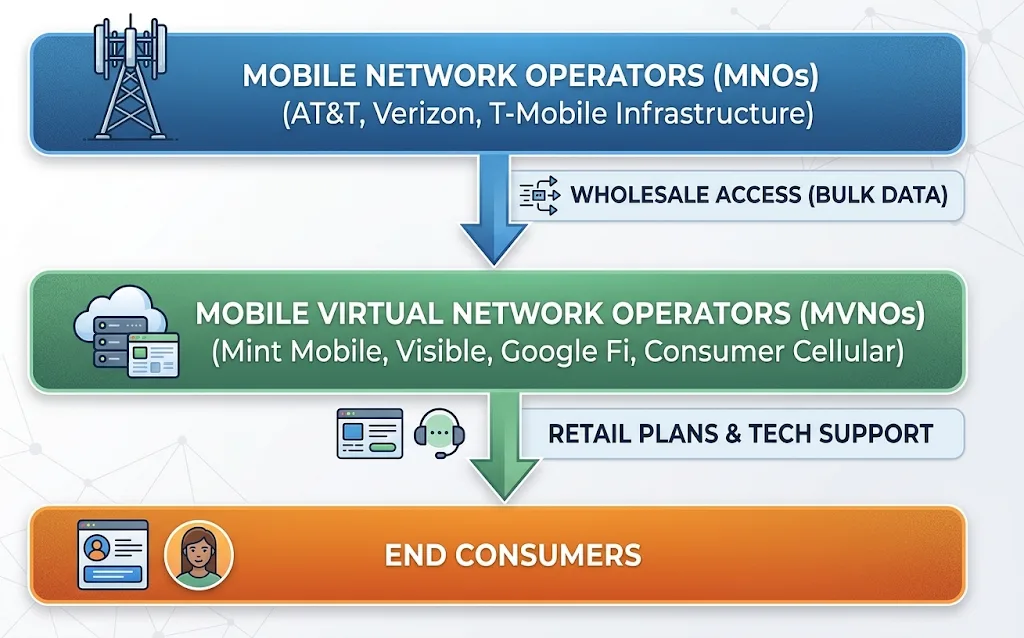
An MVNO (Mobile Virtual Network Operator) is a wireless service provider that offers mobile voice and data plans without owning physical cellular towers or spectrum licenses. Instead, MVNOs lease network capacity at bulk wholesale rates from major MNOs (Mobile Network Operators)—such as AT&T, T-Mobile, and Verizon—and pass the cost savings directly to consumers.
1. What Is an MVNO and How Does It Work?
A Mobile Virtual Network Operator acts as an agile, consumer-facing service layer built directly on top of established telecom infrastructure. While major carriers focus heavily on maintaining physical cell towers, MVNOs concentrate on customer support, OSS/BSS billing systems, device sales, and competitive plan pricing.
The Wholesale Capacity Business Model
Cellular network infrastructure must be engineered to handle extreme peak-hour traffic spikes, leaving substantial bandwidth unutilized during typical daily operations:
- Surplus Capacity Monetization: Host networks sell excess tower bandwidth to MVNOs at negotiated bulk wholesale rates.
- Lean Capital Structure: MVNOs skip the multi-billion-dollar Capital Expenditures (CapEx) required for spectrum auctions and tower deployments, enabling lower retail pricing.
- Unbundled Features: Rather than forcing users to pay for bundled media subscriptions, MVNOs provide targeted, metered, or flexible prepaid data buckets.
2. MVNO vs. MNO: Side-by-Side Comparison
While coverage maps often look identical because MVNOs share the same physical towers, key operational differences impact user experience:
| Feature / Metric | MNO (Host Carrier) | MVNO (Virtual Operator) | Impact on Users |
|---|---|---|---|
| Infrastructure | Owns & operates physical towers | Leases capacity wholesale | Identical geographical footprint |
| Data Priority (QCI) | Higher QoS tier priority | Lower priority during peak congestion | Speeds may temporarily throttle in crowded areas |
| Contract Terms | 24–36 month postpaid agreements | No contracts; 30-day or prepaid terms | Zero early termination fees (ETFs) |
| Device Policy | Promotes locked device financing | Bring Your Own Device (BYOD) focus | Lower monthly bills; requires unlocked phones |
| Bundled Perks | Streaming services & cloud add-ons | Core voice, SMS, and data only | No paying for unwanted premium add-ons |
3. Major Advantages of Using an MVNO
- No Long-Term Contracts: Plans are prepaid and month-to-month, allowing you to switch carriers immediately if pricing or coverage needs change.
- Inexpensive Network Testing: You can test local carrier coverage (e.g., verifying whether T-Mobile or Verizon reaches your home or office reliably) using an MVNO SIM or eSIM for minimal cost before committing.
- Granular Data Plans: Ideal for remote workers and light users who primarily connect over Wi-Fi and do not require expensive 50GB+ unlimited data tiers.
- Bring Your Own Device (BYOD): Compatible with virtually all factory-unlocked 4G LTE (EPC) and 5G (5GC) smartphones.
4. Potential Trade-Offs to Keep in Mind
- Data Deprioritization: In heavily congested spots (like concerts, packed airports, or sports venues), direct MNO postpaid subscribers receive priority network throughput.
- Strict High-Speed Thresholds: Many low-cost “Unlimited” plans enforce fair-usage caps (throttling speeds to 2G/128kbps levels after exceeding a monthly allotment such as 30GB–50GB).
- In-Person Support: Most MVNOs operate exclusively online or via chat support to keep overhead costs low.
5. Popular MVNOs and Their Host Networks
| MVNO Brand | Primary Host Network | Best Suited For |
|---|---|---|
| Mint Mobile | T-Mobile | Users seeking deep discounts by prepaying 3, 6, or 12 months in advance |
| Visible | Verizon | Budget single-line users requiring unlimited data and mobile hotspot |
| Google Fi Wireless | T-Mobile | Frequent international travelers and smart device ecosystem users |
| US Mobile | Verizon / T-Mobile / AT&T | Customizable pool plans and network-switching flexibility |
| Consumer Cellular | AT&T / T-Mobile | Seniors (AARP discounts), lightweight plans, and dedicated phone support |
Frequently Asked Questions (FAQ)
Do MVNOs support 5G speeds and VoLTE services?
Yes. Most modern MVNOs include access to nationwide 5G and mid-band/C-band networks along with high-definition VoLTE / IMS voice calling at no additional surcharge, provided you are in a coverage area and using a compatible handset.
Can I keep my current phone number when moving to an MVNO?
Yes. Under Federal Communications Commission (FCC) number portability rules, you have the legal right to transfer (port) your existing wireless number to any compatible carrier.
How can I verify if a plan has deprioritization limits?
Check the standardized Broadband Facts Label displayed on the provider’s product page, which clearly details high-speed data allotments, typical speeds, and throttling parameters.
References & Authority Standards
- Federal Communications Commission (FCC):
Porting: Keeping Your Phone Number When You Change Providers (Local Number Portability Rules)
- FCC Broadband Consumer Disclosures:
Broadband Consumer Labels: Standardized Disclosures for Mobile and Fixed Broadband Service
- 3GPP Technical Specifications:
Policy and Charging Control Architecture & QoS Class Identifier (QCI) Parameters (TS 23.203)
- GSMA Intelligence:
Global Mobile Operator Statistics, Wholesale Economics & MVNO Market Metrics