Why Did 5G Move to Service-Based Architecture?
In the evolution from 4G to 5G, one of the most fundamental and far-reaching architectural shifts is the transition from node-based architecture in the Evolved
From company news to science articles, explore our latest developments and professional insights.

In the evolution from 4G to 5G, one of the most fundamental and far-reaching architectural shifts is the transition from node-based architecture in the Evolved

In today’s telecommunications landscape, downtime is simply not an option. For mobile operators transitioning from legacy circuit-switched voice to advanced packet-based services like VoLTE and

IPLOOK, a leading global provider of core network solutions, is set to demonstrate its latest advancements in space-ground integrated architecture at PT EXPO Beijing, taking

Integration challenges between RAN, Core, and IMS in 5G networks impact performance, security, and service quality due to protocol, vendor, and resource issues.

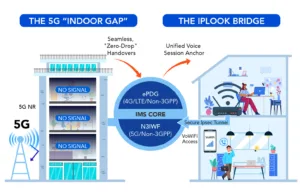
As operators scale 5G-Advanced in 2026, the “Indoor Gap” remains a critical challenge due to high-frequency signal attenuation. To maintain voice service continuity, a Converged

Carrier-Grade IMS features like reliability, scalability, security, and compliance help MVNOs deliver quality services, reduce costs, and stay competitive.

IMS and VoLTE let MVNOs deliver HD voice, video, and messaging, improving service quality, reducing costs, and enabling fast, reliable communication.

Build a complete MVNO platform with core network, IMS, billing, and BSS for scalable, secure, and flexible mobile service operations.

In the IP Multimedia Subsystem (IMS) architecture, the Proxy-Call Session Control Function (P-CSCF) serves as the critical entry point for User Equipment (UE) to access