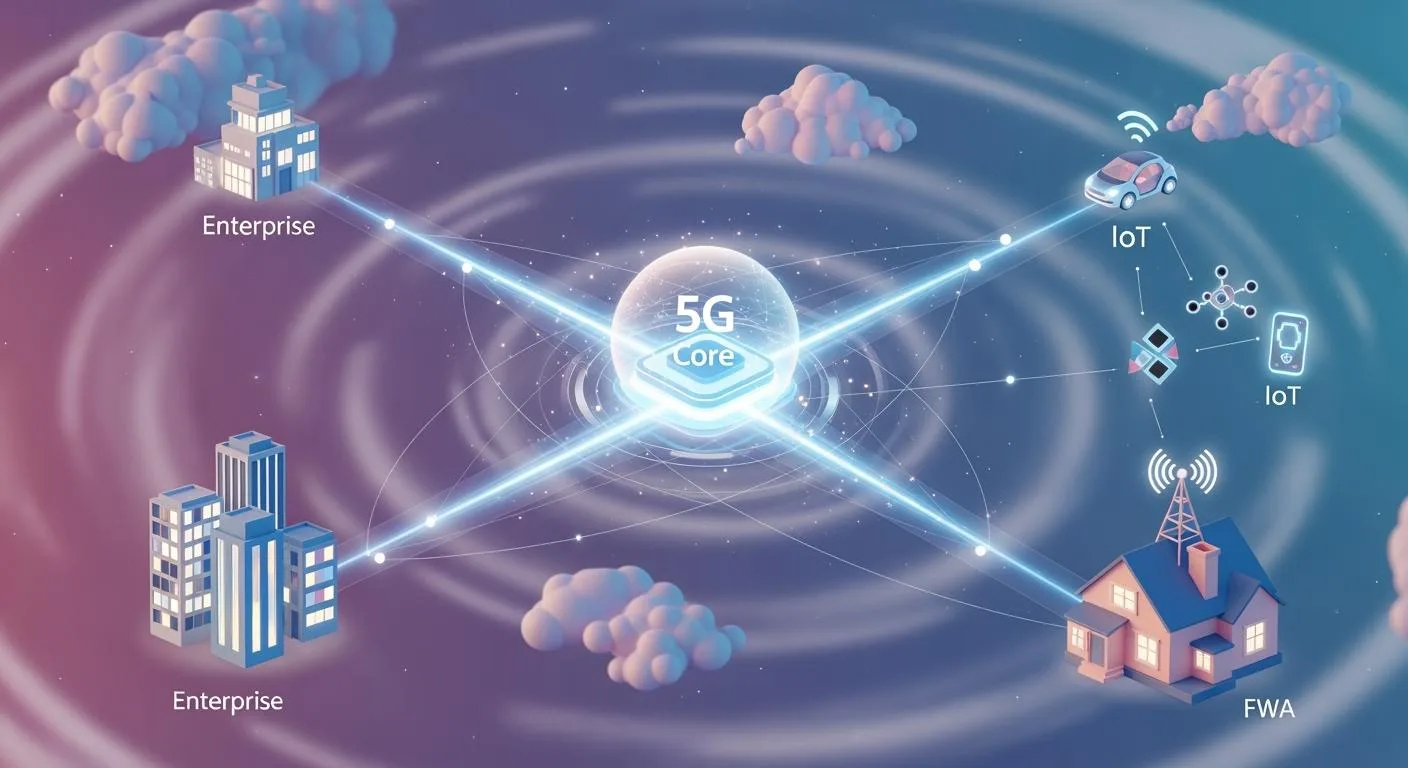
You can find new chances with a unified 5G core network. This network gives you better connectivity, reliability, and flexibility. Many groups use 5G to offer very reliable, fast communication. It helps meet different needs in many industries. For example:
-
North America has 363 million 5G connections. This covers almost 95% of people.
-
Fixed wireless access and cellular IoT are growing fast. Millions of new connections happen each year.
You can trust this technology for strict service agreements. It also helps connect IoT smoothly in your business.
Key Takeaways
-
A unified 5G core network helps businesses connect better. It makes connections more reliable and flexible.
-
Automation in 5G networks makes tasks faster. It also cuts down waiting times. This helps work get done more easily.
-
Network slicing lets businesses make virtual networks for their needs. This helps them get better performance.
-
Private 5G networks give more control and safety. They are good for important or private uses.
-
5G IoT technologies let thousands of devices connect. This helps many different jobs in many fields.
-
Real-time data processing in 5G is very important. It helps IoT and automation work fast. This makes sure things respond quickly.
-
Strong security, like encryption and zero-trust, keeps data and devices safe in 5G networks.
-
Cloud-native designs in 5G make it easy to grow and add to old systems. This helps businesses get ready for the future.
Unified 5G Core Network Essentials
Core Features of Unified 5G
A unified 5G core network helps connect many devices and services. It brings all the main parts you need for modern 5G. The network uses a new setup that keeps software and hardware separate. This makes it simple to add new things and grow your network when you need to.
Breaking up and separating functions, plus clear connections between them, lets operators keep software and hardware apart. This makes buying and setting up easier than with old systems.
The unified data repository is like a big database for user information. It helps keep data safe and the same everywhere. You can also set rules right away, which is much better than before.
Here is a table that lists the main features and what they do in a unified 5G core network:
|
Feature/Function |
Description |
|---|---|
|
Access and Mobility Management Function (AMF) |
Handles user sign-in, movement, and session control. |
|
Session Management Function (SMF) |
Manages user sessions, gives IP addresses, and sets QoS. |
|
User Plane Function (UPF) |
Moves user data packets and keeps delays low. |
|
Policy Control Function (PCF) |
Sets policy and charging rules, and picks QoS settings. |
|
Network Slice Selection Function (NSSF) |
Picks network slices for different service needs. |
|
Authentication Server Function (AUSF) |
Takes care of sign-in and security for the network. |
|
Unified Data Management (UDM) |
Handles user data and keeps it in one place. |
|
Network Slicing |
Splits the network into virtual parts for special uses. |
|
Service-Based Architecture |
Lets you set up services easily with clear connections. |
|
Network Function Virtualization (NFV) |
Makes network parts virtual for easy growth and saving money. |
Each function helps you handle users, data, and safety. This makes your network strong and ready for many 5G uses.
Benefits for Enterprises and Service Providers
There are many good things about using a unified 5G core network. Here are some of the top ones:
-
Automation helps you finish tasks faster and cuts down waiting. You can use this in factories, offices, and more.
-
Flexible choices take the place of old lines. You save money and get better support for apps that need quick response.
-
You can connect more people and devices at once. The network stays strong, even with lots of connections.
-
Saving power helps IoT devices last longer. Some can work up to 10 years without changing the battery.
-
Security keeps your data safe. This matters for business traffic and private info.
You also get more options and growth from AI-driven programming. Here are some ways this helps you:
-
Edge hosting lets you make fast choices with less delay.
-
AI-driven changes make your network smarter and quicker to adjust.
-
Putting functions together at the edge brings compute, storage, and radio close.
-
Over-the-air updates let you add new things fast.
-
One way to set up supports many areas, like health and industry.
The 5G core is changing to meet new needs for speed, size, and smart features. AI-driven, programmable systems help you build a network ready for what’s next. You can support important IoT and private services easily.
Enterprise Solutions with 5G
Connectivity and Security Needs
Your business needs strong connections to work well. 5G gives you steady links for many users and devices. Security is very important for every business. You must keep your data safe and protect your network. Here are some main things you need for good connections and safety:
-
3GPP security rules help devices and the network check each other.
-
All signals and data are kept secret with encryption.
-
You can use tools like Identity Services Engine for zero-trust rules.
-
Firewalls and traffic checks keep your private 5G core safe.
-
Strong safety steps protect all connected devices.
-
Security covers your whole business network from end to end.
-
Private 5G networks use SIM cards to control which devices join.
-
Network slicing makes separate parts with special safety rules.
Private 5G Networks
You can make your own private 5G network for your business. This gives you more control and choices. Private networks use SIM cards to let devices join. You can pick local or licensed frequencies. Both choices give you strong safety and privacy. You can change your network to fit what you need.
Here is a table that shows ways to change private 5G networks:
|
Customization Option |
Key Features |
|---|---|
|
Standalone private network using local frequencies |
High security, customer privacy, high customization, greater control and flexibility |
|
Standalone private network using operators licensed frequencies |
High security, customer privacy, easy adherence to legal norms |
|
Standalone private network with full O-Ran split |
Highly scalable, flexible scaling, high customization, greater control and flexibility |
|
Standalone private network with DU, CU split |
Highly scalable, reduced infrastructure cost, high customization, greater control and flexibility |
|
Standalone private network with Integrated Radio and Core |
Reduced infrastructure cost, high security, greater control and flexibility |
You can pick the best way for your business. Private 5G networks help you use IoT devices and keep your data safe.
Service Level Agreements (SLAs)
You need service level agreements to make sure things work well. SLAs set clear rules for how fast, safe, and reliable your network is. You can use SLAs to check if your network meets your needs. SLAs help you watch how things work and fix problems fast. You can trust your unified 5G core network to give steady service.
Tip: Always check your SLA terms. Make sure they fit your business goals and safety needs.
Customization and Integration
You can change your 5G network to fit your business. Customizing helps you support different apps and users. Integration lets you connect your new 5G network to what you already use.
Network Slicing
Network slicing lets you make virtual networks for different jobs. You can set each slice for speed, delay, or safety. This helps you support many business uses, like IoT, fast internet, and important calls.
Here is a table that shows how network slicing works:
|
Aspect |
Description |
|---|---|
|
Dynamic Provisioning |
Enables the creation of virtual networks tailored to specific user needs. |
|
Customization |
Each slice can be tailored for different applications, such as high-speed or low-latency needs. |
|
Service Types |
Supports Enhanced Mobile Broadband (eMBB), Massive Machine Type Communications (mMTC), and Ultra-Reliable Low Latency Communication (uRRLC). |
You can use network slicing to help many business areas. You can make slices for IoT, fast data, or low-delay services.
-
Network slicing lets you make virtual networks for certain clients.
-
You can give faster speeds to mobile broadband users.
-
You can give low delay for important calls.
-
You can let users reach edge computing.
Integration with Existing Systems
You must link your new 5G network to your old systems. This step helps your work go smoothly. You might face some problems:
-
Safety risks go up because the core network uses APIs.
-
Running things gets harder with cloud-native designs.
-
Real-time services need low delay and fast speeds.
You can use good steps to fix these problems:
-
Use zero trust design. This checks every time someone tries to get in.
-
Make your network better. Cloud-native, microservices designs help you run your network easily.
Note: Spending on 5G network safety will grow from $4 billion in 2025 to over $11 billion by 2029. You must watch out for new safety problems as your business grows.
Here is a table that shows how a unified 5G core network helps with safety and rules:
|
Mechanism |
Description |
|---|---|
|
Enhanced Security Architectures |
Protect core networks from cyberattacks through intrusion detection, firewalls, and DDoS protection. |
|
Network Slicing |
Allows for managing sensitive data while ensuring compliance with regulations like GDPR. |
|
Compliance with Regulations |
Operators must secure user data to meet data privacy regulations and localization laws. |
You can use these tools and steps to keep your business network strong and safe. You can use IoT devices, protect your data, and help your business grow with your unified 5G core network.
FWA in the 5G Era
FWA Reliability and SLAs
Your business needs a strong connection to work well. 5g fixed wireless access (fwa) gives fast internet without wires. You should check reliability and service level agreements (SLAs) to make sure your network works right. SLAs are rules for how often your network should work and how well it should perform. Here are some ways to make your network more reliable:
-
Check the rules from the government. These rules tell ISPs to keep certain SLAs for uptime and reliability.
-
Follow SLAs to avoid getting in trouble and to give better service.
-
Build backup paths in your network. This helps if one path stops working.
-
Watch your network all the time. You can find problems before they hurt your service.
-
Make sure important traffic goes first when the network is busy.
You should think about things like weather and land. Bad weather or hills can mess up fwa service. Other devices can cause spectrum interference and slow your network. If you do not take care of your equipment, it can break and stop your service.
High-Speed Connectivity
5g fwa lets you get fast internet at your business. 5g uses mmWave frequencies to give you high speeds. You can get speeds like wired broadband. This helps you download big files fast and use cloud apps with no wait. You can connect lots of devices at the same time. You can use IoT devices and keep your network strong.
Here is a table that shows how 5g makes fwa better for customers:
|
Evidence Description |
Key Points |
|---|---|
|
Cloud-native architecture |
You can control your network and automate jobs. This gives better performance and reliability. |
|
Assurance tools |
You can see your network. You can manage bandwidth and traffic well. |
|
Unified assurance solutions |
You can see your whole network. You can find and fix problems easily. |
|
Multi-dimensional analytics |
You get one place to check quality, performance, and customer experience. |
|
Correlation of issues |
You can link problems in different parts of the network. This helps you know how they affect service. |
Sector Applications (Smart Cities, Retail, etc.)
You can use 5g fwa in many places. Smart cities use fwa to connect sensors and cameras. Stores use fwa for fast payments and tracking items. Clinics use fwa for online doctor visits and patient records. Banks need fwa to keep transactions safe and always working. You can use fwa to help these places and keep your network strong.
Tip: Always check your SLA goals. Sectors like banks and clinics need high availability.
Cloud-Based FWA Services
Cloud-based fwa services make your network easier to run. The unified 5g core network uses cloud-native designs. You can grow your services fast and add new things without changing your setup.
CSP Solutions
Communication service providers (CSPs) help you set up fwa services. You can use remote tools to turn on cellular-enabled fwa. You can get fast internet in places without fiber. CSPs give you tools to watch your network and find threats. You can split your network to keep it safer.
Here is a table that shows why cloud-based fwa services with 5g are good:
|
Advantage |
Description |
|---|---|
|
High Speeds |
5g fwa gives you fast internet like wired broadband. |
|
Cost-Effectiveness |
You pay less than old broadband. |
|
Cloud Access |
You can save data in the cloud and download fast. |
|
IoT Integration |
You can connect IoT devices and make your business better. |
|
Scalability |
You can grow your services as you need without big changes. |
Simplified Provisioning
You can set up fwa services fast with cloud tools. You can use turnkey tools to set up your network from far away. You can turn on cellular-enabled fwa without sending workers. You can help more people get fast internet in places that need it. You can use better security to find threats and keep your network safe.
-
Use remote tools to set up fwa services quickly.
-
Watch your network with special tools.
-
Split your network to keep important data safe.
Note: 5g fwa can help connect rural areas and smart cities. You can make your business better with fast, reliable internet.
5G IoT Integration
IoT Technologies (LTE-M, NB-IoT)
You can do more with your business by using 5G IoT technologies like LTE-M and NB-IoT. These are low-power wide-area technologies that work well with a unified 5G core network. They help you connect lots of devices that send small bits of data over long distances. You can use LTE-M and NB-IoT for things like smart meters, tracking assets, and remote sensors. These technologies follow 5G standards, so your devices will keep working even when old 4G networks are gone. If you pick 5G IoT solutions that use these standards, your business will be ready for the future.
Device Density and Application Diversity
With 5G IoT, you can connect thousands of devices in one place. A unified 5G core network gives you tools to handle many devices and different uses. Here is how you can get the most from 5G IoT for your business:
-
Use network slicing to make virtual networks for different jobs. You can make one slice for smart sensors and another for video cameras.
-
Manage your resources well so you can connect more devices without slowing down your network.
-
Make user plane management better to handle all kinds of data, from simple sensor numbers to video streams.
Tip: 5G IoT lets you connect things like factory robots and smart city lights. This helps your business grow and try new ideas.
End-to-End Security
You need to keep your 5G IoT network safe from threats. 5G brings new security features to protect your data and devices. Here are some ways to keep your 5G IoT setup safe:
-
Use network slicing to keep sensitive data apart and control who can get to each part of your network.
-
Pick lightweight security for low-power devices so they do not slow down.
-
Set up a flexible security plan that fits your service needs.
-
Build an end-to-end data security chain to keep data safe across different vendors and systems.
|
Security Mechanism |
Description |
|---|---|
|
Network Slicing |
Makes virtual networks to protect data and control access. |
|
Lightweight Security |
Works for low-power devices and keeps them safe without slowing them down. |
|
Flexible Security Architecture |
Lets you choose the best security for each service. |
|
E2E Data Security Chain |
Keeps data safe as it moves through your network. |
5G IoT security uses ideas from older networks and adds new tools for today’s threats. You get endpoint security, can see your devices, and control radio access. This helps you keep your information safe and your network strong.
Supporting IoT Across Sectors
Agriculture, Energy, Manufacturing
You can use 5G IoT to make many industries better. In farming, you can connect smart watering systems and check soil conditions. 5G IoT gives you steady links for self-driving tractors and weather sensors. In energy, you can watch pipelines and power grids in real time. 5G IoT helps you find problems fast and keep things running. In factories, you can connect robots, track parts, and control machines from anywhere.
|
Capability |
Application in Agriculture |
Application in Energy |
|---|---|---|
|
Network Slicing |
Special networks for smart farming |
Watching power grids and pipelines |
|
Ultra-Reliable Low Latency |
Real-time weather checks |
Fast fault detection |
|
Edge Computing |
Advanced farm technology |
Grid strength and renewables |
With 5G IoT, you can connect more devices than ever before. This is important for smart cities, factories, and energy sites that use lots of sensors. You can watch, control, and automate your work with confidence. 5G IoT gives you what you need to build a smarter, safer, and more efficient business.
Enabling Technologies for Unified 5G
AI and Automation
AI and automation make your 5G core network smarter and faster. These tools help you spot problems and fix them quickly. You do not need to do everything by hand. Automation makes it easier to handle 5G technology. You can add new services fast and grow your network as your business gets bigger.
-
Automation helps your team work better by finding and fixing network issues fast.
-
Your team does not have to do as much work, so there are fewer mistakes.
-
AI looks at lots of data and finds patterns in your network.
-
AI helps you plan new ways to run your 5G core.
-
Machine learning and automation make your network work better and use resources wisely.
-
You give your customers better service.
AI-driven automation keeps your 5G technology working well. This helps you handle more users and devices without slowing down your network.
RF Test Automation
RF test automation checks your 5G core network for reliability and performance. Automated tools let you test your network faster and more accurately. This makes sure your 5G technology meets standards and works well for your business.
|
Evidence Point |
Description |
|---|---|
|
Streamlined Testing Processes |
RF test automation makes testing easier and saves time. |
|
Ensures Compliance |
Automated solutions help you follow 5G standards and keep your network reliable. |
|
Faster Deployment |
Automation helps launch 5G networks faster and improves performance. |
|
High Operational Efficiency |
Automated testing gets things right the first time, which is important for complex 5G networks. |
|
Adaptability |
Test solutions can change and fit new technologies and spectrum bands. |
RF test automation keeps your 5G core network strong and ready for new changes. This helps you launch services quickly and keep high quality.
Network Slicing and Orchestration
Network slicing and orchestration let you make special parts of your 5G core network for different needs. You can make slices for fast internet, low-delay apps, or secure business services. Each slice uses resources well and stays separate from others.
-
The D-SIMS framework uses smart slice management and isolation to improve resource use.
-
The SSRR method makes resource use better and increases acceptance ratio.
-
Good management in network slicing helps use resources wisely.
-
Network slicing lets you build networks for certain services.
-
Each slice fits different needs, like high bandwidth or low delay.
-
Orchestration frameworks manage slices, making sure resources are used well and services run smoothly.
Network slicing and orchestration help you deliver reliable 5G technology for many business cases. This helps you meet strict service goals and change to new demands.
Tip: Programmable network architecture gives you more control. You can make your 5G core network faster and reduce delays. Cisco’s programmable core solution lets you create new products and services quickly. You can launch these through a network application store, moving past old limits and focusing on new ideas.
Managing and Scaling Unified 5G Core
Policy and Charging Control
You need to control policy and charging to get the most from your 5G core network. Start by using advanced services. These services help you make new ways to earn money with your 5G network. Set up detailed policy control. This lets you give special services to different users and charge them the right amount. Move to a cloud-native setup. This helps you launch new services fast and work with partners more easily.
You should also use real-time charging. This means you can change prices based on what users do or need. Add convergent charging to support both old and new systems. This keeps your 5G network flexible and ready to grow.
|
Best Practice |
Description |
|---|---|
|
Advanced Services |
5G gives you new ways to earn money with special services for users and businesses. |
|
Granular Policy Control |
Lets you set detailed rules for each service and user. |
|
Cloud-Native Architecture |
Makes it easy to add new services and partners during your 5G deployment. |
|
Real-Time Charging |
Supports changing prices and plans as users need them. |
|
Convergent Charging |
Works with both old and new systems for smooth 5G deployment. |
Tip: Always check your policy and charging setup during each 5G deployment. This helps you avoid mistakes and keeps your network working well.
Service Assurance
You must keep your 5G network strong and reliable every time you set it up. Focus on what customers need first. Use automated tools to watch your network and fix problems quickly. Collect data from all parts of your network. This gives you a clear view and helps you make things better for users.
Build your 5G network so it can handle failures. Watch key performance indicators (KPIs) in real time. Use self-healing tools to fix problems before they get worse. Plan your traffic routes to stop slowdowns. Add geo-redundancy to keep your network working, even if one part fails. Use self-organizing network tools to make your radio network smarter.
|
Customer-centricity |
|
Automated operations |
|
Reliance on data |
|
Openness |
|
Enterprise focus over end-user focus |
-
Use closed-loop service assurance to find and fix problems fast.
-
Make sure your service-based setup is ready for complex networks.
Simplified Operations
You can make your 5G network easier to manage by following a few steps. Move to a unified core. This brings all your networks together and makes things simple. Use automation to handle daily jobs. This saves time and cuts down on mistakes.
Bring your infrastructure together. This lowers costs and makes your 5G network work better. Use one way to run things. This helps your team solve problems faster and keeps your group small and focused. Pick a cloud-ready design. This lets you add new solutions without losing your old systems. Offer integrated services to launch new products quickly and stay ahead in the market.
|
Strategy |
Benefits |
|---|---|
|
Transition to unified core |
Makes your 5G network simple and easy to manage. |
|
Automation |
Improves efficiency and cuts down on manual work. |
|
Infrastructure consolidation |
Reduces costs and makes your 5G network smoother. |
|
One operational model |
Helps your team work faster and smarter. |
|
Cloud-ready design |
Lets you grow your 5G network without losing old systems. |
|
Integrated services |
Speeds up new service launches and keeps you competitive. |
Note: Always review your operations plan before each 5G deployment. This keeps your network strong and ready for new challenges.
Future Trends in Unified 5G Core
Evolving Use Cases
You will see many new ways to use 5g as the technology grows. The unified 5g core helps you support more devices and services. You can use 5g for smart factories, connected cars, and remote healthcare. These new uses need fast speeds and strong connections. The future of 5g iot will bring even more changes to your business.
-
You can use enhanced mobile broadband for high-speed internet in busy places.
-
Ultra-reliable low-latency communications help you run mission-critical tasks, like remote surgery or factory robots.
-
Massive IoT lets you connect billions of devices, from sensors in farms to smart meters in cities.
You can track your devices as they move and keep their connections strong. The 5g core gives you tools to manage quality of service for each device. You can also use network slicing to make special networks for different needs. This helps you meet the challenges of 5g for iot, like keeping data safe and making sure devices work well together.
Tip: Try new 5g use cases in small steps. Start with one area, then grow as you learn what works best.
Preparing for Next-Gen Services
You need to get ready for the next wave of 5g services. The 5g core now works as a platform. You can use it to launch new apps and services quickly. Many functions in the 5g core now run as cloud services. This helps you add features faster and keep up with changes in technology.
Here is how you can prepare for the future of 5g iot and next-gen services:
-
Make sure your 5g core can connect and check user equipment easily.
-
Track devices as they move between base stations.
-
Use cloud-based functions to add new features quickly.
-
Set up network slicing to create custom networks for each service.
-
Focus on high throughput and low latency for better user experience.
You will face some challenges of 5g for iot, such as handling many devices and keeping your network secure. You can solve these by using programmable network tools and strong security steps. Cisco says you should use your 5g core to build personalized networks. This lets you support new business models and meet customer needs.
|
Step |
What You Gain |
|---|---|
|
Use cloud services |
Faster updates and new features |
|
Track devices |
Better service and reliability |
|
Network slicing |
Custom solutions for each use case |
|
Strong security |
Safe data and trusted connections |
You can shape the future of 5g by staying ready for new trends. Keep learning and testing new ideas. Your unified 5g core will help you lead in the digital world.
You can find new ways to help your business with a unified 5g core. The 5g core lets you connect more devices and handle data right away. It also helps your team work together better. Here are the main benefits:
|
Advantage |
Description |
|---|---|
|
Enhanced Connectivity |
5g gives smooth connections for teamwork and business growth. |
|
Real-time Data Processing |
5g core handles data instantly, which is important for IoT and automation. |
|
Improved Operational Efficiency |
5g core cuts downtime and helps you get more done. |
|
Bridging the Broadband Divide |
5g FWA brings fast internet to new places and helps real-world projects. |
You can be ready for what comes next by using a 5g core that changes as you need.
-
Cloud-native design lets you grow and change easily.
-
Network slicing helps you make special networks for each job.
-
Automation and NFV keep your 5g core quick and easy to manage.
Pick a unified 5g core plan to keep your business strong and ready for the future.
FAQ
What is a unified 5G core network?
A unified 5G core network lets you manage all your devices and services in one place. You can connect enterprise, FWA, and IoT solutions easily. This setup gives you better control and helps your network grow.
How do you set up network slicing for your business?
You start by choosing the services you need. Then, you use your 5G core tools to create virtual slices. Each slice supports a different task, like IoT or video calls. You can adjust each slice for speed, security, or reliability.
Why should you use private 5G networks?
Private 5G networks give you more control and security. You decide which devices connect. You can set rules for data and keep your business safe. This helps you meet special needs in factories, hospitals, or offices.
How does 5G FWA help your business?
5G FWA gives you fast internet without cables. You can set it up quickly in cities or rural areas. Your team gets reliable connections for video calls, cloud apps, and smart devices.
What makes 5G IoT better than older networks?
5G IoT lets you connect more devices at once. You get faster data and lower delays. You can use smart sensors, trackers, and machines. Your business can grow and try new ideas.
How do you keep your 5G network secure?
You use strong passwords, SIM cards, and encryption. You set up firewalls and check traffic. You update your network often. You can also use network slicing to keep data safe.
What is the role of AI in a 5G core network?
AI helps you spot problems and fix them fast. You can automate tasks and make your network smarter. AI looks at data and helps you plan better services for your users.
Can you connect old systems to a 5G core network?
Yes, you can. You use integration tools to link your old systems with your new 5G core. This helps your business run smoothly while you upgrade to new technology.