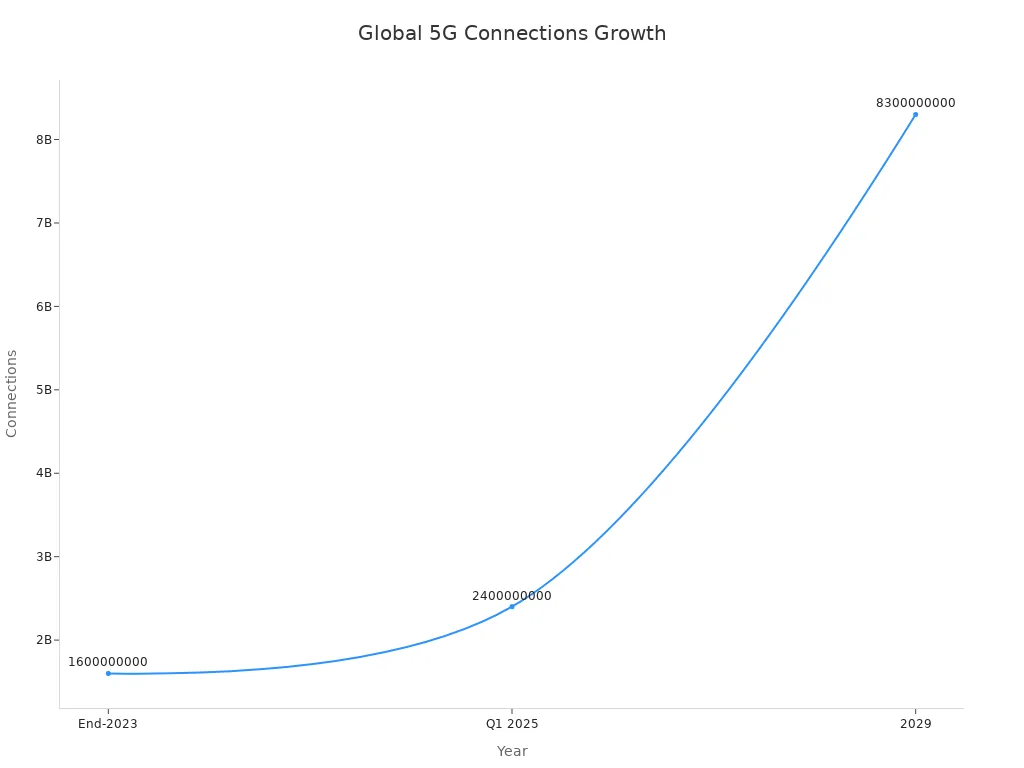
Observability Matters in 5G networks because it provides real-time information that can be utilized immediately. Traditional monitoring falls short in this regard. The complexity and rapid growth of 5G networks necessitate effective observability. The table below illustrates the swift expansion of these networks:
|
Metric |
Value |
|---|---|
|
Global 5G Connections (End-2023) |
1.6 billion |
|
Global 5G Connections (Q1 2025) |
2.4 billion |
|
Global 5G Connections (2029) |
8.3 billion |
|
Market Share by 2029 |
59% of global wireless tech |
|
North America Connections |
289 million (77% coverage) |
|
Asia-Pacific Connections |
1.2 billion (45.25% market share) |
|
China Base Stations |
Over 2.3 million |
|
Europe 5G Deployment |
72% of 4G LTE levels |
|
Daily Data Generation |
Over 500 petabytes |
|
Base Stations Density |
10 times more than 4G |
Observability Matters as it enables you to gather data from every segment of the network. This capability allows for quick identification of issues, efficient resource planning, and detection of security threats. Furthermore, observability is essential for AI-driven management and remote diagnostics. By leveraging observability, you can enhance the performance of even the most intricate 5G networks.
Key Takeaways
-
Observability gives real-time information about 5G networks. This helps people fix problems right away. It lets you find problems fast and use resources better. It also makes security stronger. Monitoring tells you what happened and when. Observability tells you why it happened. Using observability can make service better and keep customers happy. It helps stop outages before they happen. Observability tools can manage networks by themselves. They help solve problems early and fix things on their own. First, pick the best observability tools for your network. Set up dashboards to watch important numbers. Observability works with AI to manage networks. This is important for today’s complex 5G networks. Use observability to keep up with network needs. It helps give users good and steady service.
Observability Matters in 5G Networks
Why Observability Is Essential
Observability is important in 5G networks because it lets you see your whole network at once. You can find out what is happening, why it happens, and how it affects people using the network. This helps you know how every event changes how the network works and how customers feel.
You need observability for many reasons:
-
You can grow your network easily as things change.
-
You can spot and stop cyber threats right away.
-
You can use your bandwidth and resources better.
When you have strong observability, you can see all parts of your network together. This helps your business do well with 5G networks. You can link how customers feel with how the service works, which is very important for happy customers and business growth.
Today, 5G networks are getting more complicated. Observability helps you handle this and make money from 5G services. It is the base for running your network well.
Real-Time Insights and Optimization
Observability gives you real-time information that monitoring cannot give. You can look at packet-level data as it moves in the network. This helps you find problems fast and stop long outages. Real-time telemetry helps you see everything, even when there are short bursts of traffic that can slow things down.
Here is how observability helps real-time optimization in 5G:
|
Evidence Description |
Key Points |
|---|---|
|
Real-time packet-level analytics |
Lets you find problems fast and cut downtime. |
|
End-to-end observability |
Checks packet data everywhere in the 5G network for constant monitoring. |
|
Network slicing observability |
Matches packet data with service details to check performance and rules. |
|
Proactive operations |
Finds trends and problems early to protect users. |
You need to see every part of your network at once. This big-picture view helps you make your network work better and keep service good. Most AI networks need real-time checks, but only observability gives you the deep information needed for fast fixes and automation.
Power and Resource Management
Observability helps you manage power and resources in 5G networks. You can find and fix problems before they hurt users. This keeps your services working well.
With observability, you can:
-
Change network resources quickly when traffic changes.
-
Make sure your network fits what people need.
-
Save money by using the right amount of resources.
You can see how resources move and change in the network. This helps you make better choices and give good service. Observability also helps you use less energy, which saves money and helps the environment.
When you use observability, you change how you run your network. You stop just watching for problems and start fixing things before they happen. This makes your network work better, keeps it reliable, and makes customers happier.
Difference Between Observability and Monitoring
Observability Versus Monitoring Explained
You might wonder why observability and monitoring matter in 5G networks. These two things sound alike, but they are not the same. Monitoring checks if your network is okay. It looks at device health, error rates, and how much bandwidth you use. You get alerts when something is wrong. This helps you know when a problem happens.
Observability lets you see more. You can watch how different parts of your network work together. You learn why something happens, not just when or what happened. Observability helps you find the main cause of problems. You can spot unknown issues, not just the ones you expect.
Here is a table that shows the main differences between observability and monitoring:
|
Aspect |
Monitoring |
Observability |
|---|---|---|
|
Purpose |
Ensures system status |
Supports the status of services |
|
Automation |
Automates system operation activities |
Automates the process that ensures service continuity |
|
Problem Tracking |
Tracks the effect of a problem |
Tracks the root cause of an abnormality |
|
Performance Monitoring |
Monitors and preserves the performance of systems |
Attempts to find faults, abnormalities, and underperformance in services |
|
Information Correlation |
Correlates information from independent systems |
Correlates and assesses the interaction of multiple environments, systems, and services |
|
Questions Answered |
Answers the ‘When’ and the ‘What’ |
Answers the ‘Why’ and the ‘How’ |
|
Automation Development |
Developed to facilitate operations |
AI-based algorithms developed to optimize productivity |
|
Alerting |
Alerts on a problem |
Evaluates context dynamically and proactively on a potential problem |
|
Nature |
Static, reactive, and one-dimensional |
Contextual, proactive, and dynamic |
|
Condition Monitoring |
Monitors known conditions |
Observes and discovers unknown conditions |
Tip: Use observability to find out why your network acts a certain way. Use monitoring to know when something changes.
Key Distinctions in 5G Context
It is important to know the difference between observability and monitoring in 5G networks. Monitoring helps you check simple things. You can see if a device is working or not. You can check if your network uses too much bandwidth. You get alerts if something breaks.
Observability lets you see the whole network. You can understand how different parts affect each other. You can find hidden problems. You can see how one small issue can cause bigger troubles. This is very important in 5G networks because they are complex and have many moving parts.
Here are some key points that show how observability and monitoring work in 5G:
-
Observability helps you understand complex behaviors in your network. You see how everything connects.
-
Monitoring tracks device health and performance. You get numbers, but not the reasons behind them.
-
Observability gives you holistic insights. You can see how one problem spreads to other parts.
-
Monitoring cannot always find deep or hidden issues. It only shows what you already know to look for.
-
Observability helps you use AI to fix problems before users notice them.
You can see that observability and monitoring are not just about tools. They are about what you can learn from your network. Observability helps you solve problems faster and keep your network running well.
Challenges of Monitoring in 5G
Limited Visibility
There are many problems with monitoring in 5G networks. One big problem is that you cannot see everything. Old monitoring tools cannot handle the fast and busy traffic in 5G. These tools often miss important parts of the network. You might not know what happens everywhere.
-
Old tools work best in networks with one main center. 5G networks are spread out, so these tools miss things.
-
Monitoring lets you see things, but only in easy setups. 5G has edge computing and lots of different devices.
-
The huge amount of data in 5G can be too much for monitoring tools.
Not seeing everything can make your network slow or unreliable. You might not find or fix problems fast. This can make users unhappy. People may stop using your service if it does not work well. Companies can even lose money if they do not meet their promises. Old monitoring tools do not give you enough information for 5G networks. You need observability to see and understand everything.
Lack of Context for AI and Automation
Monitoring by itself cannot give you the details needed for AI and automation in 5G. You need more than just warnings and numbers. You need to know why things happen and how to fix them. Monitoring does not keep service quality high when there are lots of users or attacks.
-
AI-based assurance is needed to manage the network all the time.
-
5G networks are complicated, so you need smart AI to find and fix problems.
-
Software-Defined Networks and Network Function Virtualization add more parts. This makes things harder to control and can cause more problems.
You cannot handle the growth and changes in 5G by just using old systems. You need a strong and automatic support system. This system should use all the data and be easy to upgrade. Observability gives you the details that monitoring cannot.
Slow Root Cause Detection
Monitoring can make it hard to find the main cause of problems in 5G. You might get too many warnings from different tools. This can make you tired and confused. It can be hard to find the real issue. Tools that do not work together make it slower to find problems.
-
5G networks make a lot of real-time data. This makes it harder to see and control everything.
-
If you cannot find the main problem fast, you cannot keep up with 5G’s speed.
-
One observability platform can help you watch everything in real time and fix things faster.
If you only use monitoring, you might miss hidden problems. You might not find the main cause before users notice. Observability helps you see the whole network and fix things quickly.
Modern Observability Benefits
Enhanced Telemetry and Topology Awareness
Modern observability helps you see your 5G network clearly. You can collect telemetry data from all devices and services. This lets you watch your network change as it happens. Observability tools help you notice state changes and find problems fast. You can see how transactions move through the network and how parts connect.
-
You get real-time checks and can spot strange things.
-
AI-driven telemetry data helps you find changes and learn new things.
-
You can guess when outages might happen and keep your network working well.
Modern observability tools show you how your network is built. You can see how devices, apps, and services work together. This helps you watch app performance and keep your network strong.
Proactive Diagnostics and Intervention
Modern observability tools help you find and fix problems early. You can use telemetry data to watch network slices and check service quality. Application performance monitoring lets you track latency and throughput.
|
Example |
Description |
|---|---|
|
Continuous Monitoring of Network Slices |
Observability tools let you check each network slice for service quality metrics. |
|
Anomaly Identification |
You can detect performance issues quickly and act right away. |
|
Automated PCAP Analysis |
AI and ML in observability tools help you troubleshoot and improve resource use. |
You can use a proactive plan to keep your network healthy. Observability tools help you fix issues well. You can watch app performance and stop downtime.
Accelerated Time-to-Market
Modern observability tools help you launch new 5G services faster. You can use telemetry data to find and fix problems quickly. You can automate many jobs and work better. Application performance monitoring helps you make sure your services meet SLAs.
-
You can solve problems fast and start services sooner.
-
Automation lets you deliver services with less work.
-
You can keep customers happy and avoid fines.
Modern observability tools give AI models the details they need. You can use telemetry data to make your network more reliable. Application performance monitoring helps you keep your services strong and steady.
Observability in Action: 5G Scenarios
Troubleshooting Performance Issues
Observability helps you fix performance problems in 5G networks. If you only use monitoring, you might miss hidden problems. Observability shows you every device and service clearly. You can see how data moves and where delays happen. This lets you fix issues before users notice.
Here are some examples:
-
Healthcare devices need strong network performance. Observability keeps medical equipment working, which is important for patients.
-
IoT environments need good data. Observability helps with business jobs like billing and manufacturing by giving correct information.
-
AIOps uses high-quality data from observability. You can make better choices and work more efficiently.
Observability helps you find the main cause of slowdowns or outages. You can act fast and keep your services reliable.
Managing Network Slices
Network slicing is a big feature in 5G. You can make separate slices for different customers or services. Observability helps you manage these slices and keep them healthy. You get a big-picture view and can focus on certain customers. You check each slice’s health and spot performance problems in radio, transport, and core domains.
|
Feature |
Description |
|---|---|
|
Global Overview |
Shows all network slices together. |
|
Customer Focus |
Lets you watch specific enterprise customers. |
|
Health Monitoring |
Lets operators check slice health and fix issues. |
|
Performance Violation Identification |
Finds performance problems in RAN, transport, and core. |
Observability helps you make sure every slice meets its goals. This lets you give better customer experiences and helps your business grow.
Ensuring Edge Reliability
Edge computing matters in 5G networks. You need to keep services running well at the edge. Observability gives you real-time views into the radio access network. It helps you improve coverage and quality. You can watch performance and spot problems quickly, which stops slow service from making people leave.
|
Evidence Description |
Impact on Edge Reliability |
|---|---|
|
Enhanced RAN visibility for public 5G networks |
Gives real-time control plane views, helping coverage and quality. |
|
Performance Monitoring & Assurance segment captures 42.7% market share |
Measures key metrics to ensure quality and finds problems fast, stopping slow service from making people leave. |
|
Telemetry correlation speeds up diagnosis |
Makes service more stable and cuts down long incidents by making operations easier. |
|
Detailed performance monitoring across regions |
Cuts outages and makes service better for millions of subscribers. |
|
Local processing of high-frequency signals |
Makes scaling easier and supports automation to keep service quality in changing environments. |
Observability helps you keep edge services reliable. You can grow your network and automate tasks to keep quality high. This helps both technical needs and business goals.
Impact on Operations and Reliability
Improved Service Quality
You want your 5G network to work well for everyone. Observability lets you see your whole network in real time. You can collect data from many tools and understand how your network is doing. This helps you find problems fast and fix them before users notice.
Network observability is like a GPS for your network. It shows where issues are and helps you know what to do. You use end-to-end visibility and real-time analytics to make things better for users. With observability, your network stays strong, even when things get complicated.
|
Evidence Description |
Benefit to Service Quality |
|---|---|
|
Observability acts as a GPS for networks, mapping out issues and guiding actions. |
Helps telecom operators ensure optimal network performance across complex environments. |
|
Provides end-to-end visibility and real-time analytics. |
Enhances user experience by improving network performance. |
You can also see everything in your network, even if it uses different technologies. This helps you make smart choices and react quickly when things change.
Automation and Self-Healing
Observability lets you automate many jobs in your network. Automation keeps your network working without fixing every problem by hand. With observability, you can use AIOps to find, check, and fix network issues. This is how self-healing works in 5G networks.
-
You get real-time views, so you keep service levels high.
-
You can stop problems before they start, not just react.
-
You can use closed-loop automation to fix things right away.
Observability frameworks help you run your network in a smarter way. You can trust your network to solve problems itself, which saves time and keeps users happy.
Security and Compliance
You need to keep your network safe and follow the rules. Observability helps you do both jobs. You can look into encrypted traffic, which makes your network safer. You can spend less money and use fewer security tools. You also get better analytics, which helps you make good choices and follow the rules.
|
Benefit |
Description |
|---|---|
|
Visibility into encrypted traffic |
Enhances security by allowing monitoring of encrypted 5G core traffic. |
|
Lower tool capacity cost |
Reduces complexity and costs associated with security tools. |
|
Enhanced analytics |
Provides enriched metadata for better decision-making and compliance. |
You can watch important things like packet loss, latency, jitter, and throughput. These help you keep your network strong and reliable. Observability gives you what you need to protect your network and meet all the rules for performance and uptime.
Building Observability in 5G
Steps for Implementation
You need to follow simple steps to build observability in your 5G network. These steps help you get started and make sure you collect the right data.
-
Put in the observability solution. Make sure it works with your network and devices.
-
Find your network parts and gather data. Look for the most important places to watch. Collect information from all key parts of your network.
-
Set up dashboards. Dashboards show you important things about how your network works. They help you see problems and changes fast.
Tip: Dashboards help you find issues before users notice. You can fix things quickly and keep your services working well.
Tools and Best Practices
You need good tools and smart ways to build observability in your network. These tools help you collect, study, and show data. Best practices help you make good choices and keep your network strong.
-
Use AI and machine learning to spot patterns and guess problems.
-
Pick tools like Prometheus for monitoring, Loki for logging, and Thanos for putting everything together.
-
Watch a few important metrics. Work with vendors to get the right metrics for your network.
-
Check KPIs like user attachments and latency.
-
Set up CI/CD pipelines to make updates easier.
-
Watch real-time KPIs like latency and throughput.
-
Get developers and operations teams to work together.
Note: Using AI and ML helps you find problems faster. Working together makes your network stronger.
Overcoming Challenges
You will face problems when you build observability in your 5G network. You need answers that help you get past these problems.
|
Challenges |
Solutions |
|---|---|
|
Market fragmentation |
Use standard frameworks like NWDAF for data analytics and automation. |
|
Proprietary solutions |
Pick advanced tools for end-to-end observability. |
|
Complexity of network components |
Use NWDAF to get data analytics and machine learning for better insights. |
You can beat these challenges by picking the right frameworks and tools. Standard solutions help you handle complex networks and make data analytics easier.
Callout: Standard frameworks like NWDAF help your network grow and be ready for the future.
You can use observability to see your network in real time. This helps you manage your 5G network better than monitoring. You can find problems early and keep your network strong. You can change your network when new needs come up. Observability lets you use AI and cloud-native tools for better service. This makes customers happier.
-
You can see your whole network to find issues fast and stay safe.
-
You can keep your network working and make it run better.
-
You need to see everything in your network to handle more devices and data.
Begin by picking tools that help you collect data and fix problems quickly.
FAQ
What is observability in 5G networks?
Observability lets you see how your 5G network works. You can watch data move and find problems. You also learn how everything connects. This helps your network stay strong and reliable.
What makes observability different from monitoring?
Monitoring checks if devices work. Observability shows you why things happen. You can find hidden problems and see how parts affect each other. This gives you deeper insights.
What benefits do you get from observability?
You get real-time information and solve problems faster. You use resources better and improve service quality. Observability keeps customers happy and boosts security. You can also automate fixes.
What tools help you build observability?
You can use tools like Prometheus, Loki, and Thanos. These tools collect data, track logs, and show network health. AI and machine learning help you spot patterns and predict issues.
What challenges do you face with observability?
You may face complex networks, many devices, and lots of data. Standard frameworks like NWDAF help you handle these challenges. Picking the right tools makes things easier.
What role does observability play in automation?
Observability gives you the data needed for automation. You can use AI to find and fix problems fast. This lets your network heal itself and keeps service levels high.
What does observability mean for security and compliance?
Observability helps you watch encrypted traffic and follow rules. You get better analytics and can protect your network. This keeps your data safe and meets performance standards.
What steps should you take to start observability?
You should install observability solutions and collect data from key parts. Set up dashboards to track important metrics. Choose tools that fit your network and work with your team.