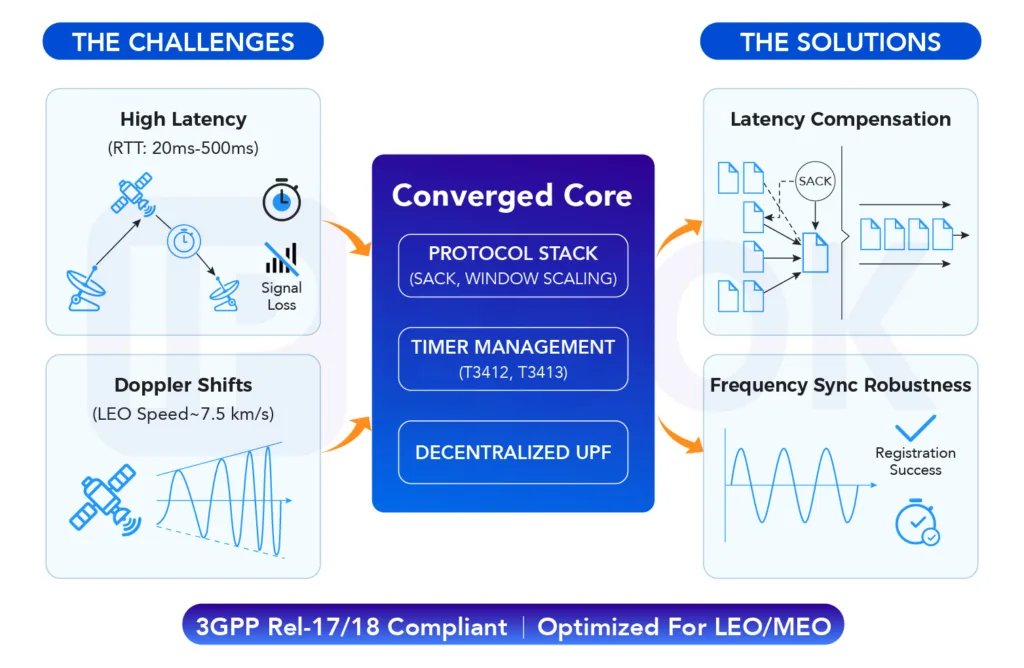
The integration of space, aerial, and terrestrial communications has become a major trend in the development of 5G-Advanced and 6G. As a key technology for seamless global coverage, Non-Terrestrial Networks (NTN) provide wide-range communication services through LEO satellites. However, the high-speed movement of satellites, long-distance transmission, and incompatibility with traditional core network architecture have brought serious technical challenges.
Key Differences and Challenges: NTN vs. Terrestrial Networks
Firstly,NTN has obvious physical differences from traditional terrestrial networks. LEO satellites move at high speed, and the transmission delay between satellites and ground stations is much longer than that of terrestrial networks. Traditional core networks designed for fixed base stations and low-delay scenarios cannot meet NTN communication requirements, resulting in three major problems: Doppler shift, high transmission delay, and traffic tromboning effect. These problems seriously affect synchronization stability, transmission efficiency, and routing performance. Therefore, the core network must be optimized in terms of signaling, protocol stack, and deployment architecture.
Addressing Doppler Shift in High-Speed Mobility
Among them,doppler shift caused by high-speed satellite movement is the primary challenge. It leads to physical layer synchronization errors, access failures, and even service interruptions during inter-satellite handover. To solve this problem, the core network should enhance the robustness of signaling processes and reduce the impact of transient synchronization fluctuations. Meanwhile, optimizing mobility management timers can expand the tolerance range of synchronization exceptions and avoid unnecessary terminal de-registration. Simplifying handover signaling also helps maintain stable connections under high-mobility conditions.
Mitigating High Transmission Delay with Protocol Optimization
In addition,high transmission delay is another typical problem in NTN. Long round-trip time reduces the efficiency of standard TCP and GTP protocols, causing low throughput and service lag. The core network needs to adopt delay-aware protocol stack optimization. The application of Selective Acknowledgment (SACK) can avoid full-window retransmission and improve transmission efficiency. TCP window scaling optimization can dynamically adjust the data transmission volume to ensure stable transmission under long-delay conditions. Adaptive protocol parameter configuration further enhances reliability in high-delay scenarios.
Resolving the Traffic Tromboning Effect via Decentralized UPF
The traffic tromboning effect caused by centralized User Plane Function (UPF) deployment wastes transmission resources and increases end-to-end delay. The effective solution is to use decentralized UPF deployment. By deploying distributed UPF near satellite ground gateways, local services can be routed and offloaded locally without detouring to the central core network. This method reduces transmission hops, saves satellite bandwidth, and improves overall network performance. Multi-node cooperation ensures uninterrupted user-plane transmission during cross-satellite movement.
Conclusion: Building the Foundation for Space-Terrestrial Integration
In conclusion, Doppler shift, high transmission delay, and traffic tromboning effect are the three core challenges restricting the development of NTN core networks. Through signaling robustness enhancement, timer optimization, delay-aware protocol stack improvement, and distributed UPF deployment, the core network can better adapt to NTN scenarios. These optimization measures lay a solid foundation for 5G-Advanced and 6G space-terrestrial integrated networks, and support the wide application of NTN in global coverage, aviation, maritime, emergency communications, and remote broadband services.