Does Virtual RAN (#vRAN) Equal #OpenRAN?
Not exactly.
What is vRAN?
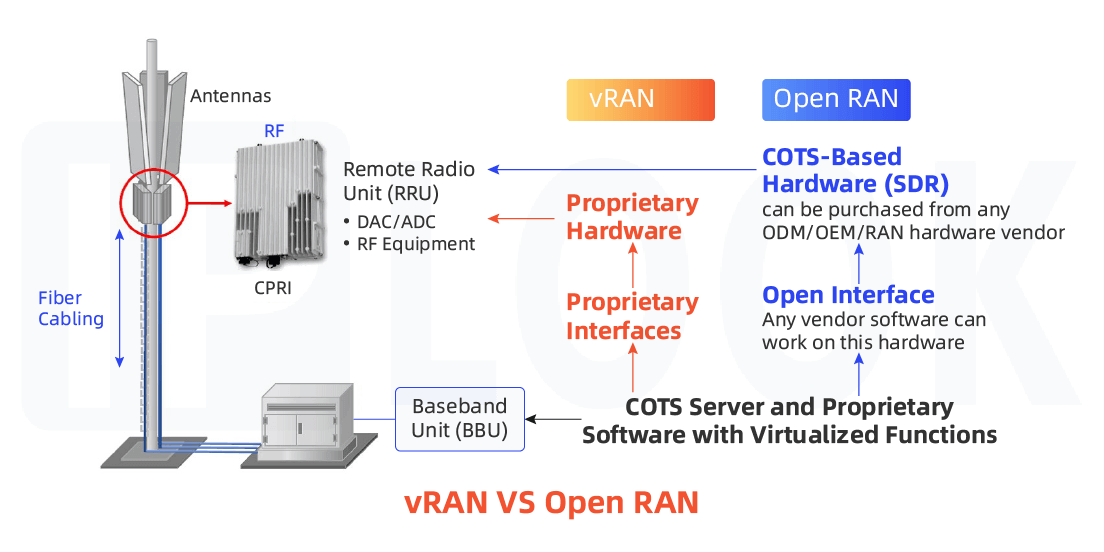
In Virtualized RAN (vRAN), the traditional proprietary Baseband Unit (BBU) hardware is replaced by software running on Commercial Off-The-Shelf (COTS) servers. However, the radio units (RRUs or RRHs) remain proprietary, and—critically—the interface between the radio and the BBU stays vendor-specific and closed.
This means that while the baseband processing is virtualized, it still only works with radios from the same vendor. For example:
Vendor A’s radio can only be paired with Vendor A’s virtualized BBU software on a COTS server.
An operator cannot simply install Vendor B’s software on the same COTS server to control Vendor A’s radios—unless the interface is opened.
As a result, vRAN alone does not eliminate vendor lock-in. It virtualizes functions but maintains proprietary boundaries.
What is Open RAN?
Open RAN goes further by standardizing and opening the interfaces between all RAN components—including between the radio units (RRUs/RRHs) and the baseband processors.
The core idea of Open RAN is disaggregation:
– The radio hardware becomes general-purpose, vendor-neutral, and based on open specifications (often GPP or COTS).
– The baseband runs as virtualized software on COTS servers—but now, thanks to open interfaces, any vendor’s software can interoperate with any vendor’s radio hardware.
Open RAN defines open northbound and southbound interfaces, separates the control plane from the user plane, and enables a modular, software-driven RAN stack. This creates a “white box” RAN environment where:
- Radios from Vendor A
- COTS servers from Vendor X
- Baseband software from Vendor B
…can all work together seamlessly.
When an operator wants to switch software vendors, they can keep the existing radios and servers in place—only the software layer needs to be updated. This dramatically increases flexibility, reduces costs, and fosters innovation through multi-vendor competition.
In Summary
| Aspect | vRAN | Open RAN |
|---|---|---|
| Hardware | Proprietary radios + COTS BBU server | Open, interoperable radios + COTS servers |
| Interfaces | Closed, vendor-specific | Standardized and open (e.g., O-RAN Alliance specs) |
| Vendor Lock-in | Still present | Minimized or eliminated |
| Interoperability | Limited to single vendor | Multi-vendor “best-of-breed” possible |
So while vRAN is a step toward cloudification, Open RAN is a transformative shift toward openness, choice, and innovation in mobile networks.