Private 5G Networks: Bridging the Gap Between Legacy Reliability and Next-Gen Innovation
While public 5G networks have surged ahead in 2021—with operators deploying base stations at unprecedented speed—private networks lag behind, often stuck in a technological time warp equivalent to 2G or 3G. Despite their critical role in industries like public safety, energy, and transportation, private networks face unique challenges that slow their evolution.

Why Private Networks Are Stuck in the Past
Private networks are defined by three core demands: high security, high stability, and cost efficiency. These requirements—while essential—create a paradox:
- Small-scale & fragmented deployments: Unlike public networks serving millions, private networks serve dozens to thousands of users per site, limiting economies of scale.
- Low R&D investment: Vendors prioritize mass-market public infrastructure, leaving private network innovation underfunded.
- Risk aversion: Industries like utilities or defense cannot afford disruption—so they cling to proven (but outdated) legacy systems like TETRA or P25.
As a result, many “private networks” today still rely on decades-old technologies—despite the transformative potential of 5G.
The Turning Point: 5G Unlocks New Industrial Possibilities
Yet the tide is turning. As digital transformation accelerates across sectors, the unique capabilities of 5G—wide-area coverage, ultra-high bandwidth, and millisecond-level latency—make it uniquely suited for next-generation private networks:
- Smart Factories: Real-time control of AGVs, AR-assisted maintenance, and AI-powered quality inspection
- Public Safety: 5G-connected drones for surveillance, emergency command centers with live HD video feeds
- Smart Transportation: Connected autonomous shuttles, predictive rail maintenance, and intelligent traffic management
- Healthcare & Logistics: Remote diagnostics, drone delivery, and warehouse robotics—all requiring guaranteed QoS
During the pandemic, we saw early proof: 5G-enabled UAVs delivered medical supplies, while autonomous 5G vehicles disinfected streets—showcasing reliability beyond consumer-grade connectivity.
Legacy vs. 5G: Complement, Don’t Replace
Importantly, 5G won’t—and shouldn’t—fully replace legacy private networks overnight. In mission-critical scenarios (e.g., firefighting, air traffic control), narrowband systems still offer unmatched voice clarity and resilience during disasters.
The future lies in **integration**: using 5G for high-bandwidth data and IoT, while retaining legacy systems for fail-safe voice. Over time, 3GPP’s Mission Critical Services (MCX) will unify these functions—but transition takes time.
IPLOOK’s Dual Path to Private 5G Integration
To help enterprises modernize without compromising security or continuity, IPLOOK offers two flexible deployment models that bridge public and private domains:
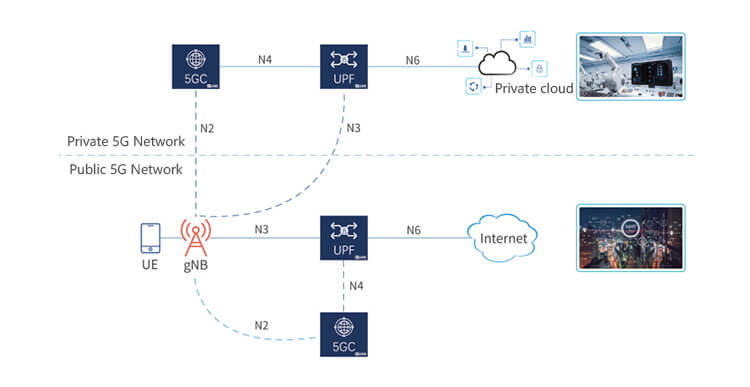
Solution 1: Shared RAN, Dedicated Core
Enterprises deploy a lightweight, on-premises 5G Core (5GC), including UPF and control plane, while sharing the gNB (radio) with the public network.
Best for: High-security environments (finance, defense) where data must never leave premises.
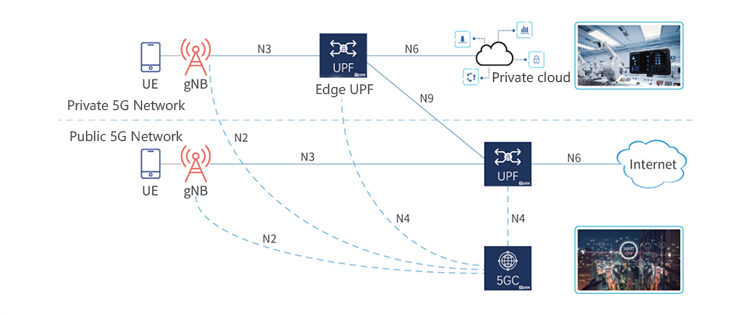
Solution 2: Shared Core Control Plane, Edge UPF
The enterprise uses the operator’s 5GC control plane but deploys its own gNodeB and local UPF at the edge—keeping sensitive traffic within the facility.
Best for: Cost-conscious deployments (campuses, logistics hubs) needing low latency without full core ownership.
The Bottom Line: Coexistence Is Key
Public networks will never fully replace private ones—nor should they. In sectors like public safety, finance, education, and critical infrastructure, network isolation isn’t optional; it’s essential for national and operational security.
The 5G era demands a new paradigm: deep integration of public and private networks, where each plays to its strengths. With cloud-native cores, edge computing, and slicing, this vision is now technically feasible—and economically viable.
Ready to Modernize Your Private Network?
IPLOOK provides end-to-end, standards-compliant private LTE/5G solutions tailored to your industry’s security, latency, and scalability needs.
Contact us today to explore how 5G can transform your operations—without compromising reliability.
Glossary
- Public Network: A wide-area network (WAN) operated by telecom providers, covering cities or countries (e.g., commercial 4G/5G).
- Internet: A global public WAN connecting billions of devices worldwide.
- Internal Network (LAN): A local network within a building or campus for file sharing, printing, etc.
- Private Network: A dedicated, isolated network serving specific users/devices in a defined area—ensuring security, control, and guaranteed performance.