Distributed Deployment Network Topology
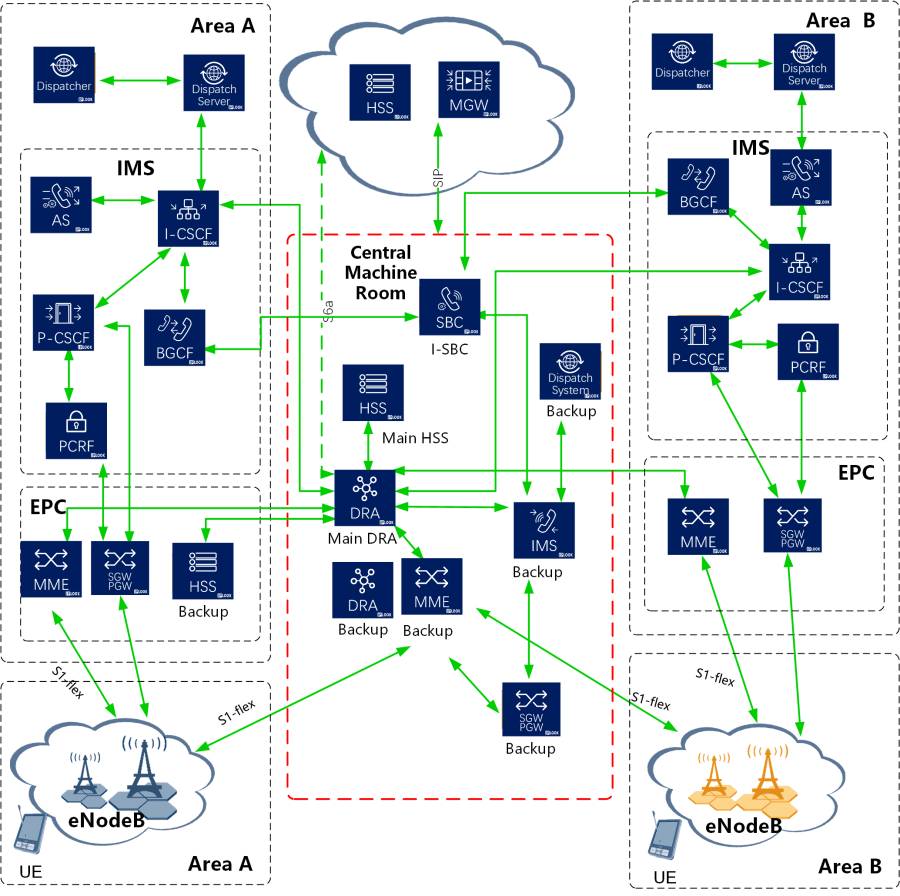
Figure 1
• Description:
- Deploy EPC, IMS, and the dispatch system in each mining area’s local machine room to handle local business operations independently.
- In the central machine room, deploy the primary HSS (Home Subscriber Server) and I-SBC (Interconnection Session Border Controller) for public network interconnection. Additionally, install backup instances of EPC, IMS, and the dispatch system—enabling automatic failover to the central site if a local mining area experiences a failure, thereby ensuring business continuity.
- Select one mining area data center to host a backup HSS, establishing a remote 1+1 redundancy setup for critical core network elements including HSS and DRA (Diameter Routing Agent).
• Key Strengths:
- Reduced bandwidth pressure on the central machine room: user data is processed locally in each mining area, minimizing backhaul traffic to the central site.
- Local autonomy: Each mining area operates its own independent core network. If the central machine room fails, local services remain unaffected.
- High availability through centralized backup: In the event of a local mining area failure, services seamlessly switch to the backup systems in the central machine room.
- Unified public network interface: The deployment of I-SBC and DRA provides a single, standardized gateway for interconnecting with external networks—eliminating the complexity of multiple access points to the public network.
- Enhanced overall reliability: By distributing critical functions and avoiding a single point of failure, this architecture prevents total network collapse due to central site outages.