5GC on Public Cloud: A Paradigm Shift Reshaping the Telecom Industry
The migration of 5G Core Network (5GC) to public cloud platforms is no longer theoretical—it’s accelerating at scale. Since mid-2021, major global operators and vendors have made bold moves that signal a fundamental transformation in how telecom networks are built, operated, and evolved.

Industry Leaders Embrace the Cloud
As of July 2021, four leading operators—AT&T, DISH, Telefónica Germany, and Swisscom—have publicly announced their deployment of 5GC on Azure or AWS. Simultaneously, infrastructure giants Ericsson and Nokia forged strategic alliances with Google Cloud and AWS, respectively, to deliver cloud-native 5GC solutions.
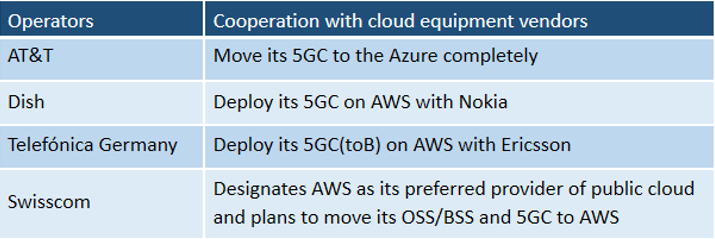
Global operators adopting public cloud for 5GC
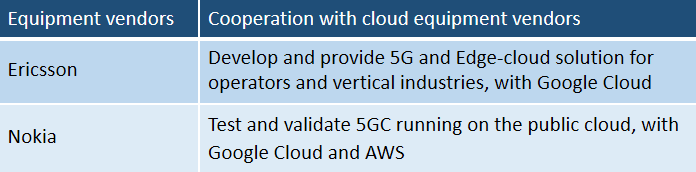
Vendors aligning with cloud hyperscalers
AT&T’s Landmark Move: A Watershed Moment
The most transformative event came when AT&T—serving nearly 175 million connections—announced the full migration of its 5GC to Microsoft Azure. In a groundbreaking deal:
- Microsoft acquired AT&T’s in-house network cloud platform technology and engineering team.
- AT&T ceased further development of its proprietary cloud stack, entrusting Microsoft with end-to-end operation and evolution of its 5GC infrastructure.
This decision, culminating a 7-year virtualization journey</strong that began in 2014, sends a clear message: running carrier-grade 5GC on public cloud is not only feasible but offers superior stability, elasticity, and cost efficiency.
Why Public Cloud for 5GC?
The answer lies in 5G’s revolutionary architecture:
- Service-Based Architecture (SBA): Enables true software-hardware decoupling.
- Cloud-Native Design: Network functions run as microservices in containers, deployable across public, private, or hybrid clouds.
- Network Exposure via APIs: For the first time in telecom history, 5G allows third-party developers (ISVs) to access real-time network capabilities—enabling applications that adapt to latency, bandwidth, and location.
In contrast to 2G–4G eras—where networks and applications operated in silos—5G fuses them into a unified innovation platform.
A New Ecosystem Economy
5G is no longer just a connectivity pipe; it’s an ecosystem enabler. To unlock its full potential, collaboration is essential among:
- Mobile operators
- Public cloud hyperscalers (AWS, Azure, GCP)
- Application developers
- Vertical industry partners (manufacturing, healthcare, logistics)
For operators, partnering with cloud giants eliminates massive R&D costs for building telco clouds from scratch and grants instant access to:
- Advanced AI/ML and data analytics
- Global developer ecosystems
- Elastic scaling and DevOps toolchains
This agility allows rapid delivery of tailored services—from ultra-low-latency AR inspections to dynamic network slicing for smart factories.
What This Means for the Future
If the “5GC + Public Cloud” model becomes mainstream, it could trigger a seismic shift:
- Disruption of traditional core network vendor dominance
- Accelerated separation of telecom software and hardware
- New business models based on network-as-a-service (NaaS)
The telecom industry is entering an era where infrastructure is commoditized, and value shifts to service innovation, ecosystem integration, and operational intelligence.
IPLOOK: Built for the Cloud-Native Future
At IPLOOK, our cloud-native 5GC is designed from the ground up for deployment on AWS, Azure, Google Cloud, Kubernetes, and OpenStack. We empower operators and enterprises to harness the full flexibility of 5G—without vendor lock-in or legacy constraints.
Ready to explore cloud-native 5GC for your network?
Contact IPLOOK today to discuss your public, private, or hybrid cloud strategy.