Core Telecom Definitions & Technical Concepts
Understanding the operational boundary between virtual and physical operators requires clear technical definitions:
- MNO (Mobile Network Operator): An entity holding government-licensed wireless spectrum that builds and operates base stations, Radio Access Networks (RAN), and full Mobile Core network infrastructure (e.g., T-Mobile, Vodafone).
- MVNO (Mobile Virtual Network Operator): A communication service provider that sells cellular connectivity directly to end users without owning physical RAN infrastructure, using wholesale capacity from host MNOs.
- MNP (Mobile Number Portability): Telecommunications regulatory framework and routing protocol that allows subscribers to switch network operators while retaining their existing MSISDN (mobile number).
- eSIM & Dual-SIM: Dual-SIM hardware permits simultaneous dual-carrier connectivity. eSIM utilizes Remote SIM Provisioning (RSP) specifications to download carrier profiles over the air, removing physical SIM fulfillment bottlenecks.
- OTT (Over-The-Top): Voice, messaging, or media services delivered via open IP networks (e.g., WhatsApp, Microsoft Teams) that bypass standard cellular circuit-switched billing channels.
Architectural Comparison of MVNO Business Models
MVNO implementations scale across four distinct tiers based on technical ownership, capital expenditure (CapEx), and operational control over billing and core infrastructure:
| MVNO Model | Mobile Core (HLR/HSS/Core) | Billing & BSS | Customer Care | Tariff & Pricing Control | Operational Characteristic |
|---|---|---|---|---|---|
| Branded Reseller (Thin MVNO) | Hosted by MNO | Hosted by MNO | MNO Managed | None (Fixed MNO catalog) | Acts strictly as a sales and marketing affiliate; lowest barrier to market entry. |
| Service Provider | Hosted by MNO | Independent (Proprietary/Third-Party) | In-House | Full Autonomy (e.g., custom 2GB / $3 tiers) | Full ownership of packaging, invoicing, rating engines, and customer experience. |
| Enhanced Service Provider | Hosted by MNO + Custom App Nodes | Independent | In-House | Full Autonomy | Integrates specialized application servers (e.g., Cloud PBX, ANI routing, enterprise softphones). |
| Full MVNO | Self-Hosted Core (GMSC, HLR/HSS, STP) | Independent | In-House | Full Autonomy | Highest infrastructure flexibility; full control over roaming agreements and call routing logic. |
Target Segments & Niche Differentiation
Because traditional MNOs design generic wholesale products for mass demographics, MVNOs win by deploying specialized services for targeted customer cohorts:
- Migrant Worker & Diasporas: Offering zero-rated cross-border calls between closed-user-group SIM cards across specific corridors (e.g., Poland to Germany via Lycamobile), removing the need for complex OTT workarounds for elder demographics.
- International Travel & Roaming: Distributing cheap global data via eSIM profiles or international multi-IMSI cards (e.g., TravelSim models), eliminating high domestic roaming tariffs.
- Price-Sensitive Low-Cost Segments: Serving students and retirees with stripped-down, pay-as-you-go micro-packages without annual contract lock-ins.
- B2B & Enterprise Workforces: Providing integrated mobile PBX solutions that automatically substitute caller ID to match company departmental numbers for distributed, remote workforces.
Revenue Monetization & Cost-Optimization Strategies
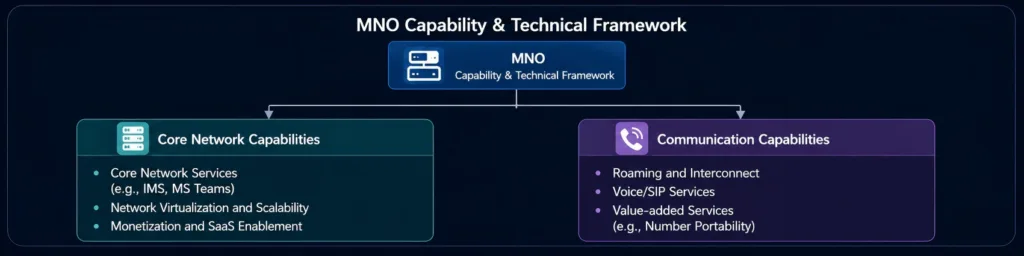
Long-term profitability in a virtual network relies on expanding active SIM counts while deploying network-level optimizations to squeeze marginal traffic costs:
1. Revenue Diversification
- Enterprise Software Bundling: Cross-selling corporate mobile data packages with unified communications licenses (e.g., Microsoft Teams Direct Routing).
- Private APN & Intranet Access: Monetizing dedicated secure data tunnels directly into client corporate networks.
2. Cost Reduction & Arbitrage
- VoIP/SIP Voice Gateway Deployment: Rerouting international voice traffic through low-cost SIP termination gateways rather than relying on legacy MNO interconnection fees.
- Postpaid Wholesale to Prepaid Packaging Arbitrage: Procuring wholesale postpaid bulk volume capacity from MNOs at steep discounts, restructuring the balance into high-margin prepaid data bundles.
Technical Integration: M2M Provisioning & CDR Data Flows
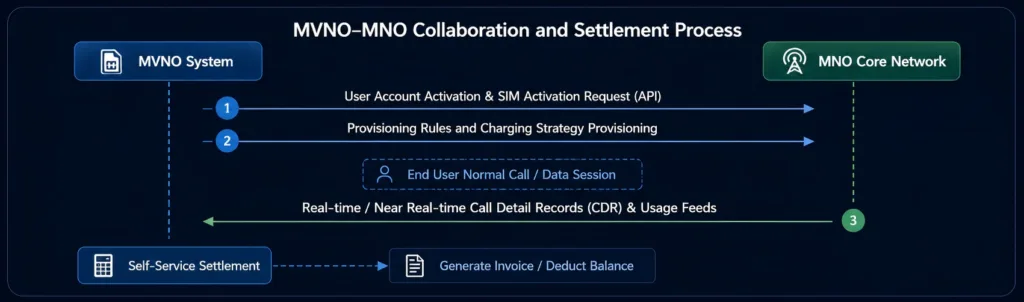
Modern MVNO operations run on automated machine-to-machine (M2M) provisioning and real-time usage mediation interfaces between the virtual provider and the host MNO:
- Subscriber Onboarding & Activation: The MVNO captures customer registration and triggers a REST/SOAP API call to the MNO’s provisioning gateway to bind the IMSI/ICCID to an active network state.
- Plan Provisioning & Policy Rules: The MVNO’s BSS pushes subscriber-specific QoS profiles, data caps, and service restrictions down to the MNO’s policy engine.
- Mediation & CDR Processing: During active sessions, the MNO records call duration and data volume consumption, feeding real-time Call Detail Records (CDRs) and data accounting feeds back to the MVNO rating engine for precise balance deduction and invoicing.
Regulatory Landscapes & Market Entry
Market viability is heavily determined by regional telecom antitrust enforcement and wholesale access mandates:
- Open Regulatory Markets (USA, Germany, Central Europe, Japan, Australia): Strong antitrust statutes mandate wholesale network access, providing standardized interconnection terms and lower legal hurdles for new MVNO entrants.
- Emerging / Unregulated Markets: Where mandatory wholesale sharing is absent, market entry requires direct commercial bilateral negotiations with host MNOs to establish infrastructure access.
References & Industry Standards
- 3GPP TS 23.002: Network Architecture Standards (Core Network, BSS/OSS Interface Specifications).
View 3GPP Specification - International Telecommunication Union (ITU): Regulatory Guidelines on Mobile Virtual Network Access and Competition.
Visit ITU Regulatory Portal - GSMA Guidelines (SGP.22): Remote SIM Provisioning (RSP) Architecture for Consumer and Enterprise eSIM Deployments.
Explore GSMA eSIM Standards