
To build a sustainable 5G business model, you should focus on long-term value. Do not chase quick profits. You need to be open and share your sustainability actions. Working together in the 5G ecosystem helps you get better results. The newest data shows there will be 3.2 billion global 5G connections by 2026. More than 60% will be in Asia Pacific.
| Metric | Value |
|---|---|
| Projected Global 5G Connections | 3.2 billion by end of 2026 |
| Asia Pacific Share | Over 60% (about 2 billion connections) |
You can use 5G to help your business grow and meet environmental goals:
- Smart power management saves energy in networks.
- Liquid cooling uses less energy in data centers.
- Renewable energy lowers your carbon footprint.
- Refurbishing devices reduces e-waste.
These steps help you build a strong base for a sustainable 5G business model.
Key Takeaways
- Think about long-term value, not just fast profits, to make a strong 5G business model.
- Work with other partners in the 5G ecosystem to get better results and share what you know.
- Use energy-saving tools like smart power management and renewable energy to help the environment.
- Learn what your customers need so you can make 5G services that fix real problems.
- Keep up with rules and work with the government to follow them and get help for your 5G plans.
- Look at data and numbers to see how well you are doing and change your plans if you need to.
- Always try new ideas and listen to what customers say to keep getting better.
- Think about servitization by giving bundled services that give more value to your customers.
5G Overview and Business Value
What Is 5G?
5G is a new kind of wireless technology. It is much faster than older networks. It also has less delay when sending data. 5G gives you stronger connections. It can support many devices at the same time. This technology uses special antennas and new radio waves. You can use 5G with smartphones, sensors, machines, and cars. The network lets you move lots of data quickly and safely.
5G’s Impact on Business
5G changes how businesses work. It helps you talk to others better. It makes your team more productive. You can make new services with 5G. Many industries get benefits from 5G. Retail, finance, healthcare, and transport all use it. They get better connections and faster service. 5G also helps people work from home. Teams in different places can stay connected.
Tip: You can spend less money at first by using subscription models. This means you pay smaller amounts over time. It helps you control your budget.
People want faster data and more smart devices. This makes strong 5G networks important. 5G connects smart devices and self-driving cars. It also helps build smart city systems. These changes help you keep up in a fast market.
| Impact Area | Description |
|---|---|
| Enhanced Connectivity | 5G gives you faster speeds and less delay. This makes talking and sharing easier. |
| Operational Efficiency | You can make your work smoother and faster with IoT. |
| Customer Experience | Digital tools like augmented reality give better service to customers. |
| IT Infrastructure Transformation | You need to update your IT systems to use 5G well. |
| Remote Work Capabilities | Good connections help teams work together from anywhere. |
Key Features and Trends
You should know what makes 5G special for your business. Here are some important things:
- You get real-time data for special offers and deals.
- 5G supports AR and VR for new experiences.
- You can track products in real time for better delivery.
- Fast mobile internet helps your team work together.
- 5G networks can connect millions of devices for automation.
- It works with artificial intelligence and edge computing for quick data use.
- 5G saves energy and helps the environment.
- Fixed wireless access brings fast internet to more places.
- 5G is a base for Industry 4.0 and digital change.
| Feature/Trend | Description |
|---|---|
| Enhanced personalization and data-driven insights | Real-time data helps you give customers special offers. |
| Immersive and interactive technologies | 5G lets people use AR and VR to see products in new ways. |
| Streamlined logistics and supply chain management | Tracking in real time helps you deliver things faster. |
| Improved mobile access and workforce collaboration | Fast internet lets teams work together from anywhere. |
| Scalable infrastructure for integrated ecosystems | 5G connects many devices for automation and new business ideas. |
| Integration with AI and edge computing | You can use data right away for smart systems. |
| Sustainability and energy efficiency | 5G uses less energy and helps your green goals. |
| Expansion of fixed wireless access (FWA) | You can bring fast internet to more places. |
| Foundation for Industry 4.0 and digital transformation | 5G helps with automation and better customer service. |
When you know these features, you can plan how to use 5G. This helps your business grow and stay ahead.
Sustainable 5G Business Model Foundations
Long-Term Value Creation
You should focus on long-term value. 5G will change how businesses work in the future. Faster speeds and less delay will make markets grow. If you change with the times, you will do well. If you wait too long, you might fall behind. Try to break old habits in your industry. Use new ways that help everyone in the ecosystem. Help customers see why 5G is useful. Make it easier for customers to invest in 5G. Work with partners to add more skills and get more value.
| Key Questions | Insights |
|---|---|
| How to break the current industry logic? | New models can help everyone in the ecosystem. |
| How to increase customer knowledge on 5G benefits? | Meeting customer needs is important for using 5G. |
| How to lower financial barriers for 5G implementation? | Making investments safer helps customers feel confident. |
| How to integrate capabilities in the ecosystem? | Working together gives more value to everyone. |
You will get lasting benefits if you use IoT, smart city tech, and self-driving cars. Success comes from starting early and always improving.
Transparency and Reporting
You need to show your sustainability actions clearly. Top companies try to save energy in their 5G work. They want to lower their carbon footprint and use new ideas to help the environment. You can join groups like the Infrastructure Masons Climate Accord. This shows you care about cutting carbon in digital systems. Open rules and good management help you check carbon in materials and products.
Note: Sustainability is very important for the industry. Data center providers are getting closer to cutting emissions. Saving energy helps you and your customers reach green goals.
You should share your progress with others. Use easy reports and dashboards to show what you have done. Being open builds trust and helps you get partners and customers.
Government and Stakeholder Roles
Governments help shape the Sustainable 5G Business Model. They make better rules for 5G around the world. Good rules in groups like 3GPP and ITU help keep things open and clear. Governments make a plan for 5G networks and spectrum. This helps you work with others and makes sure systems work together.
You should follow the best rules from governments and industry groups. Keep up with new laws and standards. Work with others to build a fair and lasting ecosystem. Working together gives better results and helps your long-term goals.
5G Ecosystem Analysis
Value Chain Stakeholders
You need to know the main groups in the 5G ecosystem. Each group has its own job. If you know what each group does, you can work together better. This helps you reach your goals faster.
- Network operators run the equipment and give 5G services.
- Equipment manufacturers make hardware like antennas and base stations.
- Device manufacturers build phones, tablets, and other devices for 5G.
- Cloud providers give cloud services that help 5G apps work.
- System integrators connect parts of the 5G ecosystem so it works smoothly.
- Software vendors make apps and services for the 5G network.
- Regulatory bodies set rules and standards for the 5G network.
Tip: Make strong partnerships with these groups. You will roll out 5G faster and get better results.
Regulatory Environment
You must follow rules from governments and industry groups. These rules keep networks safe and fair. They also help your 5G systems work well with others. Here is a quick look at the main regulatory areas:
| Aspect | Description |
|---|---|
| Spectrum Allocation | Governments must give enough spectrum for fixed and mobile 5G. |
| Standards Setting | Technical standards help networks work together and stop interference. |
| Infrastructure Access | Getting city infrastructure can be slow and political. |
| Security Measures | Protecting your network is important as 5G allows better monitoring and faster response times. |
Stay updated on new rules and best practices. This helps you avoid delays and build trust with partners and customers.
Infrastructure and Energy Efficiency
You need to focus on energy-efficient infrastructure for a strong 5G business model. Modern 5G networks use smart ways to save power and lower costs. Here are some ways you can improve energy efficiency:
- Use renewable energy with traffic offloading and smart sleep modes.
- Turn off small cells when not needed, based on user movement.
- Use machine learning to manage sleep modes and save energy.
- Use algorithms to adjust cell coverage and base station activity as traffic changes.
- Switch off underused base stations with special algorithms.
- Try dynamic switching for different backhaul technologies.
- Optimize sleep modes to balance energy savings and service quality.
- Group base stations to keep only the needed ones active.
- Use centralized methods to coordinate sleep decisions across the network.
- Update sleep modes as network demand changes.
- Use graph theory to save power and keep coverage strong.
Note: Energy-efficient equipment and smart management help you cut costs and meet green goals. These steps also support your long-term business success.
When you invest in efficient infrastructure, you help the environment and improve your profits. This keeps your network strong and ready for the future.
Customer Needs and Industry Verticals
Identifying Market Segments
You must know your customers before building a sustainable 5G business model. First, look at the main groups who will use 5G. Each group wants different things and has different goals. When you know this, you can make services that fit each group.
- Consumers want faster internet, better streaming, and smooth gaming.
- Businesses need strong connections, automation, and safe data.
- Public sector groups want smart city tools, safe travel, and good emergency networks.
- Industrial clients care about automation, robots, and real-time checks.
Tip: Talk to your customers. Ask them what problems they have. Use their answers to make your 5G services better.
Industry Use Cases: Mobility, Media, Factory of the Future
5G brings new chances for many industries. You can use it to fix real problems and add value.
- Mobility: 5G helps connect cars and smart traffic systems. Cities can use it to manage traffic and keep roads safe. Buses and trains can use real-time data to change routes and times.
- Media: With 5G, you can send high-quality video and fun content. People can watch live sports, concerts, and use virtual reality with no delays. You can give new things like cloud gaming and cool experiences.
- Factory of the Future: 5G changes how factories work. You can connect machines, sensors, and robots. This helps you check production, fix problems fast, and stop long breaks. Automation gets easier, and you can grow your work when needed.
| Industry | 5G Use Case Example | Benefit |
|---|---|---|
| Mobility | Connected vehicles, smart traffic | Safer, faster travel |
| Media | Live streaming, AR/VR | Better user experience |
| Manufacturing | Automated robots, IoT sensors | Higher efficiency, less waste |
Supply Chain Transformation
You can change your supply chain with 5G. The technology gives you real-time data and more control over each step.
- Live tracking lets you see stock and its condition anytime.
- Robots and workers can work together better and faster.
- Real-time links for vehicles help with directions and safety.
- Automated tools, like AGVs and robots, move things with care.
- IoT sensors watch shipments, so there are fewer mistakes and more trust.
These changes bring big results:
- Inventory mistakes go down by 18%.
- Supply chain works 20% better overall.
- Real-time info helps you handle problems fast.
- Automation and better planning cut your costs.
- Better routes and less waste help your sustainability goals.
Note: Using 5G in your supply chain gives you speed, accuracy, and strength. You also help the planet by using less energy and making less waste.
When you focus on what customers need and give special solutions, you get the most from 5G. This helps you build a business model that lasts.
Business Opportunities and Models
New Revenue Streams
You can make new money by using 5G in smart ways. First, see how 5G changes what you can give your customers. Many industries use 5G to make services that did not exist before.
- Smart city setups let you help with traffic, lights, and safety.
- Real-time support with AR lets you help customers or workers fast.
- New service ideas make you different from other companies.
You can also look at certain industries:
- Healthcare: Use 5G for telemedicine and remote surgeries.
- Manufacturing: Set up private 5G networks for fast, safe work.
- Market growth: The market for 5G services will grow from $2.7 billion in 2025 to $29 billion by 2030.
Here is a quick look at the main ways to earn money with 5G:
| Emerging Revenue Streams | Description |
|---|---|
| Enhanced Mobile Broadband | Give faster data and better connections to people. |
| Massive Machine Type Communications | Support lots of devices for new IoT uses. |
| Ultra-Reliable Low-Latency Communication | Allow important things like remote surgeries and real-time data work. |
| XaaS Models | Move to service-based models for software and network services. |
| After-Market Services | Give help and upgrades after the first sale. |
Tip: Focus on services that fix real problems for your customers. This builds trust and long-lasting value.
Business Model Innovation
You need to change your business model to stay ahead with 5G. Start by sharing what you know with partners and customers. Licensing your technology to makers helps more people use 5G devices.
Servitization is another good way. Offer subscriptions so customers pay as they use your services. This lowers the first cost and makes it easier for them to start.
Working with others gives you a bigger reach. Team up with partners to make solutions for smart factories or other industries. When you work together, you can offer more complete packages and stand out.
| Innovation Type | Description |
|---|---|
| Knowledge Sharing | License technology to help more people use 5G. |
| Servitization | Use subscriptions to lower customer costs. |
| Ecosystem Collaboration | Build partnerships for full solutions in important areas. |
Note: Keep your business model flexible. The 5G market changes fast, so you must adjust to new trends and needs.
Vertical Integration
You can get stronger by controlling more parts of your business. Start by investing in your own infrastructure, like private 5G networks or edge computing sites. This gives you more control over quality and costs.
Next, find ways to bring device making, software building, and service giving together. When you manage more steps, you can answer customer needs and market changes faster.
- Build your own 5G setup for better reliability.
- Make your own software to support special services.
- Offer full solutions, from devices to support.
Vertical integration helps you give steady quality and a smooth experience to your customers. You also depend less on outside suppliers, which can lower risks and help profits.
Tip: Start small by bringing one part of your business together, then grow as you learn more.
Adoption Challenges and Solutions
Technical Barriers
You will face some technical problems when starting with 5G. These problems can slow you down if you do not plan ahead. Here are the main things you need to fix:
- Many carriers are slow to use 5G Standalone. They worry about spending a lot of money and not getting enough back.
- Operators wait for clear ways to make money before upgrading to 5G Advanced.
- Limited spectrum and slow rules can stop you from using all of 5G Advanced.
Tip: Work with regulators and partners to get spectrum faster. Test new ideas in safe places. This lowers risk and helps you trust your 5G plans.
Investment and ROI Risks
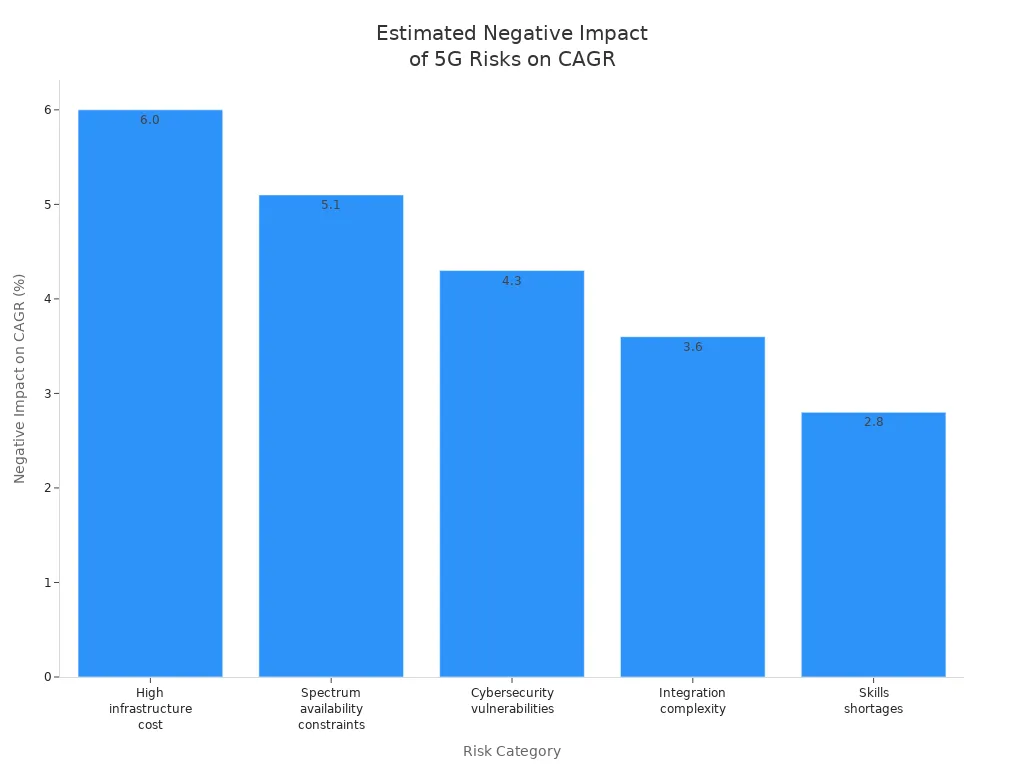
You need to know the money risks before you spend on 5G. High costs and not knowing the returns can make choices hard. The table below shows the main risks and how much they can slow growth:
| Risk Category | Risk Description | Estimated Negative Impact on CAGR (%) | Geographic Exposure | Risk Timeline |
|---|---|---|---|---|
| High infrastructure cost | Capital intensive 5G deployments | ~6.0% | Emerging Markets | Short Term |
| Spectrum availability constraints | Licensing and allocation delays | ~5.1% | Global | Short Term |
| Cybersecurity vulnerabilities | Expanded enterprise attack surface | ~4.3% | North America, Europe | Mid Term |
| Integration complexity | Coexistence with legacy networks | ~3.6% | Global | Mid Term |
| Skills shortages | Limited 5G network expertise | ~2.8% | Global | Long Term |
Many companies are not sure about moving to 5G. Their old networks work fine for now. High costs make them worry even more. To handle these risks, start with small tests. Check the results before doing more. This helps you spend less and show 5G’s value step by step.
Organizational Readiness
You need to get your team ready for 5G. Start by teaching your team and customers about 5G’s good points. Use easy words and skip hard tech talk. Build trust by adding new services slowly and showing results.
- Teach users about 5G without hard words.
- Build trust by adding new services step by step.
- Give rewards to early users.
You can pick different plans for your business:
| Strategy Type | Description | Evaluation Criteria |
|---|---|---|
| Brownfield approach | Add 5G to what you already have | Speed to market, Adaptability |
| Fully independent | Make new systems just for 5G | Enterprise grade |
| Fully integrated | Use what you have and add 5G to it | |
| Modular Greenfield | Build a new layer to make things easier |
Note: Pick the plan that fits your team and goals. Focus on building skills and trust. This will help you succeed with 5G.
Strategies for a Sustainable 5G Business Model
Knowledge Sharing and Collaboration
You need strong partnerships to do well with your Sustainable 5G Business Model. Start by working with schools and industry leaders. Academic research gives you new ideas and helps solve real problems. When you work with universities, you get smart people and research that fits your needs. Sponsored projects let you help guide new inventions. Invite experts from the industry to join school programs. This helps students learn skills they will use at work.
Companies working together makes your 5G rollout faster and easier. Share what you know and your resources with your partners. This way, you can fix problems like spectrum allocation and building infrastructure as a team. You lower risks and costs by working together. You also learn from each other and make your business better. Build a group of partners who want the same things as you. Use workshops, forums, and shared platforms to swap ideas.
Tip: Have regular meetings with your partners. Use these times to check progress, talk about problems, and think of new solutions.
Servitization and Value-Added Services
You can grow your business by giving services with your products. Servitization means you give customers more than just hardware. For example, mobile providers often give free phones with service plans. This makes it easier for customers to start using your services.
5G lets you make new packages that mix IoT, security, and cloud services. You can offer solutions that fix real problems for your clients. These packages help you stand out in the market. Customers get more value and stay loyal to your brand.
- Offer bundles that include devices, connectivity, and support.
- Make packages for businesses with IoT sensors, secure networks, and cloud storage.
- Give after-sales support and upgrades to keep customers happy.
| Service Type | Example | Benefit |
|---|---|---|
| Bundled Subscription | Free phone with service plan | Easy start for customers |
| Integrated Solutions | IoT + security + cloud package | Solves tough business needs |
| After-Sales Support | Upgrades and maintenance | Builds long-term loyalty |
Note: Servitization helps you make steady money. It also makes your business stronger when the market changes.
Continuous Innovation
You must keep improving your business to stay ahead in the 5G market. Start by watching new trends and technologies. Use feedback from customers and partners to guide your changes. Test new ideas in small projects before making them bigger. This lets you see what works and avoid big risks.
Encourage your team to learn new skills and try new ways. Invest in training and workshops. Use pilot projects to try new business models. Share your results with partners and learn from their experiences.
- Start pilot programs to test new services.
- Use customer feedback to make your offerings better.
- Invest in research and development to stay ahead.
Callout: Continuous innovation keeps your business flexible. You can handle new challenges and grab new chances.
You build a strong base for your Sustainable 5G Business Model by focusing on knowledge sharing, servitization, and ongoing innovation. These strategies help you create lasting value and stay competitive in a fast-changing market.
Implementation and Best Practices
Roadmap and Execution
You need a simple plan to build a Sustainable 5G Business Model. First, write down each step you will take. Set goals for saving energy, helping customers, and following rules. Pick tools that help the planet, like AI-driven energy management. Operators use AI to save energy by changing how much power the network uses when it is not busy. BT in the UK turns off things it does not need, which saves energy and money.
Here are steps to make your network more sustainable:
- Check your network and find ways to make it better.
- Buy hardware and software that use less energy.
- Teach your team how to use new tools and follow best practices.
- Talk to regulators to get help and advice.
- Start small projects to test green ideas.
Tip: Using dynamic resource allocation helps you spend less on energy and makes your network greener. AI-driven energy management saves a lot of money and matches your green goals.
Measuring Success
You need to check your progress with clear numbers. Use data to see if your work is helping. Look at both money and how well things run. The table below shows important ways to measure success:
| Metric | Description | Target/Goal |
|---|---|---|
| Consultant Utilization Rate | Shows how well expert staff are working. | 65% to 75% |
| Gross Margin Percentage (GM%) | Tells you how much profit you make from services. | Above 70% |
| Customer Acquisition Cost (CAC) | Shows how much you spend to get a new customer, starting at $8,000 in 2026. | $8,000 in 2026 |
| LTV:CAC Ratio | Compares money made from a client to the cost to get them. | 3:1 or higher |
| Average Billable Hour Rate (BHR) | Should be more than what you pay workers for services like Network Design. | Specific rates needed |
| Service Revenue Mix % | Shows growth in high-value services like Network Design. | N/A |
| Time to Payback | Shows how fast you earn back your money, about 28 months. | 28 months |
Check these numbers often. Change your plan if you see problems or new chances.
Scaling and Future-Proofing
You need to get ready for growth and changes. Start with solutions that can grow when you need them. WiLine’s Private 5G gives fast internet and can grow easily. Private 5G edge solutions help with smart repairs and AR/VR to get more work done. Watching supply chains and smart devices in real time helps your business run better and supports digital tools.
Here are lessons from good projects:
- High starting costs mean you must plan your budget well.
- Help from regulators is important for a smooth start.
- Mixing different technologies makes your system work together.
- Being green helps your business, saves money, and makes your brand stronger.
Operators are using AI to cut down the carbon footprint of 5G networks. AI models change how much energy network parts use when things are slow, so energy use goes down a lot.
You build a strong base by starting small, checking results, and growing bigger. Stay ready for new tech and changes in the market.
You can build a Sustainable 5G Business Model by thinking about long-term value. Be open about what you do and work with strong partners. Stay flexible and keep learning from your network and others in the industry. To make your 5G strategy better, you should:
- Use fiber routes to make more money.
- Switch to cloud-native, software-defined systems for faster growth.
- Use AI and automation to give customers a better experience.
- Grow your role as a technology partner.
- Spend money on talent and culture to keep your team strong.
Keep changing your plan and stay active in the industry. This will help you become a leader in the 5G market.
FAQ
What is the first step to building a sustainable 5G business model?
Begin by learning about your market and what customers want. Set clear goals for being green. Make a plan that includes saving energy, being open, and working with partners.
How can you measure the success of your 5G sustainability efforts?
Watch important numbers like energy use, carbon emissions, and customer happiness. Use simple reports or dashboards to show your progress to your team and partners.
What are the main challenges in adopting sustainable 5G?
You might face high costs, technical problems, and not enough skilled workers.
- Start with small test projects
- Teach your team new skills
- Work with partners to share knowledge
How do you ensure your 5G network stays energy efficient?
Pick equipment that uses less power.
Use AI and automation to control network resources.
Turn off devices you don’t need and make traffic flow better to save energy.
Why is transparency important in a 5G business model?
Being open helps build trust with customers and partners.
Share your green actions and results honestly.
This attracts new partners and helps meet rules and laws.
How can you keep your 5G business model flexible for the future?
Stay aware of new tech and trends.
- Try new ideas with pilot projects
- Listen to what customers say
- Change your plans as the market shifts
What role do governments play in sustainable 5G?
Governments create rules and help support 5G networks.
Follow best practices and stay updated on new laws.
Work with government agencies to make sure your network is safe and eco-friendly.