Network generational migration is never a purely technical question. It is a challenge of balancing economic accounts, engineering complexity and user experience at the same time. The industry learned this lesson during the 5G era, when multiple 4G to 5G options were defined but only NSA and SA survived in the market. Now that 6G standardization is progressing, the same question is back: how should networks migrate smoothly from 5G to 6G?
Lessons from the 5G Transition
NSA allowed operators to launch 5G quickly by reusing the existing 4G core and RAN infrastructure, but it created long-term path dependency. Many operators stayed in NSA for years, delaying SA and postponing the real value of 5G such as slicing and low latency. Another transitional approach, DSS, shared spectrum between 4G and 5G dynamically, but suffered from low efficiency and limited bandwidth, leaving users seeing a 5G icon without feeling any real speed gain. These lessons directly shaped how the industry approaches 6G migration.
The Baseline: SA plus MRSS and CA
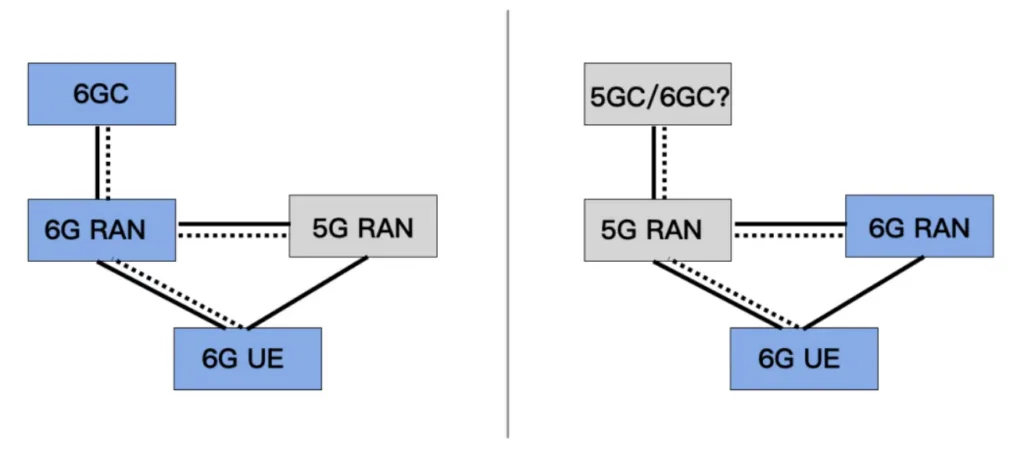
The industry has converged on a baseline for 6G: SA combined with MRSS and CA. The 6G RAN connects directly to the 6G core from day one, delivering native 6G capabilities without the transitional burden of NSA. MRSS lets 6G and 5G dynamically share the same spectrum, so operators can reuse existing 5G spectrum and RAN assets for rapid 6G coverage. Because 5G NR signaling is more flexible than 4G LTE, the extra overhead of 5G to 6G MRSS is estimated at only one to two percent, far below the losses of DSS. Carrier aggregation then adds new 6G carriers to boost capacity and throughput, giving users a genuine cross-generational speed experience.
What Is Still Under Debate
The baseline is not a universal solution. Legacy 5G equipment may not support MRSS, requiring hardware upgrades. MRSS and CA also demand deep coordination between 5G and 6G, which is easier within one vendor but difficult in multi-vendor environments. And mainstream RAN vendors have not yet formally committed to supporting MRSS through software upgrades on existing equipment. These concerns keep alternative options on the table. 6G-anchored dual connectivity gives 6G native core and control plane capabilities while leveraging mature 5G capacity. Dual stack takes a decoupled approach, with 5G RAN connecting to the 5G core and 6G RAN to the 6G core, which protects existing 5G SA investment and attracts operators with large mature 5G networks, at the cost of higher terminal complexity.
The Key Variable Is the Core Network
All of these choices are on the radio side, but the factor that decides which path succeeds is the core network: what will the 6G core look like? If the 6G core is only a light evolution of the 5G core with smoothly reusable interfaces and functions, the baseline path becomes more stable and migration friction is minimal. The mainstream expectation is that the 6G core will evolve from the 5G core rather than going through a clean break like the EPC to 5GC transition, avoiding another delayed core network that slows early 6G deployment. How far that smooth evolution will go remains an open question under active research.
IPLOOK is committed to supporting operators through this migration with a smooth, standards-based core network evolution path. Built on 3GPP-aligned cloud-native architecture, IPLOOK’s converged core solutions let operators deploy SA today and prepare for the 6G core of tomorrow without hardware lock-in or disruptive re-platforming. Our modular design supports gradual feature expansion, simplified operations and low total cost of ownership, protecting existing investment while embracing new-generation capabilities. Whether you are modernizing your current network or planning a 5G to 6G roadmap, IPLOOK helps you migrate with confidence and control.