Open Radio Access Network (Open RAN) is reshaping mobile infrastructure by replacing proprietary “black-box” systems with open, interoperable architectures. Unlike traditional RAN—where hardware, software, and interfaces were tightly controlled by a single vendor—Open RAN promotes transparency, flexibility, and multi-vendor collaboration.
In the 2G–4G era, operators depended heavily on integrated solutions that limited interoperability and weakened pricing leverage. The launch of the O-RAN Alliance in 2018 marked a turning point, aiming to break closed architectures by introducing open interfaces, hardware disaggregation, virtualization, and greater software openness. The goal was clear: foster competition, lower deployment costs, and enable more intelligent network operations.
Providers such as IPLOOK are aligning with this shift through cloud-native and virtualized solutions designed for open environments, helping operators pursue more scalable and software-driven network strategies.
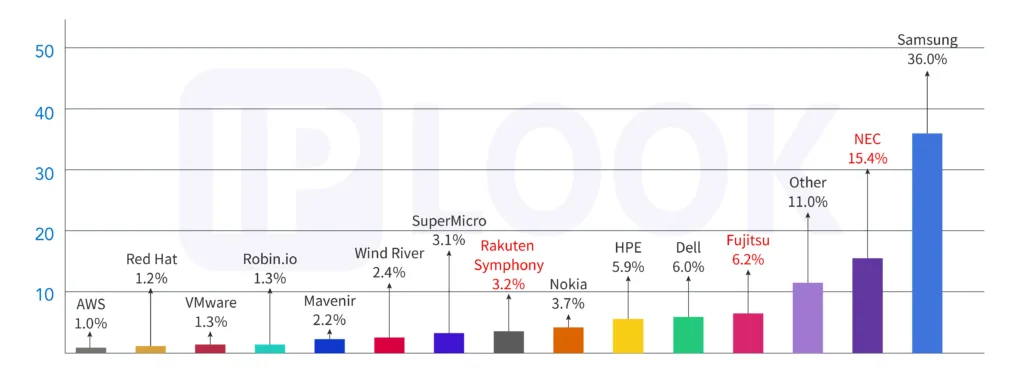
Global Market Share Landscape
After years of ecosystem development, Open RAN has entered early commercialization, though adoption remains uneven.
- Asia-Pacific currently leads global deployment, supported by large-scale 5G investment and proactive industrial policies.
- North America follows as a major innovation hub, while Europe is advancing through gradual, targeted rollouts.
- Overall, Open RAN still represents a minority of the total RAN market, with traditional suppliers retaining dominant share—evidence that structural change takes time.
Industry Headwinds
Cost remains the decisive factor. While multi-vendor models can reduce equipment pricing, integration and operational complexity may offset savings, making total cost of ownership harder to optimize. Supplier diversification has also progressed more slowly than expected.
Energy efficiency is another concern. Many virtualized deployments rely on general-purpose processors and external accelerators, increasing power consumption and operational risk. These realities contributed to a difficult period for the ecosystem in 2025, when network shutdowns, restructuring, and strategic pullbacks highlighted the gap between vision and large-scale profitability.
Despite short-term setbacks, the broader trajectory toward open, virtualized, and intelligent networks remains intact. Even long-established industry players are increasingly supporting open architectures, suggesting that Open RAN is evolving rather than retreating.
From Open to AI-Native
As the industry enters the 5G-Advanced phase and begins exploring 6G, artificial intelligence is emerging as the next defining capability. AI-driven RAN proposes embedding machine learning directly into network control loops to enable predictive optimization, automated resource allocation, and improved user experience.
GPU-based computing platforms are being explored to handle high-throughput processing more efficiently while supporting advanced antenna configurations. This signals a shift from networks built purely for connectivity toward platforms combining connectivity with intelligence.
AI-RAN is not a replacement for Open RAN but a continuation of its logic. Open architectures provide the programmable foundation required for AI-native operations. As these technologies converge, the future RAN is likely to be both open and autonomous—marking the industry’s transition from 5G experimentation to a more intelligent 6G era.