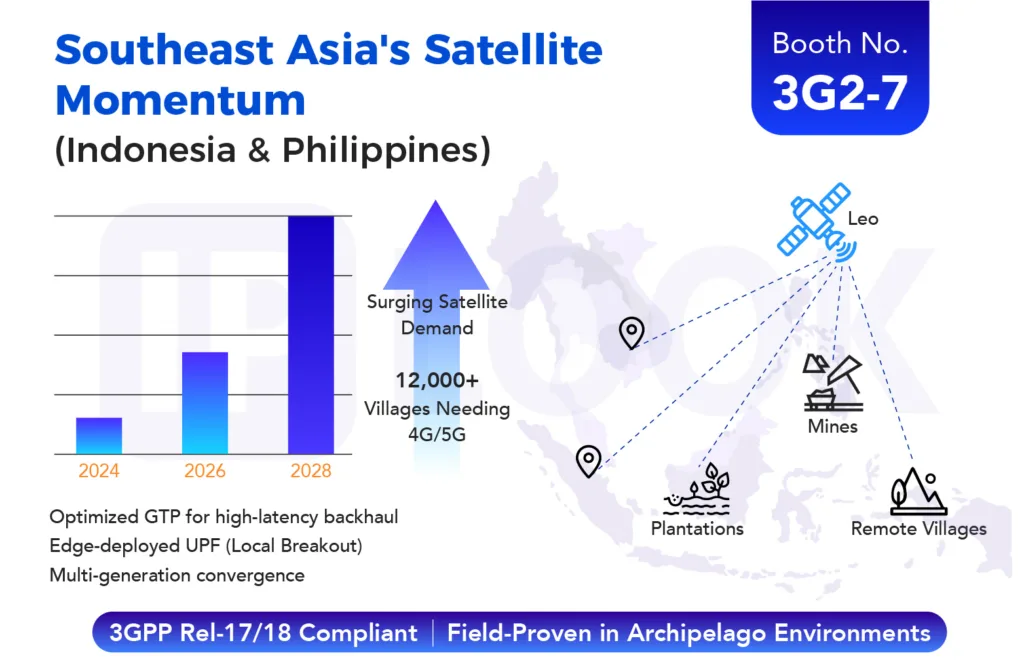
Southeast Asia’s geography presents a fundamental obstacle to terrestrial network expansion. With over 25,000 islands across Indonesia and more than 7,000 islands in the Philippines, fiber deployment is not merely expensive. In many locations it is physically impossible. Remote mining operations in Indonesia and isolated island communities in the Philippines continue to lack reliable broadband infrastructure. At the same time, the regional push for digital inclusion and industrial digitalization requires high-performance connectivity. This tension has driven an urgent shift toward satellite-to-ground 5G private networks.
A satellite link alone, however, is only as reliable as the core network that manages it. Traditional 5G cores were designed for terrestrial fiber environments with low latency and stable round-trip times. Satellite backhaul, particularly using geostationary orbits, introduces high latency, variable packet loss, and signaling complexity. Without a core engineered for these conditions, satellite-backhauled 5G networks cannot deliver the performance required for industrial private network use cases.
IPLOOK’s NTN-Converged Core
IPLOOK has developed an NTN-converged core specifically designed to bridge this gap. The solution addresses the technical challenges of non-terrestrial networks through two primary mechanisms.
First, the core optimizes GTP signaling for high latency orbits. It maintains session stability and efficient signaling exchange even when round-trip times exceed terrestrial norms by a significant margin. This ensures that the 5G network remains functional and responsive over satellite links, without the timeouts or degraded throughput that plague conventional cores.
Second, the core employs Local Breakout (LBO). Critical data traffic is processed at the edge rather than being sent over the satellite backhaul to a centralized cloud. For industrial use cases such as factory automation, surveillance analytics, or medical data processing, LBO reduces latency and conserves satellite bandwidth. Only essential signaling or non-local traffic traverses the satellite link. The result is higher performance for local applications and a substantial reduction in backhaul operating costs.
By combining these features, IPLOOK delivers a unified, satellite-optimized architecture. Regional operators can manage both fiber connected and satellite-backhauled sites from a single core platform. This unified approach lowers total cost of ownership (TCO) and simplifies network operations relative to disjointed terrestrial and satellite systems.
Market Impact in Southeast Asia
The implications for Southeast Asia are material. Remote mining sites in Indonesia can deploy private 5G networks to support autonomous haulage, real time environmental monitoring, and personnel safety systems. No fiber trenching is required. The satellite backhaul carries only necessary data while local breakout keeps control traffic on site.
In the Philippines, island hospitals can adopt telemedicine and AI-enabled diagnostic tools without waiting for multi-year fiber projects. A satellite-to-ground private 5G network provides secure, low-latency connectivity for critical healthcare applications. Similarly, small-port logistics hubs across the archipelago can implement container tracking, automated crane control, and real time inventory management using a private 5G network backhauled by satellite.
Government digital inclusion programs also stand to benefit. Millions of citizens in remote and island areas remain unconnected. Satellite-to-ground 5G private networks, deployed at community or enterprise level, can close the last mile gap more rapidly and cost effectively than terrestrial expansion.
Beyond Connectivity: Total Cost of Ownership
The business case for satellite-to-ground 5G rests not only on reach but on economics. Fiber deployment across thousands of islands requires undersea cables, landing stations, and ongoing maintenance that is often logistically prohibitive. For many applications, the TCO of a satellite-backhauled private 5G network is significantly lower. IPLOOK’s NTN-converged core further reduces TCO by eliminating the need for separate core systems for satellite and terrestrial sites. Operators can reuse the same core infrastructure, management interfaces, and operational processes across their entire footprint.
Event Presence at ATxSG 2026
IPLOOK will present this solution at ATxSG 2026 in Singapore. Attendees can visit Booth 3G2-7 from May 20 to May 22 to discuss satellite-to-ground 5G private network deployments. The booth will feature technical briefings on GTP optimization for high-latency orbits and local breakout architectures. Regional operators, enterprise customers, and government agencies are invited to explore how IPLOOK’s NTN-converged core can turn the archipelago challenge into a practical connectivity reality.
Conclusion
Southeast Asia’s geography does not have to be a barrier to digital inclusion or industrial modernization. Satellite-to-ground 5G private networks, powered by a purpose-built core, offer a viable alternative to terrestrial fiber in island environments. IPLOOK’s NTN-converged core provides the essential optimizations for signaling and edge traffic breakout that make these networks performant and economical. As the region continues to push for digital transformation, satellite-backhauled 5G will play an increasing role, and IPLOOK is ready to support that transition with proven core infrastructure. We cordially invite you to meet us at ATxSG 2026, Booth 3G2-7 in Singapore from May 20 to 22.