
You often see 5G Investments not give the expected return because companies miss how their choices really matter. You might see a difference between what the technology can do and what businesses say about it. Promising too much can make people expect things that will not happen and lead to disappointment. Slow market adoption also hurts your profits. If you ignore how these things really affect you, you will not reach your goals.
Key Takeaways
-
Make sure technical and business goals match. Teams should meet often to talk about what success means.
-
Use financial predictions that are realistic. Do not guess too high or you might lose money and feel let down.
-
Know how fast people will use new services. Customers may need time to try new things, so set goals you can really reach by looking at real market data.
-
Get ready for big costs and hard work to set up. Think about both the first money spent and the money needed to keep things running well. This helps you get better ROI.
-
Find what is missing in 5G products. Look at what businesses want besides just faster speed to get more enterprise customers.
-
Talk clearly with all teams. Make sure everyone knows why 5G is important. This helps build trust and support for spending money on it.
-
Spend money on training and learning. Give your team the skills they need to handle 5G technology well.
-
Keep making your plan better. Check your plans often and change them if needed to stay ahead and get the most ROI.
5G Investments: Where ROI Expectations Fail
Misaligned Technical and Commercial Goals
You might ask why 5G investments do not always work out. A big reason is that what the technology can do is not always what your business says it can do. People talk about faster speeds and lower latency, but these things do not always fix real problems. The technical team may want to upgrade the network. The commercial team may talk about making more money. If these teams do not talk to each other, customers get confused. This makes it hard to show clear ROI. Both teams need to agree on what success means. If they do not, your 5G investments may not help your business.
Tip: Make your technical and commercial teams meet a lot. This helps everyone know what the business really needs from 5G investments.
Overoptimistic Financial Projections
Many 5G investments start with big dreams. Companies think they will make a lot of money fast. But these guesses are not always right. In the mobile world, people often hope for too much. Here are some reasons why these guesses can hurt your ROI:
-
Companies think data use will grow fast, but it grows slowly.
-
Some guesses say mobile data may stop growing or grow just a little.
-
If you buy more spectrum or build more networks because of these hopes, you may have too much and not enough people using it.
If you only plan for the best, you may be let down. Your business could spend more than it makes, and your ROI gets worse. You should use real numbers, not just hopes, when you plan.
Market Uptake vs. Projections
You might think if you build a 5G network, people will use it right away. That does not always happen. Many 5G investments fail because people do not use new services as fast as you think. Your business may start new things, but customers may not see why they need them. Slow use means your ROI takes longer to show up. You may also have to fight other companies who offer the same things. If your business is not special, you may not reach your goals.
-
Customers wait to see if 5G is worth the money.
-
Some businesses do not tell customers why they should switch.
-
If you do not solve real problems, your 5G investments may not work.
You need to match your plans with what is really happening in the market. This helps you set goals you can reach and makes your ROI better.
High Costs and Deployment Challenges
Infrastructure and Integration Expenses
Building a 5G network costs a lot of money. You have to pay for spectrum, new hardware, and building sites. 5G needs more sites and special gear than older networks. You also need to connect new systems to old ones. This makes things cost more and slows you down.
-
Setting up a private 5G network in a big factory can cost from USD 550,000 to over USD 6 million. The price changes based on the technology you pick.
-
You keep paying for maintenance after you finish building.
-
Small companies think these costs are too high. They may wait to invest until prices go down.
Note: Spending a lot at first and paying for upkeep can slow down private 5G networks. If you do not get fast results, it is hard to say the cost is worth it.
It is even harder to build 5G in the countryside. It costs more to put 5G outside cities, even if the government helps. You need skilled workers and supplies, but there are not enough. Other industries want these things too, so you have to wait longer.
Operational and Maintenance Burdens
After you build your 5G network, you have to keep it working well. Running and fixing the network takes time and money. You need lots of small antennas and base stations because 5G does not go far. This makes your job harder, especially in busy cities.
-
Most businesses spend less on upkeep after they get private 5G. About 86% save money.
-
Around 60% save at least 11% each year on running costs.
-
Predictive maintenance can stop 25% to 30% of surprise breakdowns.
Rules and laws make things harder too. You need to get spectrum and follow strict rules. High-frequency bands are hard to get and cost a lot. These things make it tough for many businesses to use 5G.
You also have to fix technical problems. You must connect new 5G systems to old equipment. If you do not fix these problems, your network might not work right. Using lots of antennas and base stations makes things more complicated and expensive.
Tip: Plan for both the first costs and the money you will keep spending. You can get better ROI if you control these costs and fix problems early.
Value Proposition Gaps in 5G Investments
Limited Appeal Beyond Consumers
Some people think 5G will change every business. But most 5G investments only focus on regular consumers. Companies mostly sell faster speeds to smartphone users. This leaves out many enterprise customers who want more than speed. It is important to know what businesses really want from 5G.
Many enterprises notice gaps in the value of 5G. These gaps make it hard to show why a business should invest. The table below lists reasons why many companies do not use 5G:
|
Gap Type |
Percentage of Enterprises |
Description |
|---|---|---|
|
High Costs |
43% |
Many enterprises think fixed wireless access (FWA) plans cost too much, so they want better prices. |
|
Insufficient Data Allowances |
38% |
This matters for data-heavy sectors, so they want unlimited speed-tier plans. |
|
Lack of Clarity on Network Slicing |
40% |
Enterprises do not understand network slicing benefits, so CSPs need to explain better. |
|
Relevance of Network Slicing |
37% |
Many enterprises feel network slicing does not fit their needs, showing a disconnect. |
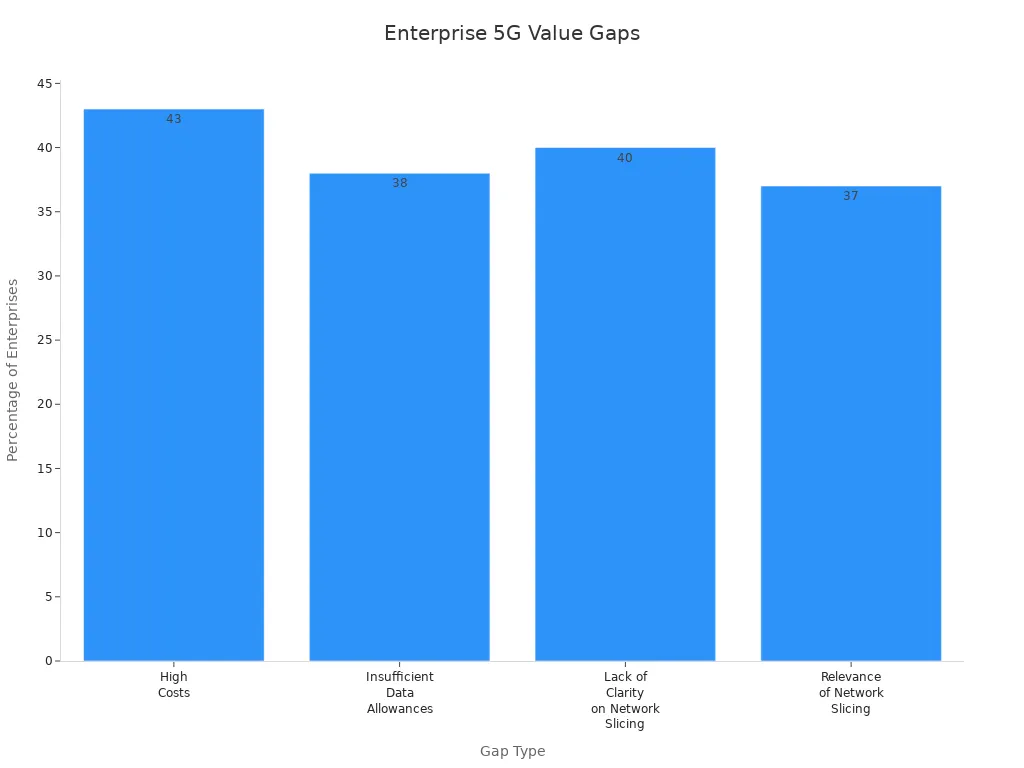
You can see that high costs and unclear benefits stop many businesses from using 5G. If you cannot explain how 5G helps, you will not succeed. These gaps cause doubt. When there is no clear reason to switch, adoption slows down. Businesses may wait for better deals or more details. This delay hurts your return on investment and makes success harder.
The “Build It and They Will Pay” Fallacy
Some people think if you build a 5G network, customers will come. This idea often leads to disappointment. Many businesses fall for this and expect quick results. But you need a strong business case to get good results.
-
Network operators wait to invest in 5G because they do not see a clear business case.
-
This waiting can make your business fall behind if others move faster.
-
Leaders often think there is no strong reason to spend on 5G now.
-
Many believe 5G needs big spending with no clear returns, so they wait.
If you do not have a clear plan, you might miss out on success. Value proposition gaps make it hard to show why 5G matters for your business. Without new ideas or clear benefits, you may not stand out. This uncertainty slows adoption and makes it hard to spend money. Your business needs to see real value before making big investments.
Tip: Focus on what makes your 5G offer special. Show how it solves real business problems. This helps you build trust and reach success faster.
Value proposition gaps make people unsure about what 5G can do for business. Without clear use cases, you may not see the adoption or ROI you want. Operators who do not fix these gaps often act slowly. This limits their advantage and makes it harder to win in a fast market.
Failure Factors in 5G ROI
Poor Adoption Rates
You might ask why 5G investments do not make as much money as hoped. One big reason is that not enough people use it. Many companies think users will switch fast, but this is rare. Checking how many people use 5G shows the real effect on your business. Most people, about 67.3%, use 5G for faster phones and more data. But regular people start using 5G slower than businesses do. Because of this, your business does not make money as quickly as you want.
-
Regular people use 5G first, but businesses are slower.
-
Many companies do not tell customers why 5G is good, so people wait.
-
If you do not show clear reasons, fewer people use 5G and you make less money.
When not enough people use 5G, your business cannot reach its money goals. You need to know what customers really want to get more people to use 5G and make more money.
Slow Network Rollout
Another reason for not making enough money from 5G is slow network rollout. You might think starting early helps, but going too fast can cause problems. Some companies started 5G before it was ready. This made them earn less from their old 4G networks. If the market is not ready, you cannot make new business plans or work with new partners. Not being ready stops you from making more money.
-
Missing technology and partners stop new ideas.
-
Only thinking about regular users limits your business.
If you do not plan your network rollout well, you miss chances to make more money. You should match your network plans with what the market needs to avoid problems.
Note: Rolling out too slowly or too quickly can both hurt your business. Make sure your network and partners are ready before you start.
Organizational Barriers
Problems inside your company can also stop you from making money with 5G. High costs, not enough skilled workers, and legal problems get in the way. Many companies cannot find enough people to run new networks. Getting legal permissions can slow down your projects. If the economy is not stable, it is hard to spend money on new technology.
|
Barrier Type |
Description |
|---|---|
|
Cost |
|
|
Skilled Labor |
Not enough experts to run and fix 5G networks. |
|
Legal Permitting |
Hard to get permission for new network sites. |
|
Economic Instability |
Unstable money makes big spending risky. |
You face these problems when you try to grow your business with 5G. About 40% of telecom companies say not having enough skilled workers is a big problem. High costs and legal issues also slow down your money growth. If you do not fix these problems, your business will not make as much money.
Tip: Train your workers and work with partners to solve these problems. This helps your business get more out of 5G and avoid failing.
How to Show ROI in 5G Projects
Set Clear, Measurable Objectives
You need to have clear goals to show ROI in your 5G projects. Many businesses do not know what success means. This is why they fail. You should pick goals that you can measure. These goals help you see progress and prove your investment is working.
Start by asking what you want to do. Do you want faster service? Do you want more customers? Do you want to spend less money? You must choose numbers that match your goals. For example, you can count new users after you start a 5G service. You can also check how much money you save with new technology.
When you pick goals you can measure, it is easier to see results. You can use these results to show ROI to your team and leaders. If you do not have clear goals, you will not know if your project works. You may waste time and money on things that do not help.
Tip: Write down your goals and look at them often. This helps you stay focused and change your plans if you need to.
Align Stakeholders and Messaging
Everyone in your business needs to agree on what is important. If your technical team and commercial team do not agree, you will have problems showing ROI. You must get everyone on the same page and make your message easy to understand.
Research shows good communication is very important. You should explain the value of 5G in simple words. Use facts and numbers to make your point. Change your message for each group. For example, your finance team wants to see how you save money. Your operations team cares about speed and how well things work.
Here is how getting everyone to agree and using clear messages can help ROI in 5G investments:
|
Aspect |
Description |
|---|---|
|
Clearly showing the ROI of next-gen wireless helps get support from everyone. |
|
|
Customization for Stakeholders |
Changing your talk for each group helps everyone agree. |
|
Comprehensive Business Case |
Using details and numbers shows the real benefits and supports ROI. |
When your teams agree, you have less confusion and fewer delays. You also build trust. Everyone knows what to expect and how to check success. This makes it easier to reach your goals and show value.
Note: Meet often and share updates. This helps everyone know what is happening. You can fix problems faster when you work together.
Realistic Cost-Benefit Analysis
You need to look at both costs and benefits before you invest in 5G. Many businesses make mistakes because they only see the good side. You need a real cost-benefit check to avoid being let down.
Start by writing down all the costs. This means equipment, setup, and keeping things working. Do not forget training and support. Next, look at the good things. These can be more customers, more money, or better service. You should use real facts, not guesses.
Smart CapEx tools can help you plan better. They use smart data and maps to help you decide. These tools help you cover more places and serve more people. You can also use smart programs to look at data. This gives you ideas for better choices.
Some companies use an Autonomous ROI Engine. This tool made project ROI better by 22% compared to old ways. It also helped businesses break even eight months sooner. The engine uses data from many places. It checks network performance and customer happiness. Smart models show what you need to fix. This helps you make better investments.
You must also watch out for bad data. If your data is wrong or missing, your check will not work. Good data rules help you keep your data clean and useful. This is important for ai adoption and making smart choices.
Tip: Use the right tools and check your data often. This helps you avoid mistakes and show ROI in your 5G projects.
You can get better at measuring by using clear numbers and checking results over time. This helps you see the value and supports ai adoption. When you focus on good data and connect your systems, you make better choices and reach your goals faster.
Focus on Data Quality and Integration
You might wonder why many 5G projects fail to show real ROI. One big reason is poor data quality. Another is weak integration between systems. If you do not trust your data, you cannot make smart choices. If your systems do not work together, you miss key insights. These problems make it hard to prove the value of your 5G investment.
Why does data quality matter?
You need good data to measure results. Bad data leads to wrong reports. You might think your project works when it does not. Or you might miss problems until it is too late. Clean, accurate data helps you track costs, see usage, and spot trends. This lets you fix issues fast and show clear ROI.
Why does integration matter?
You use many tools to run your network. If these tools do not share data, you get gaps. You might not see the full picture. For example, your billing system might not match your network data. This makes it hard to know if you make money. When you connect your systems, you get better insights. You can see how changes in one area affect another.
Tip: Always check your data for errors. Use tools that help you clean and match data from different sources.
Here are some reasons why poor data quality and weak integration hurt your ROI:
-
You waste money fixing mistakes.
-
You cannot spot problems early.
-
You miss chances to improve service.
-
You struggle to show leaders real results.
How can you improve data quality and integration?
-
Set data rules: Make clear rules for how you collect and store data. This keeps your data clean.
-
Use one source of truth: Pick one main system for your key data. This helps everyone use the same numbers.
-
Automate checks: Use software to find and fix errors fast.
-
Connect your systems: Link your network, billing, and customer tools. This gives you a full view of your business.
-
Train your team: Teach your staff why good data matters. Show them how to spot and fix problems.
|
Problem |
Why It Hurts ROI |
How to Fix It |
|---|---|---|
|
Bad data |
Wrong reports, missed issues |
Clean and check data often |
|
Systems not connected |
Gaps in insights, slow action |
Integrate key systems |
|
No data rules |
Confusion, wasted effort |
Set clear data standards |
You need strong data and good integration to prove your 5G project works. If you ignore these steps, you risk wasting money and missing your goals. When you focus on data quality and system integration, you build trust in your numbers. You can show clear, real ROI to your team and leaders.
Note: Good data and strong integration are not just tech problems. They are business needs. If you want your 5G investment to pay off, start with your data.
Building Sustainable 5G Investment Strategies

Invest in Internal Expertise
You need to build strong internal skills to make your 5G strategy work. Many companies fail because they do not train their teams. When you invest in learning, you help your staff understand new technology. This makes your strategy stronger. You can solve problems faster and avoid mistakes. You also keep your team ready for changes in the market. If you do not focus on expertise, your strategy will not last. You need people who know how to use 5G tools and data. This helps you get more value from your investment.
Tip: Set up training programs for your staff. Use workshops and online courses to teach new skills. This keeps your team sharp and supports your strategy.
Foster Cross-Functional Collaboration
You must get different teams to work together for a successful strategy. Many companies fail because their teams do not talk to each other. When you bring technical, commercial, and operations teams together, you build a stronger strategy. Each team sees the project from a different angle. This helps you spot risks and find better solutions. You also make sure everyone understands the goals. If you do not encourage collaboration, your strategy will miss key details.
-
Hold regular meetings with all teams.
-
Share updates and feedback often.
-
Use clear goals to guide your strategy.
|
Team |
Role in Strategy |
Benefit to Strategy |
|---|---|---|
|
Technical |
Builds the network |
Solves tech problems |
|
Commercial |
Finds business value |
Matches market needs |
|
Operations |
Runs daily tasks |
Keeps things working |
When you work together, you build trust and speed up progress. You also make your strategy more flexible. This helps you adapt to new challenges and reach your goals.
Continuous Improvement Approach
You need to keep improving your strategy to stay ahead. Many companies fail because they stop changing. When you use a continuous improvement approach, you check your strategy often. You look for ways to make it better. You fix problems early and try new ideas. This keeps your strategy fresh and strong. You also learn from mistakes and successes. If you do not improve, your strategy will fall behind.
Note: Set up regular reviews for your strategy. Use feedback from your team and customers. Try small changes and measure the results. This helps you build a strategy that grows with your business.
You build a sustainable 5G strategy by investing in expertise, fostering collaboration, and improving all the time. These steps help you avoid common failures. You make your strategy last and get more from your investment. If you want your 5G project to succeed, you must focus on these reasons.
Many 5G investments do not work well because teams do not talk. Teams need to set clear goals together. When technical and commercial teams agree, you make better plans. This stops you from giving up too soon. You should use key performance indicators to check progress. Financial checks and customer feedback help you see how things are going. These tools let you find problems early and fix them. If you want strong ROI, keep your plans simple and check them often. Start now by connecting your teams and tracking your 5G project’s value.
FAQ
Why do many 5G projects fail to meet ROI expectations?
You often see 5G projects miss ROI because teams do not align business goals with technical plans. Unrealistic forecasts and slow adoption also play a big role.
Why does slow market adoption hurt 5G investments?
Slow adoption means fewer users pay for new services. You wait longer to earn back your investment. This delay makes it hard to show strong ROI.
Why do high costs make 5G investments risky?
You spend a lot on new equipment, licenses, and setup. If you do not get enough users or revenue, you struggle to cover these costs. This risk lowers your ROI.
Why is clear communication important for 5G ROI?
When teams do not share goals or updates, you get confusion. Clear communication helps everyone understand what success looks like. This makes it easier to reach your ROI targets.
Why do businesses hesitate to invest in 5G?
Many businesses do not see clear benefits or use cases. High costs and unclear value make them wait. They want proof that 5G will solve real problems.
Why does poor data quality affect 5G ROI?
Bad data leads to wrong decisions. You might miss problems or waste money. Good data helps you track progress and prove your investment works.
Why is cross-functional teamwork key for 5G success?
You need different teams to work together. Technical, commercial, and operations teams each see different risks and solutions. Teamwork helps you spot problems early and reach your goals.
Why should you keep improving your 5G strategy?
The market and technology change fast. If you do not review and update your plan, you fall behind. Continuous improvement helps you stay on track and boost ROI.