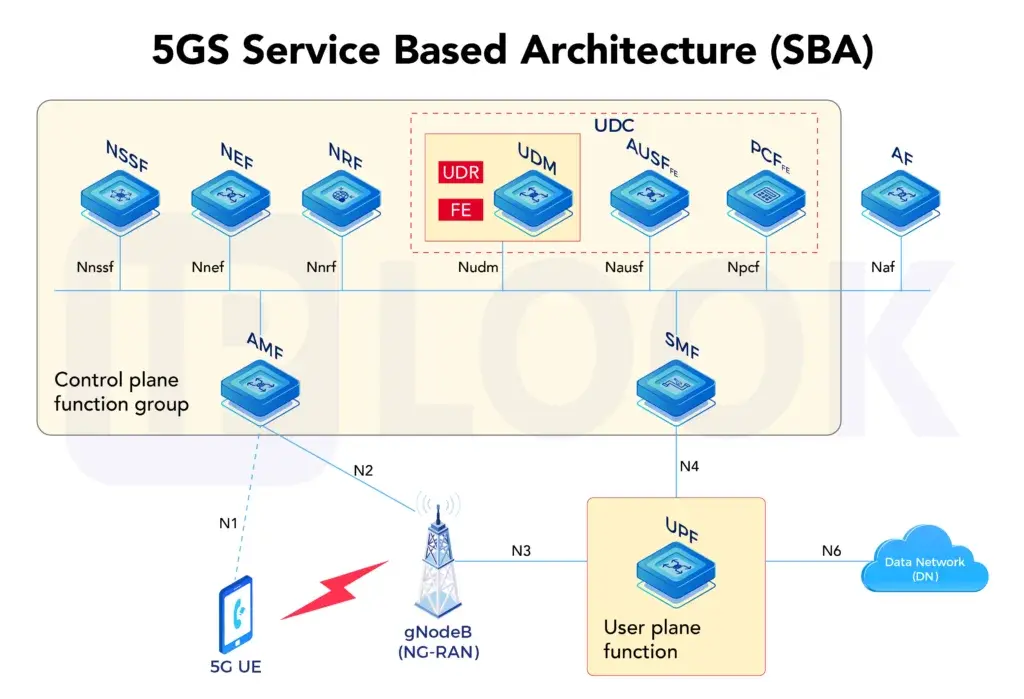
As the telecom industry evolves from 5G to 5G-Advanced, network operators and enterprises face a critical question: how to build a core network that can adapt to emerging use cases while supporting existing services? The answer lies in the Service-Based Architecture (SBA), the modular design that underpins 5G and becomes even more vital for 5G-Advanced’s next-generation capabilities.
Unlike traditional monolithic network architectures, 5GS SBA decomposes the core network into discrete, reusable network functions (NFs) — such as AMF, SMF, UDM, NEF, NSSF, and PCF — that communicate via standardized service-based interfaces. This modular approach is not just a technical detail; it is a strategic enabler for business agility in the 5G-Advanced era.
What Makes SBA So Flexible?
At its core, SBA replaces rigid, tightly-coupled network elements with a set of independent, service-oriented components. Each NF focuses on a specific function:
AMF manages access and mobility for end devices.
SMF handles session management and interacts with UPF to route user data.
UDM/UDR stores subscriber data and authentication credentials.
NEF securely exposes network capabilities to third-party applications.
NSSF orchestrates network slicing for diverse service types.
PCF enforces QoS and policy rules.
These NFs communicate over a common service bus, allowing operators to mix, match, and scale individual components without disrupting the entire network. This decoupling is the foundation of SBA’s flexibility, making it ideal for the diverse demands of 5G-Advanced.
SBA in Action: Powering 5G-Advanced Use Cases
5G-Advanced introduces new use cases like massive IoT, ultra-low-latency industrial automation, and API-driven enterprise services. SBA’s modularity lets operators tailor the core network to these needs without a full overhaul:
Massive IoT for Smart Metering: By customizing NSSF and AMF, operators can create dedicated network slices optimized for millions of low-power, low-throughput devices, ensuring efficient resource utilization and reliable connectivity.
Low-Latency Industrial Robotics: Reconfiguring PCF and UPF enables edge-based data processing, minimizing hop counts and delivering the sub-10ms latency required for real-time industrial control and robotic operations.
API Monetization & Enterprise Services: The NEF acts as a secure gateway, letting third-party developers and enterprises access network capabilities via APIs, opening new revenue streams for operators.
Network Slicing for Diverse Verticals: SBA’s granular control allows operators to deploy multiple logical networks on a single physical infrastructure, each optimized for specific industries — from healthcare to transportation — without compromising performance or security.
IPLOOK’s SBA Implementation: A Business Advantage
IPLOOK leverages SBA’s inherent flexibility to deliver 5G-Advanced core solutions that align with business goals, not just technical specifications. By breaking down the core into modular services, IPLOOK enables operators to:
Scale efficiently: Add or remove NFs to match traffic demands, avoiding overprovisioning and reducing costs.
Innovate rapidly: Deploy new services and slices in weeks, not months, to respond to market opportunities.
Future-proof investments: Seamlessly integrate 5G-Advanced features like AI-driven optimization, NTN (Non-Terrestrial Networks), and R18 enhancements without a forklift upgrade.
Conclusion
As we transition from 5G to 5G-Advanced, SBA is no longer optional — it is the architectural backbone that turns technical potential into business value. Its modularity, scalability, and service-oriented design let operators adapt to evolving market demands, monetize new use cases, and stay ahead in a competitive landscape.
Partnering with a vendor like IPLOOK, which has deep expertise in SBA implementation, ensures that your core network is a strategic asset that enables, rather than restricts, your 5G-Advanced business strategy.