
Comparing Connectivity Solutions for Rural Areas
Explore the key differences between fixed wireless and fiber-optic broadband.
| Features | Fiber-optic broadband | Fixed Wireless Access |
|---|---|---|
| Installation Process | Needs digging and costs more time and money | Easier and cheaper to set up |
| Reliability | Can stop working if the cable is cut | Very reliable with up to 99.99% uptime |
| Cost | Usually costs more for each megabit or gigabit | Often costs less than fiber |
| Speed Options | Good choices for businesses | Can give many gigabits of speed |
| Performance | Weather and other things can affect it | Point-to-point can work better in some cases |
| Latency | Low latency, usually between 1 ms and 5 ms | Higher latency, usually between 20 ms and 50 ms |
| Environmental Disruption | Less susceptible to environmental issues | More susceptible to environmental issues |
| Upgrade Cycles | Lasts 20 to 40 years with fewer upgrades | Needs upgrades every 5 to 10 years |
Decision-makers must pick between fixed wireless access and fiber-optic broadband for rural broadband. Fast internet can change lives in rural places. Only 66.8% of rural people have 100/10 Mbps high-speed internet. In cities, 97.8% have it. Fixed wireless internet is faster to set up than fiber internet. It uses networks that are already there. Fiber optic gives the fastest speed and can handle a lot of data. This is good for video streaming and 5g. People think about cost, how fast it can be set up, if the internet is reliable, how much area it covers, if it works with 5g, if it can grow, and if it is a good value for a long time. These things make people talk about fiber vs wireless. Both fiber internet and fixed wireless service want to help more people get internet. They also want to make sure the internet is ready for the future.
Key Takeaways
- Fixed wireless access can be set up very fast. It sometimes takes only a few days. This makes it great for rural places that need internet quickly.
- Fiber-optic broadband gives the fastest internet speeds. It can go up to 10 Gbps. This is good for people who use a lot of data.
- Cost is important to think about. Fixed wireless costs less to start. Fiber costs more at first but is cheaper to keep running later.
- Having good internet is very important in rural areas. Fiber does not get affected by weather much. It gives steady service.
- It is important to listen to the community. Leaders should talk to people to learn what internet they want and need.
- Funding programs like the Universal Service Fund can give money. These programs help pay for broadband in places that do not have good service.
- Using both fiber and fixed wireless together can help. This can cover more places and give better service in rural areas.
- Looking at the land and how many people live there is helpful. This helps pick the best technology for each community’s needs.
Rural Connectivity and Deployment Speed
Impact of Installation Speed
Getting internet set up fast is important for rural towns. People in these places often wait a long time for good internet. How quickly the internet is installed can change how soon families, schools, and stores get online. Fixed wireless access is known for being quick to set up. It uses towers and equipment that are already there. This lets people get new internet service in just a few days. Fiber-optic broadband takes a lot more time. Workers have to dig and put cables in the ground. Getting permits and building everything takes even longer. Some fiber projects can take many months or even years to finish.
- Fixed wireless access can be ready in just days.
- Fiber-optic broadband usually takes months or years to install.
- Planning and putting in fiber can take a long time because of permits and building work.
Towns that pick fixed wireless access often see results faster. They can get more people online sooner. Fiber gives very fast speeds but needs more time and planning.
Community and Economic Benefits
Getting fast internet helps in many ways. Students can join online classes from home. Health clinics can help patients with telemedicine. Local stores can sell to more people. When people get internet quickly, they can join the online world. Farmers can use smart tools to help with crops. Workers can find jobs they can do from home. These changes help towns grow and keep young people from leaving.
Quick setup also helps emergency workers. Police and fire teams can share news faster. Good internet helps keep everyone safe. The right technology can cover more places and support new things like 5g.
Policy and Funding Drivers
Many programs give money to help bring internet to rural places. These programs help pay for new networks so no one is left out. Leaders should know about the main ways to get funding.
| Program Name | Description | Funding Amount |
|---|---|---|
| Universal Service Fund | Helps low-income people, health clinics, schools, libraries, and hard-to-reach areas | $41.7 billion (2009-2017) |
| Connect America Fund | Gives money to ISPs for building in places without service | Part of the $41.7 billion |
| Rural Digital Opportunity Fund | Helps areas with slow internet speeds | Over $5.2 billion for 10 years |
| American Recovery and Reinvestment Act | First big investment in broadband | $7.2 billion |
| Broadband Technology Opportunities Program | Grants for building broadband projects | $3.3 billion |
| Community Connect Grant Program | Grants for internet in places with no service | N/A |
| Rural e-Connectivity Pilot Program (ReConnect) | Loans and grants for building internet | $6 billion to start, more money later |
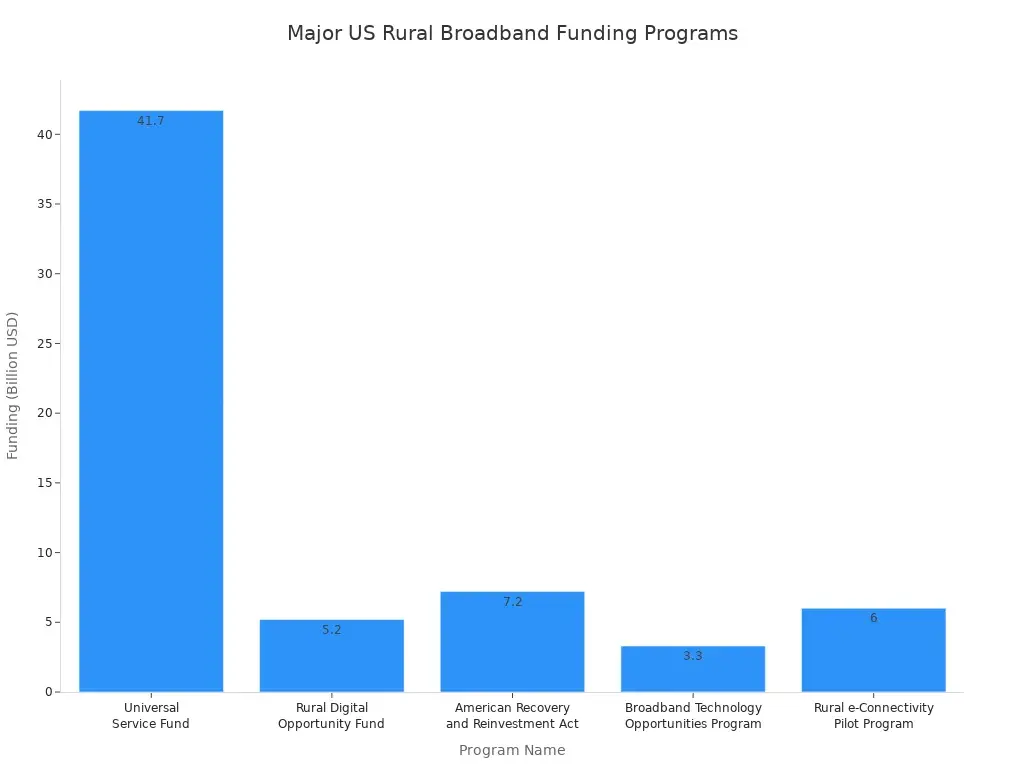
Federal laws like the American Recovery and Reinvestment Act and the Consolidated Appropriations Act gave a lot of money for internet. The ReConnect program and other grants keep helping new projects. These efforts help rural places get the internet they need for the future.
Fiber vs Wireless: Technology Overview
Fiber-Optic Broadband Basics
Fiber-optic broadband sends data using thin glass or plastic cables. These cables use light to move information very fast. Fiber-optic broadband gives high-speed internet with little delay. Many people pick fiber because it is good for streaming and online classes. It also helps people who work from home. Fiber networks reach homes and businesses with cables in the ground or on poles. These networks last a long time and work well.
Fixed Wireless Access Explained
Fixed wireless access uses radio signals to bring internet from a tower to a building. It does not need cables to go to every house or store. Instead, it connects people with wireless signals over short or long distances. Fixed wireless can use towers that are already there or new small antennas. It is good for places where putting cables is hard or costs too much. Many rural places use fixed wireless to get internet fast.
Suitability for Rural Areas
Rural areas have trouble getting internet because they are far apart and have fewer people. Fiber vs wireless is an important choice for these towns. The table below shows how the two are different:
| Feature | Fiber-Optic Broadband | Fixed Wireless Access |
|---|---|---|
| Installation Process | Needs digging and costs more time and money | Easier and cheaper to set up |
| Reliability | Can stop working if the cable is cut | Very reliable with up to 99.99% uptime |
| Cost | Usually costs more for each megabit or gigabit | Often costs less than fiber |
| Speed and Bandwidth Options | Good choices for businesses | Can give many gigabits of speed |
| Performance | Weather and other things can affect it | Point-to-point can work better in some cases |
Many rural towns use both fiber and fixed wireless. Fiber networks can be the main line, and fixed wireless can reach homes and farms far away. This helps close the gap for people without internet. Millions of people in rural areas use fixed wireless when fiber is not there. Wireless companies often work with local groups to cover more places. Cell phone companies also use fixed wireless to reach new customers.
Note: Fixed wireless access and fiber-optic broadband often work together. This mix brings fast and steady internet to more places and helps rural towns grow.
Cost, Speed, and Reliability Comparison

Installation and Maintenance Costs
People who make decisions look at costs first. Fiber-optic broadband needs workers to put cables underground or on poles. This job takes a lot of time and big machines. The first cost for fiber optic networks is high. But fiber optic cable lasts a long time and does not break easily, so fixing it costs less.
Fixed wireless access uses towers and antennas. Workers can put these up fast. It costs less to set up fixed wireless internet than fiber. How much it costs to keep working depends on the weather. Towers and antennas need to be checked often, especially after storms. Fixed wireless internet can reach homes without digging, which saves money in the country.
Note: Fiber optic cable costs more at the start, but is easier to fix. Fixed wireless access costs less to begin, but fixing it can cost more if the weather is bad.
Internet Speed and Latency
Internet speed and latency change how well things work online. Fiber-optic broadband gives fast internet with the same upload and download speeds. Many fiber optic networks can go up to 10 Gbps. Latency is low, usually between 1 ms and 5 ms. This means video calls are smooth, downloads are quick, and streaming works well.
Fixed wireless access gives good speed for people in the country. Download speeds go from 25 Mbps to over 100 Mbps. Upload speeds can be 10 Mbps to 50 Mbps. Latency is higher, usually between 20 ms and 50 ms. This can make gaming and video calls harder.
| Feature | Fixed Wireless | Fiber |
|---|---|---|
| Download | 25–100+ Mbps | 100–1000+ Mbps |
| Upload | 10–50 Mbps | 100–1000+ Mbps |
| Latency | 20–50 ms | <10 ms |
Fiber internet does not have problems like buffering or slowdowns. Most fiber cables are underground, so weather does not stop service. Fixed wireless towers are outside and can have more problems from weather.
- Fiber-optic broadband gives the same speeds up to 10 Gbps.
- Latency for fiber can be as low as 1 ms to 5 ms.
- Fixed wireless access gives download speeds from 25 Mbps to over 100 Mbps.
- Latency for fixed wireless is higher, from 20 ms to 50 ms.
Speed and Reliability in Rural Contexts
Speed and reliability are very important for people in the country. Fiber internet gives steady quality. Fiber optic cable does not lose signal or get messed up by weather. Fiber-optic broadband can handle lots of use and will work for a long time. Fixed wireless internet helps where fiber cannot go, but how well it works can change.
Studies show fixed wireless access can have trouble when many people use it or when the weather is bad. Fiber-optic broadband keeps speed and reliability steady. The table below shows the main differences:
| Metric | Fiber-Optic Broadband | Fixed Wireless Access |
|---|---|---|
| Speed | Consistent | Variable |
| Latency | Low | Higher |
| Environmental Disruption | Less Susceptible | More Susceptible |
| Signal Degradation | Minimal | Significant |
| Network Congestion | Rare | Common |
Things that change speed and reliability in the country are:
- Type of technology: Fiber optics, fixed wireless access, satellite, and DSL give different quality.
- Geography: Hills, trees, and distance can make networks weaker.
- First costs: High costs can stop better internet from being built.
- Weather: Bad weather can hurt how well the internet works.
Fiber optic cable gives high speeds and is reliable. It does not have buffering or slowdowns. Fixed wireless internet has more risks from weather. Fiber-optic broadband is not bothered much by interference and gives steady quality. Fiber optic networks can grow and are ready for the future.
Tip: Fiber-optic broadband gives the best quality for country internet. Fixed wireless access is fast to set up and costs less, but speed and reliability can change with weather and too many users.
Scalability and Long-Term Value
Network Expansion Potential
Fiber-optic broadband and fixed wireless access can help more people get internet in rural areas. Fiber projects in Washington use fiber-to-the-home to connect homes and businesses. This helps close the digital divide and gives strong internet for the future. Some places use both fiber and fixed wireless together. This mix helps reach hard-to-get areas. It makes sure more people can get broadband where fiber is tough to build.
Fixed wireless access uses new ideas like beamforming to make service better and reach farther. Local2U spent $3.5 million to grow fixed wireless in rural places. Fixed wireless can give fast internet over big spaces and different land without lots of cables. It can grow faster than wired networks. Providers can add new base stations and set up advanced equipment quickly. Both fiber and fixed wireless help build strong networks for rural towns.
Durability and Upgrade Cycles
Fiber-optic networks last a long time. Most fiber networks work for 20 to 40 years. Tier 1 fiber fails very rarely, about 1 in 100,000 times. Fiber needs fewer upgrades, so it is a strong choice for rural internet.
Fixed wireless access equipment does not last as long. Radios and electronics need to be replaced every five to seven years, sometimes up to ten years. This means fixed wireless needs more upgrades. Fiber can last over 30 years, but fixed wireless needs updates in less than ten years. Public officials must think about keeping networks strong. Technology and weather can change, so upgrade times may change too.
“Radio equipment or electronics typically need replacement every five to seven years, or up to ten years, indicating a significantly shorter lifespan compared to fiber assets.” — Jonathan Chambers
Regulatory and Environmental Factors
Rules and nature problems affect both fiber-optic broadband and fixed wireless access. The table below shows some main issues for fiber:
| Challenge Type | Description |
|---|---|
| Uncertainty around federal funding | Federal money for rural internet is not certain, which makes things hard for providers. |
| Deployment complexities and costs | Small providers face high costs and tough jobs when putting fiber in places with few users. |
| Workforce shortages | There are not enough workers. About 180,000 new workers are needed in the next ten years. |
Fixed wireless access has its own problems:
- Hard rules to follow
- Long environmental checks
- Not sure about federal money
- Lots of environmental tests needed
- Problems with needing special rule exceptions
- Delays from long environmental reviews
- Few people means less money back
- High costs to build networks
- Maintenance costs can be more than what users pay
- Questions about the BEAD program
Both fiber and fixed wireless must get past these problems to help rural areas. Providers need to plan for rule changes and nature issues to keep networks good for a long time.
Evidence from the Field: Case Studies
Fixed Wireless Access ROI in Rural Regions
Fixed wireless access works well in rural areas. Providers use towers and antennas to cover more places fast. This way, they spend less money and finish quicker. In Oklahoma, a provider got hundreds of homes online in under two months. The town saw good changes right away. Students could join online classes. Farmers used smart tools to grow more crops. The network worked with 5g and could be upgraded later. Service providers spent less to run the network than fiber internet projects. Fixed wireless access gave most people what they needed, especially where fiber could not be installed. The network was reliable and helped close the digital divide.
Fiber-Optic Broadband Challenges in Low-Density Areas
Fiber internet has problems in places with few people. Providers must buy costly equipment and hire workers to put cables over long distances. It takes more time because workers cross hills, rivers, and forests. Bad weather can break cables and cost a lot to fix. Rules and permits also slow things down. Land ownership and permits cause delays. Small towns find it hard to get fiber internet because of these problems.
- High costs for installation because lots of resources are needed.
- Long times to set up because of tough geography and distance.
- Cables can be damaged by weather and nature.
- Rules about land and permits make things slower.
Even with these problems, fiber internet is very reliable and works well. It gives fast and steady connections. But the challenges make it tough for fiber to reach every rural home.
Hybrid Approaches and Partnerships
Many rural towns use both fiber and fixed wireless to get better internet. Providers mix fiber internet with fixed wireless access to build strong networks. This helps connect clinics, schools, and homes that fiber alone cannot reach.
Sky Fiber shows a good hybrid model. It uses fiber and next-generation fixed wireless access (ngFWA) to bring broadband to rural places. This way, more people get online, like clinics and students who need internet.
Hybrid networks give fast services and cost less to run. Providers can serve more people and earn more money. Cable companies put fiber deeper in their networks but keep coaxial for the last part. Federal money helps these projects in rural and underserved places. Fiber makes internet faster and more reliable than old cable.
- Cable companies put fiber deeper in their networks but keep coaxial for last-mile delivery.
- This plan helps rural and underserved places with federal money.
- Fiber makes internet much faster and more reliable than old cable.
Hybrid solutions help rural towns get past the limits of each technology. They cover more places, work better, and make sure everyone gets good internet.
Deployment Decision Framework
Assessing Community Needs
Leaders need to know what the community wants. Every rural area faces different problems and has different goals. People in the town should help decide which broadband is best. Surveys, meetings, and workshops let everyone share their thoughts. This builds trust and helps people work together.
A communication infrastructure index shows if a town is ready for new networks. It checks if internet is available, affordable, reliable, and used by many people. States use these tools to decide where to spend money and support new ideas. Offices and grant programs help broadband projects. The American Rescue Plan Act and the Infrastructure Investment and Jobs Act give billions of dollars for expansion.
Checklist for Assessing Community Needs:
- Ask people about their internet experience.
- Hold meetings to hear concerns and ideas.
- Use surveys to get data on speed and reliability.
- Check the communication infrastructure index for maturity.
- Look at state and federal funding opportunities.
Balancing Speed, Cost, and Reliability
Picking between fixed wireless access and fiber-optic broadband means looking at speed, cost, and reliability. Each technology has its own benefits. Leaders must compare these things to find what works best.
Service availability is very important. Leaders should check which providers serve the area. Online tools and local feedback help find options. Speed and data caps change how networks work. Advertised speeds may not match real-life experience. It is important to ask about actual speeds and any limits.
Prices and fees can change over time. Contracts may have hidden costs or price increases after the first year. Customer service matters, especially in rural areas where outages can happen. Good support keeps networks running well.
Key Questions for Balancing Speed, Cost, and Reliability:
- Which providers offer service in the area?
- What are the real speeds and data caps?
- Are there hidden fees or price changes?
- How reliable is customer support?
- Does the technology support future needs like 5g?
Aligning Technology with Stakeholder Goals
Broadband projects work best when they match what people want and follow policy rules. Leaders must talk to residents, businesses, schools, and local officials. Outreach makes sure policies and funding help real needs.
A clear policy framework sets goals and responsibilities. Planning and capacity building guide investments and show what success looks like. Grants and loans help projects and keep networks strong. Program evaluation helps leaders learn from past efforts and improve future plans.
| Method | Description |
|---|---|
| Stakeholder outreach and engagement | Talking to many people to make sure policies and funding help the community. |
| Policy framework | Setting clear goals and responsibilities for broadband deployment to guide efforts. |
| Planning and capacity building | Making state and local broadband plans to set goals and guide investments. |
| Funding and operations | Giving grants and loans to support broadband projects and keep them working. |
| Program evaluation and evolution | Checking how programs do to help future actions and change strategies for broadband deployment. |
Leaders must use this framework to compare fiber-optic broadband and fixed wireless access. They should match technology choices with community needs, budget limits, and long-term goals. This process helps build networks that support growth and keep rural areas connected.
Tip: A strong deployment framework makes sure every step, from community input to policy alignment, leads to better broadband for rural communities.
Decision-makers know fiber gives very fast speeds and low delay. It can handle lots of data for many years. Fixed wireless is quicker to set up and costs less at first. Each technology works best for different rural places. Leaders should look at what their town needs most. They should talk to many people and use funding programs like the Universal Service Fund or BTOP:
| Program Name | Description | Funding Amount | Impact |
|---|---|---|---|
| Universal Service Fund | Helps low-income customers, healthcare providers, schools, libraries, and high-cost areas | $41.7 billion (2009-2017) | Brought broadband to over 5.5 million locations |
| Broadband Technology Opportunities Program (BTOP) | Paid for broadband projects for homes and public places | $3.3 billion | Connected 14,149 homes and businesses and about 26,000 public institutions |
A clear plan makes sure money is spent wisely and can grow later.
FAQ
What is the main difference between fixed wireless access and fiber-optic broadband?
Fixed wireless access sends internet using radio signals from towers. Fiber-optic broadband moves data through cables made of glass or plastic. Fiber gives faster speeds. Fixed wireless is quicker to set up and can reach faraway places.
Which technology installs faster in rural areas?
Fixed wireless access is faster to install. Providers use towers and antennas that are already there. Fiber-optic broadband needs digging and putting cables in the ground. This takes more time and work.
How do costs compare between fixed wireless and fiber?
Fixed wireless access costs less to put in. Fiber-optic broadband needs more money for equipment and workers. Fiber costs less to fix over time. Fixed wireless may need new parts more often.
Which technology provides better reliability?
Fiber-optic broadband is very reliable. It does not have problems from weather or interference. Fixed wireless access can stop working during storms or if too many people use it. New systems help fixed wireless work better.
Can both technologies support future internet needs?
Both technologies can grow as more people need internet. Fiber networks last a long time and are easy to upgrade. Fixed wireless access can change fast with new equipment. It can use features like 5G.
Is fixed wireless access suitable for all rural locations?
Fixed wireless access works in most rural places. It helps where fiber is hard to build. Some areas with hills or thick trees may need more towers or a mix of technologies.
What are hybrid broadband solutions?
Hybrid solutions use both fiber-optic broadband and fixed wireless access. Providers use fiber for main lines. Fixed wireless connects homes and farms that are far away. This plan covers more places and makes service better.
How do policy and funding programs affect technology choice?
Policy and funding programs give money for broadband projects. Leaders use grants and loans to build networks. The choice depends on what the town needs, how much money is available, and what the programs ask for.