Strong internet helps people learn, work, and talk to others. FWA Network growth brings big changes around the world. It can reach places where fiber or cable cannot go. In many areas, FWA gets over 90% of new broadband users in the US. Latin America thinks its market will grow from $1.43 billion in 2023 to almost $14.77 billion by 2032. This fast growth shows why every community needs good, fast internet for progress and digital inclusion.
Key Takeaways
- FWA Network growth helps many more people get online, especially in places that do not have good internet. Fast internet from FWA technology lets people stream videos, learn online, and work from home. When the FWA Network grows, it helps the economy by making new jobs and helping local businesses. Digital inclusion is very important; FWA technology helps people who do not have regular broadband get online. Cities and country areas have different problems, so they need special plans for good internet. Small businesses do better with faster internet, so they get more customers and people know about them. Operators can look at data to find places that need better internet, so they can grow the network in the right way. Working with the community and sharing information in many languages helps people trust and use FWA Network services.
FWA Network Expansion Benefits
Better Connectivity
FWA Network expansion gives internet to millions more people. Many homes in places with poor service now get online because of this technology. The table below shows how FWA Network helps more people connect:
| Evidence Description | Details |
|---|---|
| Number of underserved homes connected | 40 million in the U.S. and hundreds of millions worldwide |
| FWA subscribers in rural regions | 40% of 8.4 million subscribers in India are in rural areas |
| Reach of FWA technology | Nearly half of U.S. rural households, with rapid growth |
Providers use FWA Network to give fast internet speeds. Three’s 5G FWA service has an average download speed of 150 Mbps. T-Mobile’s median download speeds went from 166.87 Mbps to 209.08 Mbps in one year. These speeds are as good or better than basic cable and fiber packages. People in faraway places can now stream videos, take online classes, and work from home.
More companies compete to offer broadband. They use hybrid network designs, mixing licensed and unlicensed spectrum to cover more areas. Open RAN standards help lower costs and make service better. Telecom operators build infrastructure and make partnerships to reach more homes. These steps make internet faster and more reliable.
Economic Opportunities
FWA Network expansion brings new jobs and helps local businesses. People can start online stores, offer remote services, and join the digital economy. In places without regular broadband, FWA technology connects homes and businesses. Using 5G FWA is important for cheap internet access. This helps schools, clinics, and shops grow.
Closing the digital gap brings economic benefits. Experts think GDP per person will go up by 2.5% by 2032. Developing countries will get the most benefits, adding about $3.3 trillion to global GDP. FWA Network helps people learn new skills and find better jobs.
Spectrum availability is important for FWA Network growth. Licensed spectrum gives higher power and longer range, so there is less interference. Mobile carriers use their current infrastructure and unused spectrum to expand services. Delays in spectrum auctions and competition for spectrum can slow growth, especially for smaller providers. When spectrum is available, FWA Network can reach more people and help the economy.
Digital Inclusion
FWA Network expansion helps people who are left out join the digital world. In places where fiber cables cannot go, FWA technology gives a flexible and cheaper solution. Companies like Tarana Wireless bring high-speed internet to communities that need it. This access is important for education, healthcare, and daily life.
Fixed Wireless Access is a key technology for connecting rural and underserved regions. It closes the digital gap and lets everyone join online activities. FWA technology improves internet for homes and businesses in places without regular broadband. The rollout of 5G FWA makes internet cheaper and more reliable.
Note: Digital inclusion means everyone can use the internet for learning, working, and connecting with others. FWA Network expansion makes this possible in places that need it most.
Spectrum management and fiber infrastructure help FWA Network grow in different regions. Licensed spectrum gives reliable service and longer range. Providers use energy-saving technologies and sustainable practices. These efforts connect more people and support digital inclusion.
Regional Challenges for FWA Network
Urban and Rural Needs
Cities and rural areas have different problems with internet. Cities have lots of people living close together. Rural areas have fewer people spread out. These differences make each place face special challenges.
Rural Infrastructure Limits
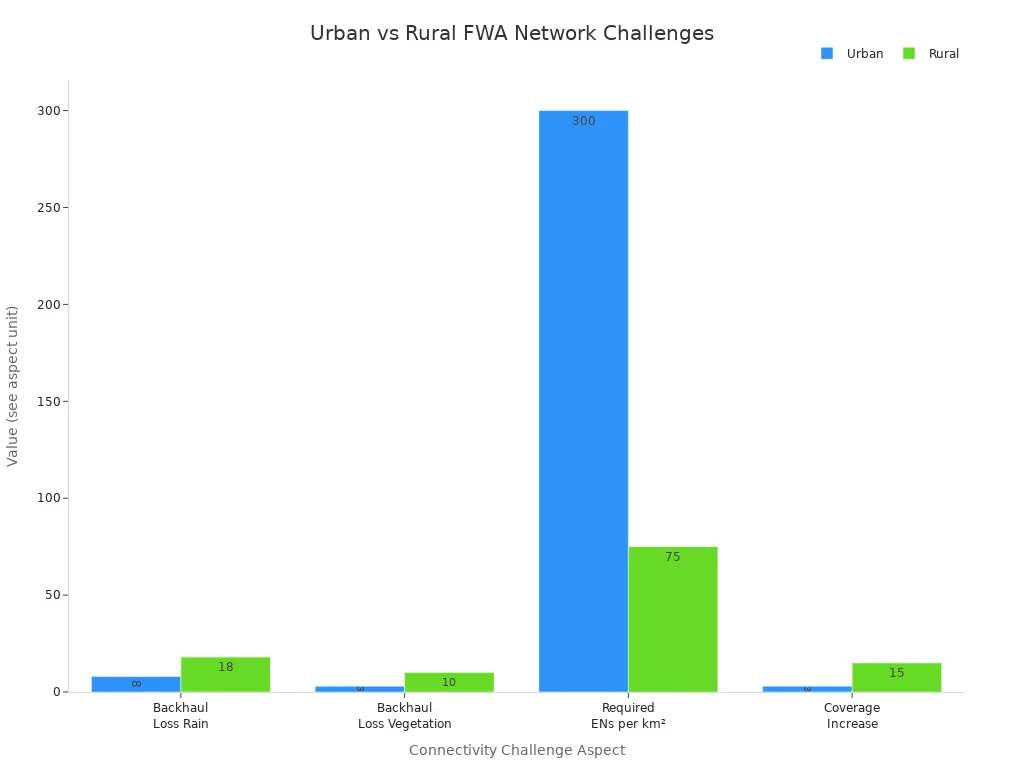
Rural areas often do not have the basics for fast internet. Building towers and connecting homes costs more because homes are far apart. Expanding broadband in rural places costs twice as much as in cities. Companies earn less money, so they may not invest. In rural America, 22.4% of people do not have fixed broadband with minimum speeds. License-free or shared spectrum can help lower costs for operators.
The table below shows how rural and urban places face different technical problems:
| Aspect | Urban Environment | Rural Environment |
|---|---|---|
| Backhaul Connectivity Loss | 8% from rain, 3% from plants | 18% from rain, 10% from plants |
| Service Capacity | 300–500 Mbps | Higher capacity with fewer ENs |
| Required ENs per km² | 300 ENs | 75 ENs |
| Coverage Reduction | 3% more infrastructure | 15% more infrastructure |
Operators like GeoLinks use smart ideas to reach rural homes. They use license-free spectrum and flexible networks. These steps help lower costs and connect more people.
Urban Capacity Management
Urban areas have their own problems. Many people live close together, so networks must handle lots of users. Operators need to manage spectrum and capacity well. They use more equipment in each area to keep speeds high. In cities, only 1.5% of people do not have fast broadband, but meeting demand is hard. Rain and buildings can cause signal loss, but it is less than in rural areas.
Companies like AT&T use licensed spectrum in cities to stop interference. Licensed spectrum gives higher power and better service. Operators must plan carefully to avoid slow networks during busy times.
Bridging the Digital Divide
The digital divide means some people have good internet and others do not. FWA Network growth helps close this gap. It brings fast internet to places where fiber cables cannot go. 5G FWA is a good solution for areas without regular broadband. It lets rural and underserved communities join the digital world.
- 5G FWA helps close connectivity gaps and lets people join the digital economy.
- It allows upgrades step by step, moving toward gigabit access for all.
- Delays in rural investment mean lost chances, so acting fast matters.
Operators face limits when growing networks. Getting licensed spectrum takes time and has many rules. Licensed spectrum is best for high power and long range. It also stops interference from other users. But the process can slow network growth. The main limit is how fast companies get permits and spectrum.
Note: When operators use smart plans for spectrum and capacity, they can reach more people and help close the digital divide. This work matters for every region, city or countryside.
FWA Network and Local Business Impact
Small Business Visibility
Small businesses must be easy to find online to grow. When a town gets better internet, more people engage with local shops online. This happens in many rural places after FWA Network arrives. For example, a bakery in Iowa saw increased local engagement after new wireless internet came. People found stores, restaurants, and repair shops faster. More online visits help small businesses get more customers and sell more.
Rural Digital Traffic Growth
Rural towns have fewer people using the internet regularly. Slow internet makes it hard for businesses to connect with customers online. After FWA Network comes, more people use the internet every day. Local businesses see more visits to their websites. In one Texas county, a hardware store’s website traffic doubled in six months after FWA Network started. This means more people can find and support local shops.
Service Page Performance
Good internet helps business websites load faster. When pages load fast, customers have a better experience. FWA Network gives rural and small-town businesses a chance to provide fast and easy-to-use websites. A flower shop in Nebraska made its website faster after getting FWA Network. The site saw more orders as a result.
Tip: Fast internet lets businesses update their websites and add new products or services. This keeps customers interested and helps the business grow.
FWA Network also helps businesses use online tools like maps, reviews, and booking systems. These tools make it easier for customers to find and pick local services. When more people get online, the whole community benefits. Small businesses become easier to find, and local economies get stronger.
Prioritizing FWA Network Investment
Data Analysis for Expansion
Operators want to know where people need better internet. They analyze usage and demand data to identify areas with high need for better service. If lots of people express interest in fast broadband, it means many want better service. Operators use this information to decide where to build next. They look for towns and neighborhoods with high demand. This helps them pick places where people really want new internet.
Companies save money by using this data. They do not build networks in places with low demand. Instead, they spend money where people show they need internet. This helps them get more customers and not waste money. Data analysis shows where to grow.
Aligning Build-Out with Community Needs
Operators match their building plans with the needs of each area. They assess what people in each area are looking for in internet services. If people need affordable wireless internet or rural broadband, operators know what to offer. They make packages that fit what people want. This makes their spending work better.
Tip: Operators can use data to tailor their services to local needs. This helps them show up meet community demands and get more customers.
Competitor Footprint Tracking
Operators watch where other companies build networks. They look at maps and reports to see new towers and coverage. This helps them not build where there is too much competition. They focus on places where many people want internet and not many rivals are there.
The table below shows how watching competitors helps with investment:
| Factor | Description |
|---|---|
| Topography & land use | Finding hills or forests before they cause problems. |
| Competitive landscape | Seeing where rivals build so they do not waste money. |
| Demographic shifts | Watching where people move so the network grows before too many people come. |
Operators use this to plan better. They build networks in places with fewer problems and less competition. They also watch if people move to new towns. This helps them build before too many people need internet.
FWA Network investment works better when operators use data and watch competitors. They reach more people, save money, and help towns get the internet they need.
Bridging Urban-Rural Divide
Multilingual Content
Multilingual content lets FWA Network providers reach more people. Many families speak different languages at home. Companies make websites, apps, and flyers in many languages. This helps everyone use digital services. It makes information clear for all people.
Mobile apps and telehealth tools with many languages show this works. These tools fit people’s cultures and are easy to use. People like using services in their own language. MIL and other groups build these platforms and teach digital skills. These steps help people learn and use FWA Network more.
Note: Multilingual content makes digital tools easier to use. It helps communities use technology and close the digital divide.
Outreach Material Improvement
Making outreach materials better means using simple words and pictures. Providers explain FWA Network in ways that are easy to understand. They translate guides into local languages so more people can read them. This is important where people do not know much about the internet.
Clear, accessible materials help people find answers about FWA services. This helps more people sign up for new internet services. Outreach that matches local language and culture builds trust. It helps more families join FWA Network.
Local Partnerships
Local partnerships are important for building trust and growing FWA Network. Providers work with schools, libraries, and community groups. They also talk to local news and government websites. These connections make FWA Network services more trustworthy.
- Governments in Latin America think fast internet is important for growth.
- Spectrum rules and laws help 5G grow faster.
- Public and private groups work together for big 5G projects in Brazil and Mexico.
- These actions help both city and country people get needed services.
These partnerships help reach people who do not use the internet much.
Tip: Working with local groups and making materials in many languages helps close the urban-rural gap. It makes FWA Network easier to access and trust, so more people use it.
Government Advocacy for FWA Network
Broadband Portal Accessibility
City governments help FWA Network reach more people. They make websites to share broadband news with everyone. These sites show where FWA Network is and how to join. Well-designed, accessible sites ensure more people find these resources and learn about new internet projects.
Local leaders share clear, relevant information about wireless broadband and FWA coverage on these sites. More people see the sites, so cities get more chances for money and help. Telecom companies and agencies notice cities that provide good information about broadband needs.
Schema Markup for Coverage Maps
Schema markup is special code for websites. It helps digital platforms read coverage maps more effectively. Governments add this code to show where FWA Network is available. When people look for information about internet coverage in their area, they get the right answers.
Here is an example of schema markup for a coverage map:
{
  "@context": "https://schema.org",
  "@type": "Map",
  "name": "FWA Network Coverage Map",
  "url": "https://city.gov/fwa-coverage",
  "areaServed": "Springfield, IL"
}
Tip: Schema markup helps people and businesses find FWA Network faster. It also helps governments show funders where service is available.
Analytics for Policy Evidence
Governments use analytics to prove FWA Network is needed. They count website visits, service inquiries, and sign-ups. These numbers show where people want better internet. High demand for fast broadband indicates a clear need for improved services.
Leaders use this data to ask for grants. They show proof to state and federal groups. Analytics help plan where to build new FWA Network zones. Leaders see which areas want internet most and start there.
| Metric | What It Shows | Why It Matters |
|---|---|---|
| Portal visits | Community engagement | Higher visits mean more need |
| Coverage map clicks | Interest in FWA Network locations | Guides expansion plans |
| Sign-up rates | Adoption of new services | Proves demand for funding |
Note: Analytics give proof for FWA Network projects. Good data helps win grants and get partners.
Government advocacy is important because it brings attention and money to FWA Network. Good websites and strong data help communities get what they need. When leaders use these tools, every region can get better internet.
Measuring Inclusion and Success
Domain and E-Commerce Growth
Communities want to see if better internet makes a difference. Watching domain and e-commerce growth helps answer this. When more people get online, local shops often make new websites. These websites help stores sell things and find more buyers. In one Midwest county, leaders saw 60% more new business domains after FWA Network came. Tribal areas in the Southwest also had more online stores and digital services. This shows that better internet helps people join the digital economy.
Digital Participation Correlation
Digital participation means how often people use online services. When internet gets better, more people look for local shops, jobs, and events online. In one tribal area, online engagement for local crafts doubled in a year after new wireless service. More online activity led to more online sales and business growth. Leaders use this data to show that better internet helps everyone, not just a few.
Note: More online activity and new websites mean people feel included online. This is a big sign of success for any region.
FWA Network Success Tracking
Leaders and operators need tools to check progress. Performance dashboards help them see how local digital services are doing. These dashboards show website visits, user activity, and service adoption rates. By looking at these numbers, leaders can see which places gain the most from new internet.
A table can help track important numbers:
| Metric | What It Measures | Why It Matters |
|---|---|---|
| Domain registrations | New business websites | Shows digital growth |
| E-commerce sales | Online transactions | Tracks economic impact |
| Digital traffic | Local online activity | Measures digital participation |
| FWA penetration rate | Homes with new internet | Shows reach of the network |
Operators compare these numbers to other regions. If a town’s digital activity grows faster than others, it means the internet rollout is working. Leaders use this proof to ask for more money or help. They also share good news to inspire other places.
Tip: Tracking these numbers helps communities see real change. It also helps leaders make smart plans for the future.
Measuring inclusion and success matters because it shows digital investments work. When leaders track growth and share results, they help every region move forward.
FWA Network growth helps people everywhere. People get faster internet, more jobs, and more ways to learn. Operators use smart devices like the Nokia FastMile 5G Receiver. These tools make networks better and cost less to run.
- More than half of new FWA devices in 2024 use 5G. North America and India are leading with these new devices.
- The market will grow by 26% in 2025. This shows many people want FWA and it helps close the digital gap.
Communities, businesses, and leaders need to work together. Everyone can help build a future where all people can connect and do well.
FAQ
Why does FWA Network growth matter for rural areas?
FWA Network brings fast internet to places without cables. Rural families and businesses can get better jobs, school, and healthcare. This helps close the digital gap.
Why do small businesses benefit from FWA Network expansion?
Small businesses get more customers when they are online. FWA Network gives them faster internet, so websites load quickly. This helps them connect with more customers and sell more.
Why is spectrum management important for FWA Network success?
Spectrum management lets providers use radio waves without problems. Good management means more people get strong, steady service. It also helps networks reach more homes.
Why should governments support FWA Network projects?
Governments help by giving money and sharing news about FWA Network. Their support brings better internet to more people. This helps the economy and makes life better.
Why does FWA Network help with digital inclusion?
FWA Network connects people who cannot get fiber or cable. Everyone can use the internet for school, work, and talking to others. This makes sure no one is left out.
Why do operators use data when planning FWA Network expansion?
Operators analyze community needs and demand signals. This data shows where people want better internet. This helps operators build networks where people need it most.
Why is tracking FWA Network impact important for communities?
Tracking shows if more people use the internet and start businesses. Communities see real change. Leaders use this data to plan new projects and ask for more help.