
Telecom operators feel more pressure to know the FWA ROI Timeline as more people sign up. Deloitte says that fixed wireless access will grow by about 20% each year in 2025 and 2026. The United States and India will have high demand. ABI Research thinks there will be almost 265 million FWA subscribers by 2029:
| Source | Growth Rate | Projected Subscribers by 2029 |
|---|---|---|
| ABI Research | 14% CAGR | Almost 265 million |
Operators need to change how they spend money on networks. They should focus on places and times that give the best returns. Smart choices about spending can help them grow faster and make more money.
Key Takeaways
- FWA is likely to grow by 20% each year. There may be 265 million subscribers by 2029.
- Knowing ROI helps operators spend money wisely. It also helps them avoid big mistakes.
- Important numbers like Payback Period and ARPU show if FWA projects work well.
- Industry data shows FWA can be quicker and cheaper to set up than fiber networks.
- Real-life stories show FWA gives fast internet without high prices.
- Operators should care about customer experience. This can lower churn and help more people sign up.
- Automation and analytics help operators make networks work better. They also help improve ROI.
- Marketing and partnerships help operators find new customers. This helps them grow their subscriber numbers.
Understanding FWA ROI
ROI Definition for FWA
Operators ask why ROI matters for fixed wireless access. ROI shows how much profit a company makes compared to what it spends. For FWA, ROI tells how fast and well operators get back their costs from network setup, equipment, and running the service. This number helps leaders see if their FWA projects are good for their money.
Knowing ROI for FWA is important because it helps operators spend wisely. Operators want to see if their money will come back soon. They also check if FWA can match other broadband choices. A clear ROI meaning helps companies set goals, watch progress, and change plans if needed. When operators know their FWA ROI Timeline, they can plan to grow and avoid big mistakes.
Note: ROI for FWA is not only about money spent. It also counts time, customer happiness, and market share. Operators who track ROI can find problems early and fix them before they get worse.
Key ROI Metrics
Operators need to know which numbers matter most for FWA ROI. These key metrics help explain why some FWA projects do well and others do not:
- Payback Period: This shows how long it takes for the investment to pay itself back. Shorter times mean quicker returns.
- Net Present Value (NPV): NPV tells the value of future profits in today’s dollars. If NPV is positive, the project should add value over time.
- Internal Rate of Return (IRR): IRR shows the yearly return expected from the FWA investment. Higher IRR means better chances.
- Average Revenue Per User (ARPU): ARPU tracks how much money each subscriber brings in. Higher ARPU can make the FWA ROI Timeline faster.
- Churn Rate: This shows how many customers leave the service. Lower churn rates keep revenue steady and improve ROI.
- Customer Acquisition Cost (CAC): CAC tells how much it costs to get each new subscriber. Lower CAC means growth is more efficient.
Operators who watch these metrics can see why some plans work better than others. They can also spot trends and make changes before problems get big. Tracking the right metrics helps operators reach their goals faster and with less risk.
FWA ROI Timeline Benchmarks

Industry ROI Timeline Data
Industry benchmarks help operators see why the FWA ROI Timeline matters for planning. These benchmarks show how fast companies can get their money back and start making profits. Operators look at data from around the world and their own regions to compare progress.
- Global 5G FWA connections may grow by 358% by 2030. This big increase means operators can make money faster.
- 5G FWA is quicker and cheaper than fiber networks. Operators can set up FWA faster and spend less, which makes the FWA ROI Timeline shorter.
- FWA can be up to ten times faster than 4G. This helps it compete with other broadband and brings in more customers.
- Building fiber takes a lot of time and money. FWA lets operators cover more places quickly, especially in growing areas. This means they can make money sooner and pay back costs faster.
- The FWA market could reach $670 billion by 2034. Operators can earn more by using extra spectrum and giving more people internet.
- People want faster internet every year. Online services need more speed, so operators must offer better plans. FWA with 5G helps meet these needs and helps operators reach their money goals.
Operators use these benchmarks to pick where and when to invest. They want to know why the FWA ROI Timeline is important for their business. Benchmarks help them see what to expect and set good goals.
Operators who use industry benchmarks can avoid big mistakes. They can plan better and make smarter choices about building networks.
Real-World ROI Examples
Real-world examples show why operators should care about FWA ROI Timeline benchmarks. These stories help companies see what works and what does not. Operators learn from others and use this to make better plans.
| Aspect | Details |
|---|---|
| Deployment | Orange’s 5G FWA trial in Romania, the first in Europe. |
| Trial Setup | Two Samsung Fixed Wireless Access points using 26GHz spectrum, with 15 test customers. |
| Coverage | Achieved over 1km coverage from access points, delivering high-speed internet. |
| Performance | Average 3Gbps for four simultaneous users, with applications like 4K streaming and online gaming. |
| Results | Demonstrated fiber-like experience over wireless, with throughput measurements of 1Gbps at 1.2km. |
| Business Case Focus | Aimed to assess customer benefits and service quality to build a business case for FWA. |
Orange’s trial in Romania shows FWA can give a fiber-like experience without high costs or long waits. The trial used new technology to give fast internet to a big area. Operators saw good results and happy customers, which helped them make a strong business case.
Operators look at these examples to see why FWA ROI Timeline benchmarks matter. They see that quick setup and strong performance can bring faster profits. Real-world cases help operators feel sure about investing in FWA and setting clear goals for their own projects.
Real-world examples help operators learn from others. They can use smart ideas to make their own FWA ROI Timeline better and get more subscribers.
Factors Affecting FWA ROI Timeline
Deployment and Operational Costs
Deployment and operational costs decide how fast operators get their money back. If costs are high at the start, it takes longer to earn profits. Spending money wisely helps operators pay back faster. Operators need to know where their money goes so they can make good choices.
| Cost Category | Description |
|---|---|
| Infrastructure and Setup Costs | Big setups cost a lot, from £200,000 to £800,000. Small setups cost less, between £40,000 and £80,000. |
| Integration and Training Costs | Operators pay for system checks and training, about £1,350 for each unit. |
| Operational and Maintenance Costs | Each year, operators spend 15% to 20% of their first costs on upkeep and support. |
| Energy Costs | 5G networks use more energy than 4G, so bills go up. |
| Savings from Private 5G | Most companies save money after using private 5G. 86% spend less, and 60% save at least 11% each year. |
Operators see that big setup costs can slow profits. They also see that yearly maintenance and energy bills add up. But many companies save money with private 5G, which helps them earn faster. Planning well and watching costs help operators reach their goals sooner.
ARPU and Pricing
ARPU and pricing are important because they show how much money each customer brings. Higher ARPU means operators get their money back faster. Operators must pick prices and move customers to better plans.
| Metric | Value |
|---|---|
| Current Average ARPU | $82 |
| Target Average ARPU | $90 |
| Business Pro 250 Plan Price | $150/month |
| Subscriber Shift Required | 5 percentage points (from 10% to 15%) |
Operators try to get customers to pick higher-priced plans. They use special ways to help customers switch. Service must stay good so customers do not leave. When ARPU goes up, operators earn money faster and FWA looks like a better choice.
- Move customers to higher-priced plans.
- Use smart ways to help customers switch.
- Keep service good so customers stay.
Churn and Retention
Churn and retention rates show how many customers stay or leave. High churn means operators lose money and earn slower. Operators must keep customers happy to protect their income.
Operators watch churn to find problems early. They use rewards, good support, and strong service to keep customers. When more customers stay, operators get steady money and reach their goals faster.
Operators who work hard to keep customers can stop losing money and improve their FWA ROI Timeline.
Market and Competition
Market and competition change how fast operators get their money back. Operators need to know why these things matter. They feel pressure from other companies, new technology, and changing rules. Each thing can make them earn money faster or slower.
Operators pay close attention to technology. New technology makes networks better and faster. When networks get better, operators can give better service. People want fast internet and a strong connection. Operators who use new technology get more customers. This helps them reach their goals sooner.
Rules from the government are important too. Governments decide who can join the market and what rules to follow. Good rules help operators start FWA services quickly. They can build networks and help more people. Hard rules or delays can slow down their work. Operators must follow the rules to avoid trouble.
Prices and money are a big part of competition. Operators pick prices to get more customers. Lower prices can bring in new users fast. This helps them grow and get their money back sooner. But if prices are too low, they might not make enough money. Operators need to find the right price to win customers and still earn profits.
The table below shows how these things affect FWA ROI timelines:
| Factor | Influence on FWA ROI Timelines |
|---|---|
| Technology Evolution | Advances in technology enhance service reliability and speed, leading to quicker ROI. |
| Regulatory Environment | Policies can either promote or restrict market entry, affecting investment returns. |
| Pricing and Economics | Competitive pricing strategies can drive consumer adoption, impacting the speed of ROI realization. |
Operators also watch what other companies do. If one company starts a new plan or makes its network better, others must act fast. Quick moves help them keep their customers. If they move too slow, they might lose customers and wait longer for profits.
Operators need to study the market before making choices. They check how many people want FWA, what prices work, and what rules they must follow. They also see how many other companies offer the same thing. In busy markets, competition is hard. Operators have to work harder to be different.
Operators who know about market and competition can make better choices. They can change their plans, pick good prices, and use new technology to reach their goals faster.
Operators who stay ready and can change plans can turn problems into good chances. They can get more customers and make money sooner. Market and competition show why some FWA projects do well and others do not.
FWA Subscriber Growth Trends

Global Subscriber Growth Forecasts
Subscriber growth for fixed wireless access keeps going up worldwide. Many people want fast and reliable internet. Wired connections are hard to build in some places. Experts think growth will stay strong for a few years. After 2026, growth will slow down as markets mature.
The table below shows how global 5G FWA subscriptions change:
| Year | Global 5G FWA Subscriptions (millions) | CAGR (%) | Total FWA Service Revenues ($ billion) |
|---|---|---|---|
| 2024 | 71 | – | – |
| 2030 | 150 | 23% | 46 |
This data shows 5G FWA subscribers will double by 2030. The compound annual growth rate (CAGR) is 23%. Operators see FWA as a big part of their plans. When more people sign up, markets get full. New subscriptions will slow after 2026. Operators must focus on keeping customers and good service.
📈 Note: Fast early growth helps operators get money back quickly. Long-term success depends on keeping customers happy as the market matures.
5G FWA Adoption Rates
5G technology is a big reason FWA adoption rates rise. Many people in rural and underserved areas need fast internet. 5G FWA gives them a quicker and cheaper way to get online. They do not have to wait for cables or fiber.
Key reasons why 5G drives FWA adoption are:
- 5G FWA gives high-speed internet without wired infrastructure.
- Users get gigabit speeds and low latency. This makes gaming and streaming possible in remote areas.
- 5G networks grow fast, so more people get reliable internet.
- 5G FWA uses cellular towers, which saves time and money.
- Operators pick 5G FWA to reach new customers faster than fiber.
The table below shows growth in 5G FWA subscriptions and revenues:
| Year | Global 5G FWA Subscriptions (millions) | CAGR (%) | Total FWA Service Revenues ($ billion) |
|---|---|---|---|
| 2024 | 71 | – | – |
| 2030 | 150 | 23% | 46 |
Operators see 5G FWA is a strong business choice. It helps them shorten the FWA ROI Timeline and reach more people with less money spent. As 5G networks grow, more homes and businesses will pick FWA for internet.
Regional Growth Patterns
Subscriber growth is not the same everywhere. Some regions grow faster because of strong demand or better infrastructure. Others grow slower as they wait for new technology.
The table below shows how regions compare in FWA market value:
| Region | 2023 Valuation (USD Billion) | 2032 Projection (USD Billion) | Growth Drivers |
|---|---|---|---|
| North America | 20.0 | 32.0 | High demand for reliable connectivity |
| Europe | 10.0 | 18.0 | More investments in digital infrastructure |
| APAC | 8.5 | 12.0 | More people and smartphone use |
| South America | 2.5 | N/A | More technology access brings opportunities |
| MEA | 2.36 | N/A | More technology access brings opportunities |
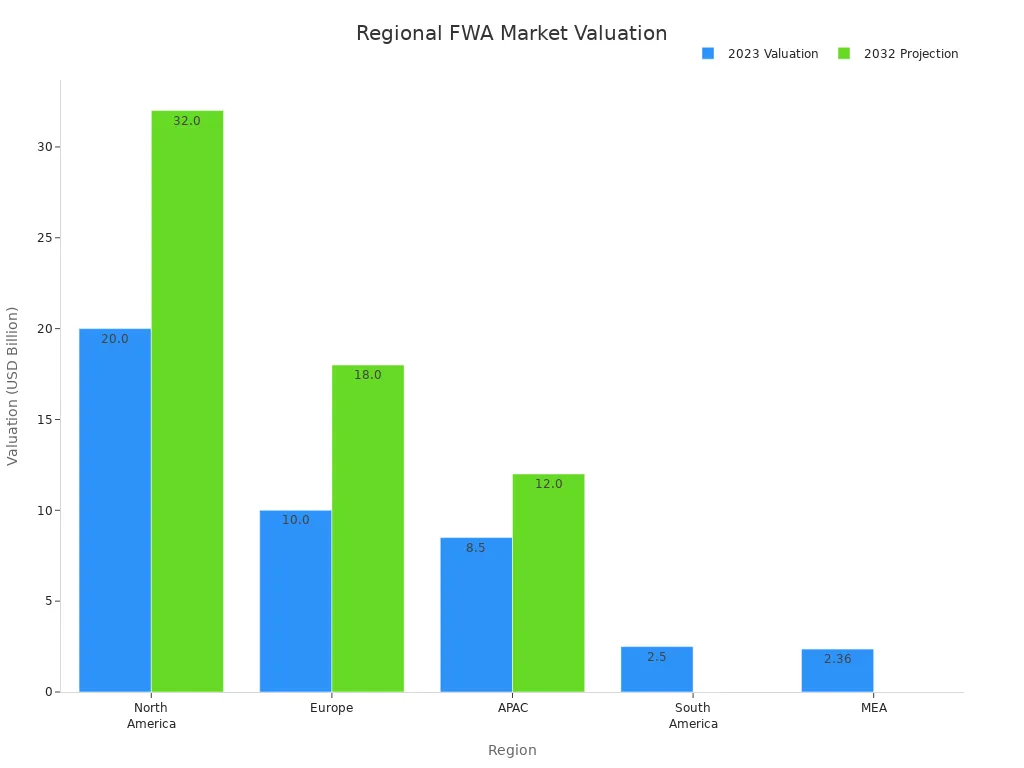
North America leads the world in FWA market value. People there want reliable internet for work, school, and fun. Europe follows, with countries investing in digital infrastructure. Asia-Pacific grows fast because more people use smartphones and need better internet. South America and the Middle East & Africa show promise as technology spreads.
🌍 Tip: Operators who know regional patterns can invest and market in areas with the most growth.
Subscriber growth trends show why FWA is important for operators. They must watch global forecasts, follow 5G adoption rates, and study regional differences. These trends help operators plan for the future and change strategies as the market shifts.
Influences on Subscriber Growth
Marketing and Acquisition
Marketing and acquisition help FWA get more subscribers. Operators learn about their audience to reach them better. They use data to find people who want fast internet. This helps them spend less money and get more customers.
- Operators use data to make groups of customers. This helps them get more value from their marketing.
- They look at their business to see what makes them better than others. This helps them show why their service is special.
- Marketing and customer experience work together. Operators learn what customers like and fix problems. This lowers the number of people who leave.
- Promotions are made for certain places and groups. Operators can focus on families, students, or businesses in different areas.
- Sponsoring local events helps people know the brand. People trust the brand more and sign up.
Operators who use these ideas grow faster. They know targeted marketing works better than general ads. Happy customers tell friends, which brings even more growth.
Network Coverage and Quality
Network coverage and quality help FWA grow in some areas. People want good internet where regular broadband is not available. Operators who build strong networks get more subscribers.
- FWA grows fastest where regular broadband is missing. Good coverage is important for getting new customers.
- New technology makes networks better. Better service quality makes FWA more attractive.
- FWA works best where there are no big obstacles. High network quality makes customers happy and helps growth.
Operators who invest in coverage and quality see their subscriber numbers go up. People pick FWA if it works well and stays reliable. Good coverage means fewer complaints and fewer people leave.
Pricing and Value
Pricing and value are important for FWA. People want good internet at a fair price. Operators who set smart prices and give value get more sign-ups and keep customers longer.
| Metric | Description |
|---|---|
| Customer Acquisition Cost | Shows how much it costs to get one new customer. It tells how well marketing works. |
| Average Revenue Per User | Shows how much money each customer brings in. It tells if customers see value in the service. |
| Operational Efficiency | Metrics like Mean Time To Repair (MTTR) help keep customers happy and staying longer. |
Operators watch these numbers to see if their prices work. Low costs mean they can grow faster. High revenue per user shows customers like the service. Fast repairs and good support keep customers happy and loyal.
💡 Operators who balance price and value know why customers join and stay. This helps them grow steady and stay strong in the market.
Competitive Dynamics
Competitive dynamics are the reasons why FWA subscriber growth goes up or down in different places. Operators need to know about these things to make good choices and stay ahead of others. When companies compete, they try to give better service, lower prices, and reach more people. This makes them come up with new ideas and helps more people get internet.
The table below shows important competitive dynamics that change how many people use FWA:
| Competitive Dynamic | Impact on FWA Subscriber Growth |
|---|---|
| Expansion of Smart Devices | More connected devices mean higher demand for FWA. Over 30 billion devices will connect by 2025. |
| Rising Consumer Expectations | About 80% of consumers want fast and reliable internet. Operators must meet these needs to win. |
| Competitive Pricing Strategies | Lower prices can boost customer sign-ups by 15%. Companies must balance price and profit. |
| Increased Focus on Rural Connectivity | One in four rural homes still lacks reliable broadband. FWA can fill this gap and grow fast. |
Why do these things matter? When there are more smart devices, families and businesses need more internet. People use phones, tablets, smart TVs, and even smart fridges. As more devices connect, the need for strong internet grows. FWA helps meet this need fast, especially where cables are slow to come.
People also want faster and better internet now. Most people expect good speeds and service. If a company cannot give this, customers will leave. This makes companies spend money on better technology and support. Operators who give what people want can get and keep more customers.
Lower prices help some operators grow faster. When companies make prices cheaper or have deals, more people sign up. Customer sign-ups can go up by 15% when prices are low. But operators must be careful not to lose money. The right price helps a company get noticed and still make money.
Rural areas are a big chance for growth. Many homes in the country do not have good internet. FWA can reach these places faster than fiber or cable. Operators who focus on rural areas can get new customers and grow quickly.
📊 Operators who know about these competitive dynamics can make smarter choices. They can pick the best markets, set good prices, and buy technology that helps customers.
Competitive dynamics show why FWA subscriber growth is different in each place. Operators who pay attention to these things can grow faster and reach more people.
Accelerating ROI and Growth
Deployment Optimization
Operators want to know why deployment optimization matters for FWA ROI and subscriber growth. Smart deployment helps them reach the right customers faster and use resources better. Operators can use several strategies to make their networks work harder and earn money sooner.
- Precision targeting helps operators find the best places and people for FWA. They look for areas where people need fast internet and where competition is low.
- Real-time analytics let operators see how customers use the network. They use AI to study data and make quick decisions. This helps them fix problems before customers notice.
- Intelligent automation allows operators to manage traffic without delay. Automated systems can spot congestion and adjust network settings. This keeps service quality high and customers happy.
- Full-spectrum intelligence means operators watch all types of network traffic. They can keep service smooth for everyone, even when many people use the network at once.
- Congestion management helps operators act before slowdowns happen. They can move traffic or add resources to busy areas.
Operators who use these tools can serve more customers with less waste. They get their money back faster because their networks run better and customers stay longer.
Customer Experience
Operators ask why customer experience is so important for ROI and growth. The answer is simple. Happy customers stay longer and tell others about the service. This brings in new subscribers and keeps revenue steady.
Enhancing customer experience is crucial for reducing churn and increasing subscriber growth in the FWA market. By improving service quality and addressing customer complaints, providers can foster loyalty and attract new subscribers, ultimately leading to faster ROI.
Operators focus on quick support, clear bills, and reliable service. They listen to complaints and fix issues fast. When customers feel valued, they do not leave for other providers. This reduces churn and helps operators reach their goals sooner.
Partnerships and Innovation
Operators want to know why partnerships and innovation matter for FWA success. Working with technology leaders and following national plans can boost both ROI and subscriber growth.
- 5G FWA technology gives operators faster speeds and better coverage. This attracts more customers and helps them earn money sooner.
- Aligning with national digital strategies opens doors to new markets and funding.
- Solutions like Huawei’s Easy FWAi improve how networks run and how customers feel. Intelligent resource scheduling keeps service smooth, while easy operations and maintenance save time and money.
- Operators in the Middle East and Central Asia show that government support, smart investments, and new technology can turn better connectivity into real economic value.
- Focusing on enterprise solutions and private networks helps operators find new ways to grow.
Operators who build strong partnerships and use new ideas can stand out in the market. They can reach more customers, keep them happy, and see faster returns on their investments.
---## Accelerating ROI and Growth
### Deployment Optimization
Operators want to know why deployment optimization matters for FWA ROI and subscriber growth. Smart deployment helps them reach the right customers faster and use resources better. Operators can use several strategies to make their networks work harder and earn money sooner.
– Precision targeting helps operators find the best places and people for FWA. They look for areas where people need fast internet and where competition is low.
– Real-time analytics let operators see how customers use the network. They use AI to study data and make quick decisions. This helps them fix problems before customers notice.
– Intelligent automation allows operators to manage traffic without delay. Automated systems can spot congestion and adjust network settings. This keeps service quality high and customers happy.
– Full-spectrum intelligence means operators watch all types of network traffic. They can keep service smooth for everyone, even when many people use the network at once.
– Congestion management helps operators act before slowdowns happen. They can move traffic or add resources to busy areas.
Operators who use these tools can serve more customers with less waste. They get their money back faster because their networks run better and customers stay longer.
### Customer Experience
Operators ask why customer experience is so important for ROI and growth. The answer is simple. Happy customers stay longer and tell others about the service. This brings in new subscribers and keeps revenue steady.
> Enhancing customer experience is crucial for reducing churn and increasing subscriber growth in the FWA market. By improving service quality and addressing customer complaints, providers can foster loyalty and attract new subscribers, ultimately leading to faster ROI.
Operators focus on quick support, clear bills, and reliable service. They listen to complaints and fix issues fast. When customers feel valued, they do not leave for other providers. This reduces churn and helps operators reach their goals sooner.
### Partnerships and Innovation
Operators want to know why partnerships and innovation matter for FWA success. Working with technology leaders and following national plans can boost both ROI and subscriber growth.
– 5G FWA technology gives operators faster speeds and better coverage. This attracts more customers and helps them earn money sooner.
– Aligning with national digital strategies opens doors to new markets and funding.
– Solutions like Huawei’s Easy FWAi improve how networks run and how customers feel. Intelligent resource scheduling keeps service smooth, while easy operations and maintenance save time and money.
– Operators in the Middle East and Central Asia show that government support, smart investments, and new technology can turn better connectivity into real economic value.
– Focusing on enterprise solutions and private networks helps operators find new ways to grow.
Operators who build strong partnerships and use new ideas can stand out in the market. They can reach more customers, keep them happy, and see faster returns on their investments.
Operator Recommendations
Shortening FWA ROI Timeline
Operators want to know why they should make the FWA ROI timeline shorter. Getting money back faster lets them use profits to grow their networks sooner. Operators who move quickly can handle changes in the market better. They need to find ways to spend less and build networks faster. Using automation for planning, testing, and checking networks saves time and money. Real-time automation makes work easier and helps operators do things more efficiently. Operators who use these tools can find problems early and fix them before they cost too much. They should focus on places where lots of people want FWA and there are not many other providers. This helps them earn money faster and not waste resources.
Operators who make their ROI timeline shorter can beat competitors and grow their services more easily.
Maximizing Subscriber Growth
Operators need to know why getting more subscribers is important in tough markets. More subscribers bring in more money and make the company stronger. Operators who grow their subscriber numbers fast can stay ahead of others and do well for a long time. They should use automation in network work. Automation helps them plan and grow FWA networks without wasting time. Operators who make their networks work better give customers a smooth and high-quality experience. This makes customers happier and less likely to leave.
Operators can also get more fiber broadband customers by working with fiber companies. This helps them reach new people and offer bundles. They should give FWA service in places where they have spectrum and extra capacity. This stops mobile networks from getting too busy and keeps service good for everyone.
- Use automation for planning and running networks.
- Make networks work better so customers are happy.
- Grow fiber broadband by teaming up with partners.
- Offer FWA where there is spectrum and extra capacity.
FWA Success Checklist
Operators want to know why a checklist is important for FWA projects. A checklist helps them remember all the key steps and avoid mistakes. Operators who follow a plan can give reliable service and meet their goals.
Key things for FWA success are:
- Fixing signal problems with special solutions for each situation.
- Setting clear goals for how fast users should get internet.
- Picking the best antenna for each place.
- Making MIMO channels work better to improve the network.
Operators who pay attention to these things can give strong and steady service. They earn trust from customers and set up for future growth.
✅ A good checklist helps operators stay focused and reach their FWA goals.
FWA helps operators get their money back faster and grow subscribers quickly. This happens most in places where people want fast internet and 5G is spreading. Operators who move fast can be first in the market. To get better results, leaders should do these things:
- Start referral or loyalty programs to keep customers.
- Make partnerships with other companies to reach more people.
- Give extra services like cloud storage to add value.
- Use automation and save energy to cut costs.
- Make pricing and customer service easy to understand.
- Spend money on digital upgrades.
- Work hard to keep customers coming back.
| Growth Factor | Description |
|---|---|
| Demand for High-Speed Internet | More people want fast internet in cities and country areas. |
| Advancements in 5G Technology | 5G networks make FWA quicker and help it compete. |
| Remote Work and Online Education | More people work and learn at home, so FWA is needed more. |
| Regional Dynamics | North America is ahead, but Asia Pacific is growing fast with help from governments and cities. |
Operators need to check these trends often and change their plans to stay ahead.
FAQ
- Why do operators choose FWA over fiber in some areas?
- Operators pick FWA because it costs less and is quicker to install. FWA can reach places where putting cables is hard or costs too much. This lets operators help more people in less time.
- Why does 5G technology boost FWA subscriber growth?
- 5G gives faster speeds and wider coverage. People want fast internet for streaming and games. Operators use 5G FWA to meet these needs and get more subscribers.
- Why is ARPU important for FWA ROI?
- ARPU shows how much money each customer brings. Higher ARPU means operators get their money back faster. Operators check ARPU to see if their prices are working.
- Why do churn rates affect FWA business success?
- High churn means lots of customers leave. Operators lose money and must spend more to get new users. Low churn keeps money steady and helps operators grow.
- Why should operators focus on rural markets for FWA?
- Many rural homes do not have fast internet. FWA can reach these places without building new cables. Operators find new customers and grow their business in rural areas.
- Why do partnerships help operators improve FWA ROI?
- Partnerships let operators use new technology and reach new markets. Working with others helps them spend less and give better service. This makes it easier to earn money back faster.