
Choosing an mvno partner for your business can be hard. There are many choices. Over 2,138 MVNOs are working right now. Soon, 283 more MVNOs will start. You need to ask the right questions before you choose. Each mobile services provider is good at different things. Knowing which questions to ask will help you a lot. Focus on questions that show real value when picking an mvno partner. The right questions help you feel sure about your choice. Use this list to make picking an mvno partner easier. This way, you do not have to guess.
- 2,138 MVNOs are active today
- 283 more MVNOs are launching soon
Key Takeaways
- Make sure the network works well and covers your area. This helps your business stay connected.
- Ask if you can change your plan when your business grows or shrinks. This lets you adjust as needed.
- Look for clear prices and bills. This helps you avoid extra costs and surprises.
- Check what kind of customer support is offered. You need help when something goes wrong.
- Learn about the contract rules and how to end it. This helps you stay flexible.
- Make sure your devices will work with the service. This stops problems with your old or new devices.
- Keep your data safe and follow the rules. This protects your business and customers.
- See how the MVNO works with MNOs. This helps you get good service and support.
1. Network Coverage and Quality
When you pick an MVNO partner, you should check network coverage and quality. These things decide if your business can stay online and help customers. Many businesses have trouble with network quality and coverage when using MVNO services. This happens because MVNOs do not always have strong deals with Mobile Network Operators (MNOs). Weak deals can cause small coverage and network problems. If your business has these problems, your customers may get upset and leave. You want to stop these risks by making sure your MVNO partner gives good network coverage.
Coverage Maps
Ask for detailed coverage maps from each MVNO you look at. Coverage maps show where you can get service. They help you see if the network works at your business and for your customers. Do not just look at the map. Ask questions like:
- Does the coverage map show rural areas or just cities?
- Are there any places with no service?
- How often does the MVNO update its coverage map?
Tip: Always check the MVNO’s coverage map with real feedback from other businesses near you.
Service Reliability
Real-World Performance
Coverage maps are a good start, but real-world performance is important too. You should ask for facts about dropped calls, slow speeds, and network outages. Fast and steady connections help your business work well. Recent studies show that:
- Network speed and good connections are important for all businesses, like stores and offices.
- Fast internet helps your team talk, work together, and do remote work.
- Slow networks can make tasks late, make workers unhappy, and even lose money.
Service Level Agreements
Ask about service level agreements (SLAs). SLAs are clear promises for network uptime and support times. A good SLA helps you feel safe. It shows that the MVNO cares about service quality.
You should also know the difference between MVNOs and MNOs. The table below shows the main differences:
| Feature | MNOs | MVNOs |
|---|---|---|
| Network Ownership | Own and run their own infrastructure | Use MNOs’ infrastructure |
| Service Reliability | Control coverage and quality themselves | Depend on MNOs, which can change reliability |
| Business Model | Serve many types of customers | Focus on special groups with custom plans |
| Flexibility | Less flexible prices | Give custom plans and good prices |
| Target Market | General customers | Special markets with certain needs |
You want an MVNO that works closely with its MNO partner. This helps make sure you get the best coverage and service quality.
2. Plan Flexibility and Customization
When you choose an MVNO partner, you need flexible plans that grow with your business. Your needs can change fast. You may add new staff, open new locations, or run special promotions. You want mobile plans that can adjust without trouble.
Scalable Options
You should look for MVNOs that offer scalable options. These options help your business grow without stress. Many MVNOs use outside support teams. This lets them handle more customers during busy times, like holidays or sales events. You do not need to worry about slow service or long wait times.
- MVNOs can scale support quickly during promotions or busy seasons.
- Outsourced teams give you access to experts who know how to solve problems fast.
- You get cost savings because you do not need to hire more staff.
- Modern support uses both people and AI tools. This means you get quick and personal help.
- Your customers get the same good service, no matter how many people join your plans.
Tip: Ask your MVNO if they can handle sudden growth or changes in your business.
Seasonal Adjustments
Your business may have busy and slow times. You need plans that let you adjust easily. Some months, you may need more lines. Other months, you may need fewer. Good MVNO partners let you make these changes without high fees or long waits.
Adding/Removing Lines
You should check if you can add or remove lines when you need to. This helps you control costs and avoid paying for unused services. Some MVNOs let you do this online with just a few clicks. Others may need a call or email. Make sure you know the process before you sign up.
Temporary Plans
Sometimes, you need short-term solutions. You may hire extra workers for a project or event. Temporary plans help you give these workers service without long contracts. Ask your MVNO if they offer these options. This keeps your business flexible and ready for anything.
You should always compare plans and pricing. Look for clear rules and no hidden fees. Flexible mobile plans help you save money and stay ready for change.
3. Pricing Transparency and Billing System
You need clear pricing and billing when you choose an MVNO partner. Transparent pricing helps you plan your budget and avoid surprises. Many businesses face problems with hidden fees and unclear bills. You should always ask about the billing system before you sign any contract.
Pricing Structure
MVNOs use different pricing models. Each model affects your costs and the value you get. You should know how each MVNO sets its prices. Here are some common pricing strategies:
| Pricing Strategy | Description |
|---|---|
| Bundling | You get discounts on devices when you buy them with service plans. |
| Competitive Pricing | MVNOs match or beat other providers’ prices to attract you. |
| Premium Pricing | You pay more for exclusive or high-demand devices. |
| Promotional Pricing | You see short-term deals and trade-in offers during special times. |
| Financing and Leasing | You can pay for devices in installments or lease them. |
| Cost-Plus Pricing | MVNOs add a markup to the device cost to make a profit. |
Tip: Ask your MVNO which pricing model they use. This helps you compare offers and spot the best deal.
Regulatory rules require MNOs to give fair network access and pricing to MVNOs. This helps keep prices fair for you.
Billing Customization
Every business has different billing needs. You may want monthly, quarterly, or custom billing cycles. A good MVNO lets you choose what works best for you.
Payment Options
You should check if the MVNO offers flexible payment options. Some MVNOs support prepaid, postpaid, hybrid, or custom agreements. You may want to pay by credit card, bank transfer, or even set up automatic payments. Flexible payment choices make it easier to manage your cash flow.
Hidden Fees
Hidden fees can hurt your budget. Many businesses find extra charges in their bills. These can come from billing errors, overcharges, or unclear contracts. Studies show that 7-12% of telecom bills have mistakes. You should always ask your MVNO to explain all possible fees.
- Ask for a sample bill before you sign up.
- Check for fees like activation, early termination, or data overages.
- Make sure you understand all charges before you agree.
Note: Clear billing helps you avoid surprises and control your costs.
A good MVNO will let you customize your billing cycle, add or remove data fields, and reduce manual work. This makes your billing process smooth and error-free. You get a better customer experience and save time.
4. Customer Support and Service

You need strong customer support when you choose an MVNO partner. Good support helps you solve problems fast and keeps your business running. Many businesses lose time and money because they cannot get help when they need it. You should always check how an MVNO handles support before you sign up.
Support Channels
You want many ways to reach your MVNO. Most MVNOs offer several support channels. These can include:
- Phone calls
- Live chat
- Online ticket systems
- Social media
Some MVNOs also have help centers with guides and FAQs. You should ask which channels are available 24/7. You may need help at any time, so round-the-clock support is important. If you have a problem late at night, you do not want to wait until morning for help.
Tip: Try each support channel before you choose an MVNO. See how fast and helpful the answers are.
Response Times
Fast answers matter. You should know how long it takes to get help. Many industries have set standards for response times. The table below shows common response times in different sectors:
| Industry Sector | Standard Response Time |
|---|---|
| E-commerce and Retail | 24 hours |
| Technology and Software | 4 to 8 hours |
| Healthcare and Services | 24 to 48 hours |
| Financial Services | 24 hours |
| Hospitality and Travel | 24 hours |
You should ask your MVNO how fast they answer requests. Some MVNOs promise a reply in a few hours. Others may take a day or more. Fast response times help you fix problems before they grow.
Account Managers
Some MVNOs give you a dedicated account manager. This person knows your business and helps you with any issues. You get one point of contact for all your needs. An account manager can speed up solutions and give you personal service. You should ask if this service costs extra.
Self-Service Tools
Many MVNOs now offer self-service tools. These tools let you solve simple problems on your own. You can:
- Reset passwords
- Check usage
- Pay bills
- Add or remove lines
Self-service tools save you time. You do not need to wait for a support agent. You can fix small issues right away. Ask your MVNO what self-service options they provide.
Good customer support means you get help when you need it, in the way you want. Always test support before you decide.
5. Contract Terms and Commitments
When you choose an MVNO partner, you must look closely at the contract terms. These terms affect your flexibility, costs, and long-term plans. You want to avoid surprises and make sure the agreement fits your business needs.
Contract Length
MVNO contracts often last several years. You should know how long you must stay with your provider. Most MVNO business agreements last between three to seven years. The length can change based on the MVNO’s technical skills and how competitive they are in the market.
- Many MVNO contracts last 3 to 7 years.
- Some MVNOs offer shorter terms if you have special needs.
- Longer contracts may give you better prices, but less flexibility.
Tip: Always ask for the contract length in writing. This helps you plan for the future.
Termination Policies
You need to know how to end your contract if things change. Some MVNOs have strict rules about ending agreements. Others give you more freedom. You should ask questions like:
- Can you end the contract early?
- Are there penalties for early termination?
- How much notice do you need to give?
A clear termination policy protects your business from unexpected costs.
Renewal Options
MVNO contracts often include renewal terms. You should check if the contract renews automatically. Some agreements roll over for another year unless you say no. Others need you to sign a new contract.
| Renewal Type | What It Means |
|---|---|
| Automatic Renewal | Contract continues unless you cancel |
| Manual Renewal | You must agree to a new contract |
| Flexible Renewal | You can choose to renew or end the contract |
Note: Mark your calendar with renewal dates. This helps you avoid unwanted renewals.
Trial Periods
Some MVNOs offer trial periods. A trial lets you test the service before you commit. You can see if the network, support, and billing meet your needs. Trials usually last 30 to 90 days.
- Use the trial to check coverage and support.
- Ask if you can cancel without penalty during the trial.
- Make sure you get all trial terms in writing.
A trial period gives you peace of mind. You can walk away if the service does not fit your business.
Choosing the right contract terms helps you stay flexible and avoid costly mistakes. Always read the fine print and ask questions before you sign.
6. Device Compatibility and Options
When you pick an MVNO partner, you need to check which devices work. Device compatibility is important for your team. If your devices do not work, you may have problems. You could face delays and spend more money.
Supported Devices
Ask your MVNO for a list of supported devices. Some MVNOs only work with certain brands or models. Others let you use many types of phones, tablets, and IoT devices. Check if your current devices are on their list. If you want to buy new devices, make sure they will work.
- Find MVNOs that support both Android and iOS devices.
- Ask if the MVNO works with 5G, LTE, and older networks.
- See if the MVNO can support special devices like rugged phones or IoT sensors.
Tip: Always test a device on the MVNO’s network before buying a lot.
BYOD Policies
Many businesses let workers bring their own devices. This can save money and make people happy. But BYOD policies can cause problems with device compatibility. Big carriers now lock many devices. Most personal phones stay locked to the first carrier. Locked devices often do not work on MVNO networks. This makes it harder to add new users and their devices.
You might pay more to set up new customers. Your support team may spend more time fixing device issues. Old tricks to unlock phones do not work much now. Locked phones rarely work on MVNOs. You need to plan for these problems.
Device Upgrades
Ask your MVNO about device upgrade options. Some MVNOs have upgrade programs. These let you trade old devices for new ones every year or two. Upgrades help your team use the newest technology. They also lower the chance of device failures.
| Upgrade Option | Benefit |
|---|---|
| Annual Upgrade | Always have the newest device |
| Lease-to-Own | Lower upfront costs |
| Bulk Discounts | Save money on large orders |
Warranty Support
Check if your MVNO gives warranty support. Warranties protect you from broken devices. Some MVNOs handle warranty claims for you. Others send you to the device maker. You should know who to call if a device breaks.
- Ask if the MVNO gives extra warranties.
- Find out if you get a loaner device during repairs.
- Make sure you know the warranty steps.
Good device support helps your business run well. Always ask about compatibility, upgrades, and warranties before picking an MVNO partner.
7. Data Security and Regulatory Compliance
You need to keep your business and customers safe. Data security and regulatory compliance are very important. You cannot skip these steps when picking an MVNO partner. If you do not follow the rules, you could get fined. You might lose your customers’ trust. Your business could even close.
Security Protocols
Pick an MVNO that cares about security. Ask them what security steps they use. The best MVNOs follow strict rules for safety. They use strong tools to protect your data. Here is a table with things you should check:
| Security Protocols | Description |
|---|---|
| Robust Encryption Standards | Uses top encryption to stop hackers from reading your data. |
| PCI Compliance | Follows rules to protect payment information and cardholder data. |
| Secure Access Controls | Limits who can see or change important data. |
| Regular Security Audits and Compliance | Checks systems often to find and fix weak spots. |
| Data Redundancy and Backup Systems | Saves copies of data and backs up every night to prevent loss. |
| AWS Hosting for Maximum Security | Uses Amazon Web Services for strong firewalls and multi-factor login. |
| Continuous Security Updates and Patching | Updates systems often to block new cyber threats. |
Tip: Ask your MVNO how they update security and back up data.
KYC/eKYC and GDPR/CCPA
You must follow laws that protect customer data. These laws include KYC, eKYC, GDPR, and CCPA. These rules help stop fraud and keep information private.
Here are things you should check:
| Aspect | Description |
|---|---|
| Fraud Management | Uses smart tools and biometrics to stop identity theft and fraud. |
| Compliance Management | Keeps records and reports in real time to meet legal rules. |
| Customer Onboarding | Lets you sign up new users quickly and safely with eKYC. |
Lawful Intercept
Ask if your MVNO can help law enforcement if needed. This is called lawful intercept. Some countries require this by law. Make sure your MVNO can do this fast.
Regulatory Filings
Find out who handles telecom taxes and reports. Some MVNOs do this for you. Others make you do it. Ask questions like:
- Who files telecom taxes?
- Who does government reports?
- Will you get help with audits?
Note: Clear answers help you avoid legal problems.
Pick an MVNO that makes following rules easy. The right MVNO will help you stay safe and follow all laws. Always check their security and compliance before you sign a contract.
8. Business Features and Integrations
When you pick an MVNO partner, you want more than calls and data. You need business features that help you do your job better. Good MVNOs give you tools that make work easier and help your business grow.
Enterprise Tools
Look for MVNOs that give you enterprise tools. These tools help you manage users and control costs. They also keep your team connected. Some MVNOs have a web portal. You can use it to add or remove users with just a few clicks. You can set spending limits for each line. You can track device inventory. You can also assign roles and permissions.
These features save you time. You do not have to call support for every change. You can do most tasks by yourself.
Tip: Ask if the MVNO’s portal works on computers and mobile devices.
Analytics & Reporting
You need to see how your business uses mobile services. Analytics and reporting tools help you do this. With a dashboard, you can see how many lines you have. You can see which plans people use the most. You can also see where you spend the most money.
Analytics tools help you set better prices and find the right customers. You can build better bundles too. You can make fast choices because you see the data right away. MVNO dashboards show you easy charts and graphs. You can check line data, retention rates, plan use, and how much people use. This helps you spot trends and fix problems early.
Good MVNO platforms also show you subscriber growth, average revenue per user (ARPU), churn rates, and usage trends. These facts help you plan promotions and set prices.
The table below shows important things you should track:
| Reporting Metric | Description |
|---|---|
| Voice, SMS, and data usage trends | Shows how customers use your services |
| Active and churned subscribers | Tracks who stays and who leaves |
| Product activations | Measures success of new products |
| Revenue reconciliation | Checks if your billing matches your income |
| MNP report | Follows number changes and customer movement |
| Custom reporting | Gives you special reports for your needs |
| Churn prediction | Uses AI to warn you if customers might leave |
| Integration of multiple sources | Combines data from different systems for a full view |
The Telecom Data Analytics Solution sends you reports automatically. These reports give you a clear summary of your business health.
Device Management
You want to control all your devices from one place. Good MVNOs give you device management tools. You can lock or wipe lost devices. You can update software from far away. You can also track device location.
This keeps your business safe and your devices up to date.
API Access
APIs let you connect your MVNO services to other business tools. With API access, you can automate user onboarding. You can sync billing with your accounting system. You can pull usage data into your own dashboards.
APIs save you time and help you make fewer mistakes. You can build custom solutions that fit your business.
Picking an MVNO with strong business features and integrations helps you stay ahead. You get more control, better data, and tools that grow with you.
9. Data Usage Policies and Limits
You need to know how your MVNO partner handles data usage. Every business uses data in different ways. Some teams use only a little data. Others stream video, run apps, or use cloud tools all day. You must check the rules for data caps, overage charges, and special cases like international data and roaming.
Data Caps
Most MVNOs set a limit on how much high-speed data you can use each month. This is called a data cap. After you reach the cap, your speed may slow down. Some plans stop high-speed data. Others let you keep using data at a lower speed.
Here is a table that shows common data caps and what happens after you reach them:
| MVNO Plan | Premium Data Cap | Throttling Policy |
|---|---|---|
| Boost | 30 GB | 512 kbps after cap |
| Google Fi Essentials | 30 GB | 256 kbps after cap |
| Mint | 35 GB | 128 kbps after cap |
| Visible+ | 50 GB | Deprioritized after cap |
| AT&T Premium | No cap | No deprioritization |
| T-Mobile Highest | Several hundred GB | May deprioritize after high usage |
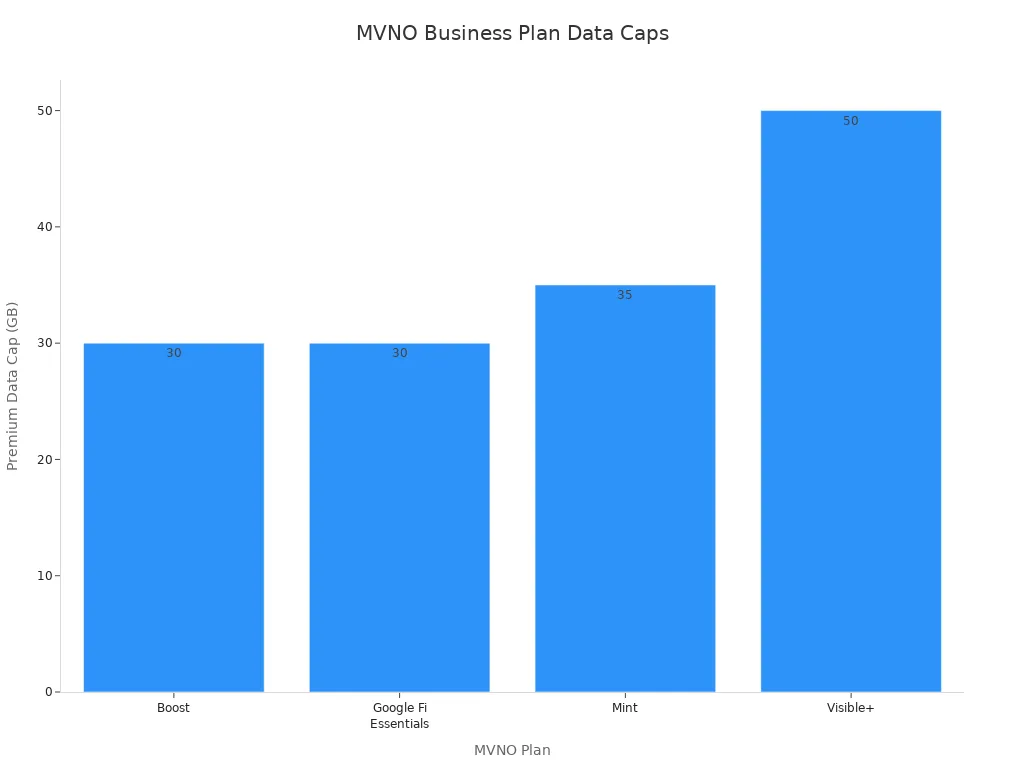
Note: The average smartphone user in the U.S. used about 15 GB of data per month in 2022. If your team streams HD video, you might use 30–50 GB each month. Many MVNO plans cover this amount.
Overage Charges
You should ask your MVNO what happens if you go over your data cap. Some MVNOs charge extra fees for more data. Others slow your speed but do not charge more. You need to know these rules before you choose a plan.
- Some MVNOs offer unlimited data but slow your speed after the cap.
- Others charge by the gigabyte for extra data.
- A few plans have no cap or overage fees.
International Data
If your team travels, check the rules for international data. Some MVNOs include free data in other countries. Others charge high rates for every megabyte. You should ask:
- Is international data included in your plan?
- How much does extra data cost in each country?
- Can you buy a travel pass or add-on for trips?
Roaming
Roaming means using your phone outside your home network. Some MVNOs let you roam in other states or countries. Others block roaming or charge high fees. You should check:
- Does your plan include domestic roaming?
- What are the costs for international roaming?
- Will you get alerts if you start roaming?
Tip: Always read the fine print about data caps, overage charges, and roaming. This helps you avoid surprise bills and keeps your business running smoothly.
10. MVNO/MNO Relationship and Experience
Picking an MVNO partner with a strong MNO relationship is very important for your business. This connection can change your service quality, prices, and how well your business does over time. You should always ask about the MVNO’s partnership with its MNO and how long they have worked in the market.
MNO Partnership Strength
A strong MVNO/MNO partnership means you get better network access, faster help, and more reliable service. You need to know how your MVNO works with its MNO. Here are some key things that shape this partnership:
| Factor | Description |
|---|---|
| Wholesale Agreements | The MVNO makes deals with the MNO for prices and terms. Good deals help both companies do well. |
| Value Proposition | The MVNO must show the MNO how it brings new customers or reaches special groups. |
| MNO Support Level | The MNO may give extra help, like customer service or special network features. |
| Business Model and Financial Planning | A strong business plan helps the MVNO make money and keeps the MNO interested. |
Tip: Ask your MVNO if they can talk directly to MNO support teams or use special network features. This can really help your daily service.
Market Share & Tenure
You should check how long the MVNO has been around and how much of the market they have. MVNOs with bigger market share and more years in business are usually more stable. They know how to fix problems and keep customers happy.
| Category | Market Share (%) | Year |
|---|---|---|
| Prepaid | 70 | 2024 |
| Reseller | 65 | 2024 |
| Consumer | 60 | 2024 |
These numbers show that top MVNOs have a big part of the market. You want a partner who has done well and can meet your needs.
Niche Experience
Every business is unique. Some MVNOs work with special groups, like retail, healthcare, or IoT. You should ask if the MVNO has worked in your industry before. A partner with niche experience knows your problems and can give you custom solutions.
- Find MVNOs that help businesses like yours.
- Ask about special features or plans for your industry.
- Check if they have done similar projects before.
References & Case Studies
You should always ask for references or case studies. These show how the MVNO has helped other businesses. A good MVNO will share stories from clients in your field. You can learn about their problem-solving and customer service.
Note: Talking to other businesses gives you real ideas about what to expect. Ask for at least two references before you choose.
Choosing an MVNO with a strong MNO partnership, good market share, and proven experience helps your business grow. You get better service, more help, and peace of mind.
If you ask these 10 questions, you can stop common mistakes when picking an MVNO partner. Many businesses have problems like these:
- Not doing market research
- Picking a partner just because of price
- Thinking operations will be easy
- Forgetting about marketing
- Not thinking about customer support
A checklist helps you follow clear steps and get better results:
| Benefit | Explanation |
|---|---|
| Improved Productivity | You follow steps and focus on what matters most. |
| Increased Accuracy | You catch important details and avoid errors. |
| Better Decision Making | You make choices based on facts, not guesses. |
Use this checklist to look at different MVNOs and find the best partner for your business. If you need more help, you can ask for support to start your MVNO search today.
FAQ
What is an MVNO?
An MVNO is a Mobile Virtual Network Operator. You buy mobile services from an MVNO. The MVNO uses another company’s network to give you service.
How do MVNOs differ from MNOs?
MVNOs do not own cell towers. They rent network access from Mobile Network Operators (MNOs). You get similar coverage, but MVNOs often offer lower prices and more flexible plans.
Can I keep my current phone number when switching to an MVNO?
Yes, you can keep your number. You need to ask your new MVNO about number porting. Make sure you have your account details ready.
Are MVNOs safe for business use?
Yes, many MVNOs follow strict security rules. You should check their data protection and compliance policies before you sign up.
What happens if I need more lines or data later?
You can add more lines or data with most MVNOs. Ask about their process for upgrades. Some let you do this online in minutes.
Do MVNOs support international roaming?
Some MVNOs offer international roaming. You should check the rates and coverage before you travel. Ask if you need to activate roaming in advance.