Wi-Fi 6 and 5G in Industrial Networks: Choosing the Right Wireless Technology for Your Enterprise
In today’s smart factories and industrial environments, wireless connectivity is no longer optional—it’s foundational. While both Wi-Fi 6 and private 4G/5G networks play critical roles, understanding their strengths, limitations, and ideal use cases is key to building a future-proof industrial network.
What Is Wi-Fi 6?
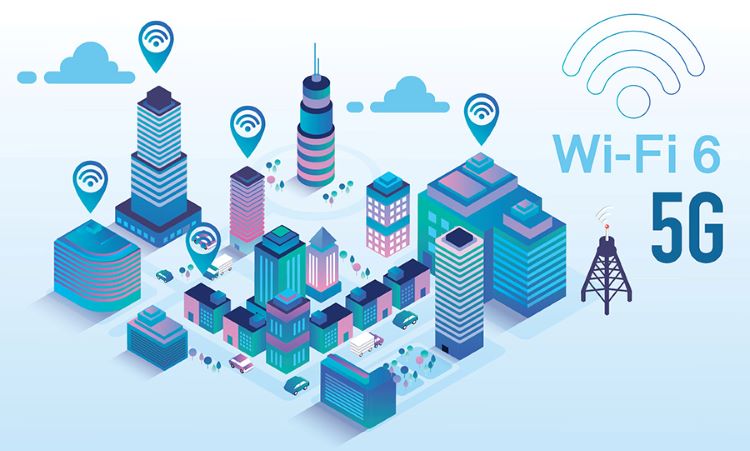
Wi-Fi 6 (IEEE 802.11ax) is the latest generation of Wi-Fi technology, succeeding Wi-Fi 5 (802.11ac). It delivers a theoretical peak throughput of 9.6 Gbps—nearly three times faster than Wi-Fi 5—and introduces revolutionary efficiency improvements for high-density environments.
Key Advantages of Wi-Fi 6 in Industrial Settings
- Multi-User Simultaneous Communication: Unlike older Wi-Fi standards that serve devices one at a time, Wi-Fi 6 uses OFDMA (Orthogonal Frequency Division Multiple Access) to allow an access point (AP) to communicate with up to 8 devices simultaneously.
- Lower Latency & Higher Efficiency: By dividing channels into smaller sub-channels, OFDMA reduces contention and waiting time—critical for real-time control systems.
- Better Performance in Dense Environments: Designed to solve network congestion caused by hundreds of IoT sensors, robots, tablets, and AR/VR headsets operating in close proximity.
Industrial Applications of Wi-Fi Today
Thanks to its low cost, ease of deployment, and high bandwidth, Wi-Fi—especially Wi-Fi 6—is widely used in industrial scenarios such as:
- Inside the factory:
- Industrial equipment automation and edge computing
- AR/VR-assisted maintenance and training
- Robotic coordination and AGV (Automated Guided Vehicle) control
- Smart lighting, HVAC, and environmental monitoring
- Outside the factory:
- Secure backhaul between factory sites and data centers
- Inter-factory communication in distributed manufacturing
Wi-Fi vs. Private Cellular: Matching Technology to Business Needs
While Wi-Fi 6 excels in many areas, industrial digital transformation demands more than just speed. Factors like mobility, reliability, security, and deterministic latency often tip the scale toward private LTE/5G. IPLOOK recommends the following approach based on real-world requirements:
| Scenario Requirement | Recommended Solution |
|---|---|
| Low budget, non-critical data, high bandwidth (e.g., office Wi-Fi, visitor access, basic IoT monitoring) |
Wi-Fi 6 – Cost-effective, easy to deploy, sufficient for static or low-mobility use cases. |
| High security, reliability, and QoS (e.g., SCADA systems, video surveillance, mission-critical alerts) |
Private 4G/5G or Wi-Fi 6 + enterprise-grade security stack (WPA3, segmentation, NAC). |
| High mobility, precise location, ultra-reliable low latency (e.g., autonomous mobile robots, CNC machine telemetry, drone inspection) |
Private 5G – Only cellular networks offer seamless handover, licensed-spectrum reliability, and integrated positioning capabilities. |
The Future Is Converged—But Practicality Rules
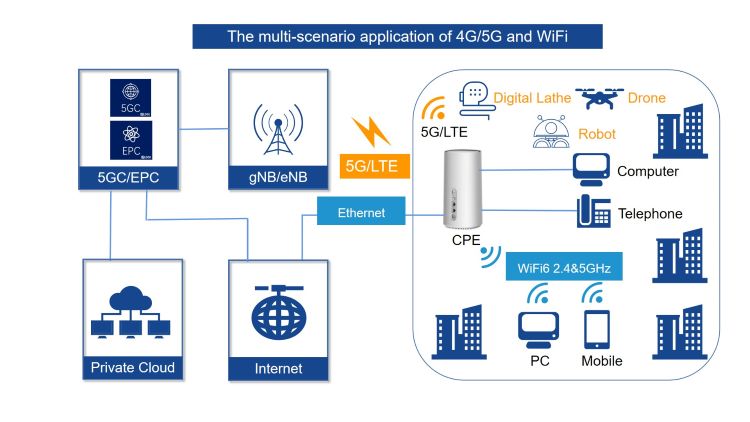
The industry trend points toward converged 5G + Wi-Fi 6 architectures, where each technology plays to its strength:
- Wi-Fi 6 handles high-bandwidth, stationary devices (cameras, kiosks, workstations)
- Private 5G manages mobile, mission-critical assets (robots, vehicles, wearables)
However, for most enterprises—especially those prioritizing data sovereignty, end-to-end security, and carrier-grade SLAs—a private LTE/5G network remains the more robust and scalable foundation.
IPLOOK: Enabling Intelligent Industrial Connectivity
IPLOOK is actively developing integrated solutions that support both standalone and hybrid deployments of Wi-Fi 6 and private 4G/5G cores. Our cloud-native 5GC and EPC platforms empower enterprises to choose the right mix of technologies—today and tomorrow.
Need help designing your industrial wireless strategy?
Contact IPLOOK to discuss your specific requirements and explore tailored 5G, Wi-Fi 6, or converged network solutions.