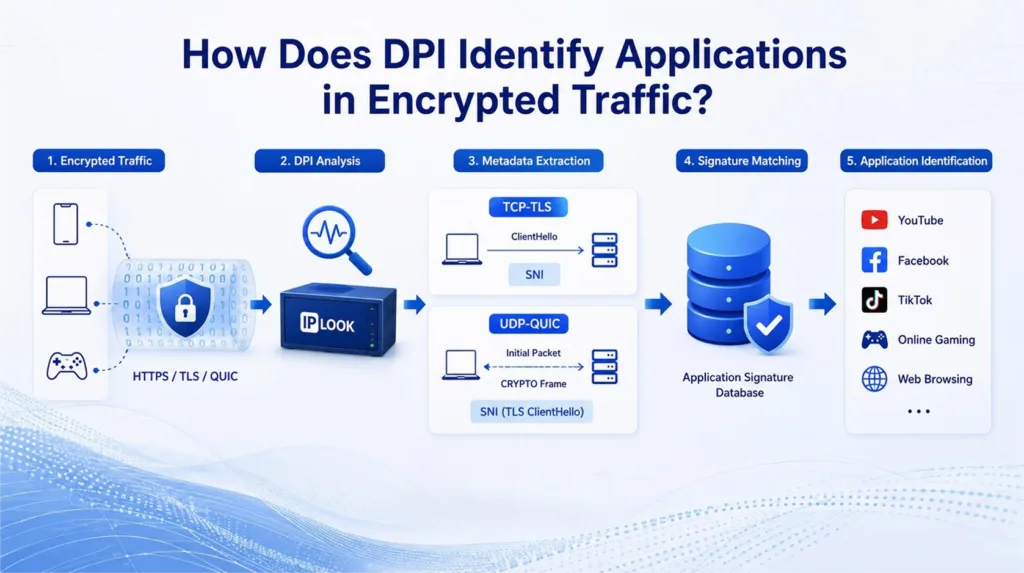
As encrypted traffic grows, traditional IP and port-based detection is no longer enough. More and more applications hide their identity inside TLS and QUIC encryption, making it difficult for operators to understand what is actually running on their networks. So how does DPI identify applications without directly inspecting encrypted payloads? The answer lies in analyzing handshake metadata and application signatures, which allows intelligent traffic identification while respecting the privacy of encrypted content.
Reading the Handshake, Not the Payload
DPI does not need to decrypt traffic to recognize applications. Instead, it examines the metadata exchanged during the connection handshake. For TCP-TLS traffic, DPI extracts the SNI from the TLS ClientHello message, which reveals the destination service the client is trying to reach. For UDP-QUIC traffic, DPI analyzes the Initial packets to extract the TLS ClientHello information in the same way. Because these handshake fields are exchanged in plaintext by protocol design, DPI can identify applications accurately without breaking encryption or accessing user content.
Matching Against Application Signatures
Extracting metadata is only half of the process. DPI then matches these features against application signature databases, which contain known patterns for thousands of applications and services. By combining handshake information with signature matching, DPI builds a reliable picture of the application mix on the network, even as new applications and protocols continue to emerge. This enables intelligent traffic identification that keeps pace with a constantly changing application landscape.
What Application-Aware DPI Enables in 5G
When integrated into the 5G user plane, DPI transforms raw traffic into business intelligence. Integrated into IPLOOK’s 5G UPF, DPI supports application-aware traffic management, differentiated QoS, and flexible charging. Operators can prioritize critical applications, apply different quality-of-service policies to different services, and charge based on the actual application used rather than simple volume. This turns the network from a passive pipe into an intelligent platform that aligns resource allocation with business value, making 5G networks smarter with intelligent traffic identification.
IPLOOK integrates DPI capabilities directly into its 5G UPF, enabling operators and enterprises to see, manage and monetize application traffic across their networks. Built into IPLOOK’s cloud-native 5G core, this application-aware approach supports differentiated QoS, flexible charging and precise traffic control without compromising encryption or user privacy. Whether you are optimizing network resources, launching value-added services or preparing for future 6G capabilities, IPLOOK provides the intelligent core foundation to make your network application-aware and revenue-ready.