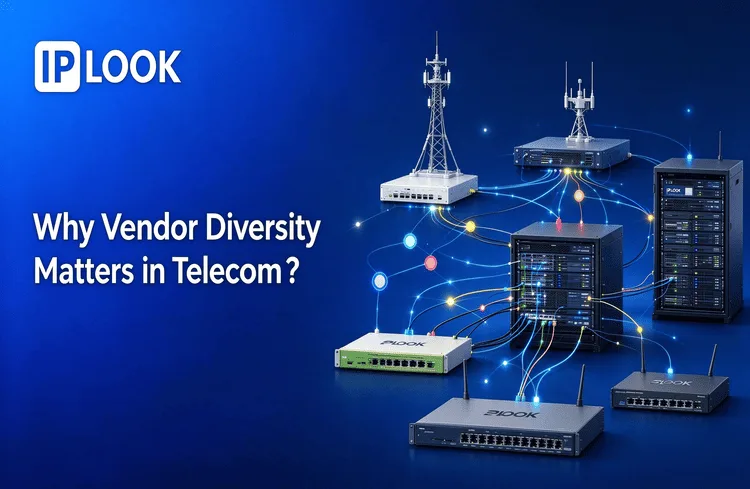
For decades, many telecom operators built their core networks around single-vendor end-to-end solutions. This approach promised simplified integration and single-point accountability, but it also introduced long-term constraints that are becoming harder to ignore as networks evolve toward 5G and cloud-native architectures. Today, vendor diversity is widely discussed but often misunderstood. The true value of a multi-vendor architecture does not lie in having more suppliers for the sake of it. It lies in stronger interoperability, greater network flexibility, and sustainable strategic independence for operators.
Reducing Vendor Lock-In and Commercial Risk
Single-vendor network deployments almost always lead to varying degrees of vendor lock-in over time. When hardware, software and management interfaces are all proprietary, operators lose negotiating leverage on pricing, upgrade paths and feature roadmaps. They become tied to the vendor’s release schedule and pricing model, even when better alternatives emerge in the market. A multi-vendor framework built on open, standardized interfaces breaks this dependency. Operators can introduce or replace individual network functions without overhauling the entire core, maintain commercial leverage, and avoid being forced into unnecessary bundled upgrades or long-term commitments that do not align with their business needs.
Boosting Network Resilience and Fault Isolation
Networks built on a single vendor stack carry hidden resilience risks. A systemic software bug, supply chain disruption or end-of-life decision from one vendor can impact the entire network all at once, creating broad points of failure. In a properly designed multi-vendor architecture, different network layers or functional domains are delivered by different suppliers. This creates natural fault isolation: an issue in one vendor’s component does not cascade across the full network. Operators can also maintain parallel vendor pools for critical functions, enabling faster failover and reducing exposure to single-point operational and supply chain risks. This diversity strengthens overall network reliability and reduces outage impact scope.
Enabling Flexible Technology Selection and Best-of-Breed Deployment
No single vendor excels equally across every domain of modern telecom networks. One vendor may lead in 5G radio performance, while another offers superior core network control plane capabilities or more cost-effective user plane solutions. Single-vendor strategies force operators to accept the full product portfolio of one supplier, even if individual components are not the strongest fit for their use cases. Vendor diversity allows operators to adopt a best-of-breed approach, selecting the strongest solution for each functional domain. This flexibility is particularly valuable for targeted use cases such as enterprise private networks, industrial IoT and network slicing, where specific performance requirements vary widely.
Supporting Continuous 4G and 5G Network Evolution
Telecom networks are long-term assets that evolve continuously over decades, from 4G EPC to 5G Core, and eventually toward 6G. A single-vendor network ties the entire evolution roadmap to one supplier’s product strategy and delivery timeline. Operators cannot accelerate migration for certain services or retain legacy components longer where it makes business sense. A multi-vendor, standards-based approach decouples network evolution from any single vendor roadmap. Operators can migrate individual domains at their own pace, preserve existing 4G investments while introducing 5G functions incrementally, and adopt new technologies as they mature, rather than waiting for a full vendor platform refresh.
Critically, successful vendor diversity is not about adding as many vendors as possible. Overly fragmented supply chains can add integration complexity and operational overhead. The real goal is to build an open, standards-based architecture that enables genuine interoperability between qualified vendors. This balanced approach delivers the benefits of choice and resilience without unnecessary operational complexity.
IPLOOK delivers standards-compliant 4G and 5G core network solutions designed for open multi-vendor environments. Our products implement fully 3GPP-aligned interfaces and support seamless interoperation with third-party radio access networks, user plane elements and OSS systems. With IPLOOK as part of your multi-vendor strategy, you can break free from vendor lock-in, strengthen network resilience, and evolve your network on your own timeline. Whether you are building a new 5G core or modernizing an existing 4G network, IPLOOK provides flexible, interoperable core network solutions that fit your architecture, not the other way around.