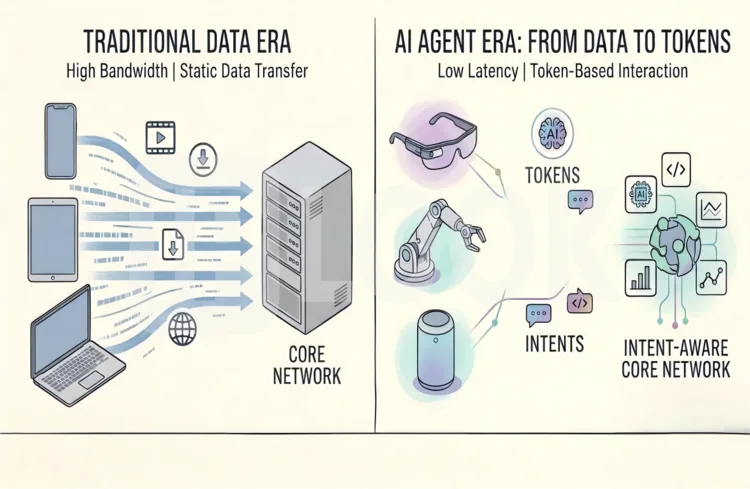
Latest research data published by GSMA clearly illustrates a major structural shift in global mobile traffic patterns brought by widespread Mobile AI devices and large language model deployments across 2026. For many years, mobile network load was dominated by large scale continuous data transmission services such as video streaming and file downloads. The market landscape is now undergoing a fundamental reversal. Operators are seeing a sharp rise in high frequency token based interactive communications between end side AI agents and remote cloud large language models, which are gradually replacing traditional bulk data flows as the primary traffic type on mobile networks.
Legacy Core Networks Fail To Support AI Native Traffic
This profound shift in user interaction logic cannot be supported by legacy core network infrastructure designed for static data pipelines. The entire core layer requires synchronous technical iteration to match new AI business characteristics. Conventional mobile core systems act merely as passive transmission pipelines responsible for forwarding data packets without distinguishing service types or business priorities. Such rigid architecture cannot efficiently process massive token micro transactions, instant low latency AI agent inquiries and frequently changing dynamic session links generated by intelligent terminal equipment. To fully unlock commercial value from mobile AI services, core networks must evolve into active intelligent service layers with rapid response capabilities.
Three Key Core Network Adaptations For AI Token Traffic
Intent-Aware Intelligent Traffic Routing
Three core technical upgrades allow modern mobile core networks to fully adapt to AI oriented traffic operation demands. The first upgrade is intent aware routing capability. Instead of forwarding data according to fixed packet rules, the core network identifies the service intent behind each AI agent request and carries out differentiated traffic scheduling and priority allocation accordingly, ensuring critical AI reasoning tasks obtain stable network resources.
Software Defined Dynamic Resource Allocation
The second upgrade centers on software defined resource agility. The core platform dynamically distributes User Plane Function and control plane computing resources on demand, meeting the strict ultra low latency requirement of AI model online inference requests without wasting idle hardware capacity.
Open API Ecosystem Integration With AI Workflows
The third upgrade lies in open ecosystem integration design. Standardized open APIs are exposed inside the core system, enabling seamless two way synchronization between network scheduling capabilities and end to end AI agent workflow logic, realizing deep collaboration between telecom infrastructure and artificial intelligence business systems.
IPLOOK Aligns Core Software With GSMA Open Network Vision
As a professional software supplier focusing on mobile core network products, IPLOOK fully aligns its technical roadmap with GSMA’s open intelligent network development vision. Our series of software defined network functions adopt highly modular, flexible architecture design. Operators and industrial enterprise clients can carry out targeted function expansion and configuration adjustment according to their own AI business layout, smoothly complete network transformation to adapt to the emerging token based AI traffic ecosystem without large scale hardware replacement or full system reconstruction work.
Upgrade Your Core For The AI-Driven Connectivity Future
If your current core network architecture lacks the ability to support intelligent AI interaction services, it is time to optimize and upgrade. Reach out to the IPLOOK team to discuss customized core network transformation solutions, and jointly build the next generation intelligent mobile connectivity infrastructure oriented toward AI era business scenarios.