IPLOOK’s 5G Satellite Solution: Bridging the Final Connectivity Gap
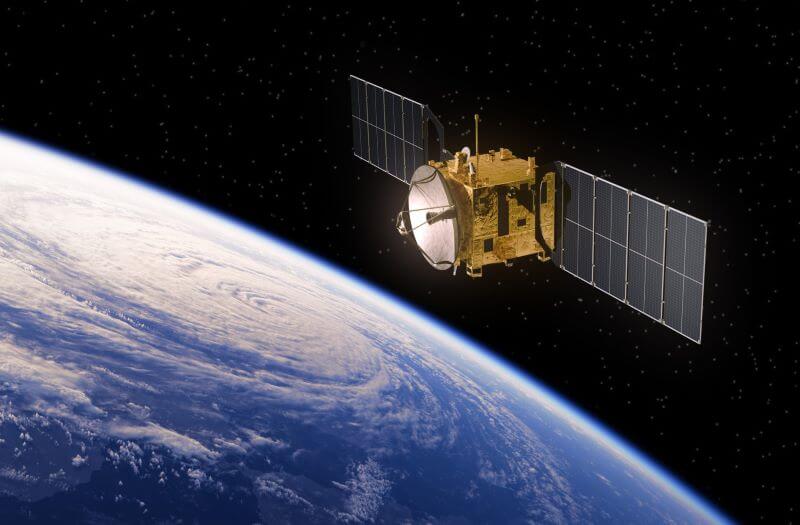
In an era where “always-on” connectivity is non-negotiable, terrestrial networks alone cannot reach every corner of the globe. Enter satellite communication—a transformative technology that uses artificial satellites as relay stations to deliver reliable, high-capacity, long-distance communication where fiber, cell towers, or microwave links simply cannot go.
Why Satellite? The Power of Global Seamless Access
Satellite internet provides truly global coverage, enabling communication in remote deserts, open oceans, polar regions, and disaster zones. Since the 1990s, advances in electronics and digital signal processing have propelled Satellite Mobile Communication (SMC) systems into mainstream viability.
Depending on orbital altitude, satellites fall into three categories:
- LEO (Low Earth Orbit): 500–2,000 km — ultra-low latency, ideal for real-time apps
- MEO (Medium Earth Orbit): 2,000–36,000 km — balance of coverage and performance
- GEO (Geosynchronous): ~36,000 km — wide footprint, but higher latency
Why LEO Satellites Are Leading the Revolution
Among these, LEO constellations (like Starlink, OneWeb, and China’s future Orbital Internet) are reshaping global connectivity thanks to their unique advantages:
For Subscribers
- Ultra-low communication latency
- High data rates with low path loss
- Seamless handover between satellite and terrestrial networks
For Operators
- Lightweight satellites enable cost-effective multi-launch deployments
- Efficient frequency reuse across beams and orbits
- Scalable, secure, and customizable service models
For the Telecom Industry
- Opens new B2B/B2C markets (aviation, maritime, energy)
- Enables point-to-multipoint content delivery
- Accelerates 5G Stand-Alone (SA) deployment in unserved areas
IPLOOK’s Integrated 5G + Satellite Solution
At IPLOOK, we’ve engineered a converged 5G satellite communication solution that unifies space and ground networks into a single, intelligent core. Our approach leverages:
- LEO satellites for wide-area, low-latency user access
- GEO satellites as high-capacity data trunk links
- IPLOOK 5GC as the unified control plane supporting satellite terminals, gNBs, and standard mobile devices simultaneously
Using real-time ephemeris data, our 5GC dynamically tracks satellite positions to ensure seamless handovers and call continuity—even as users move across vast, infrastructure-free zones.

Figure: IPLOOK’s converged 5G + satellite architecture
Flexible Deployment Models
Our solution supports multiple integration scenarios to meet diverse operational needs:
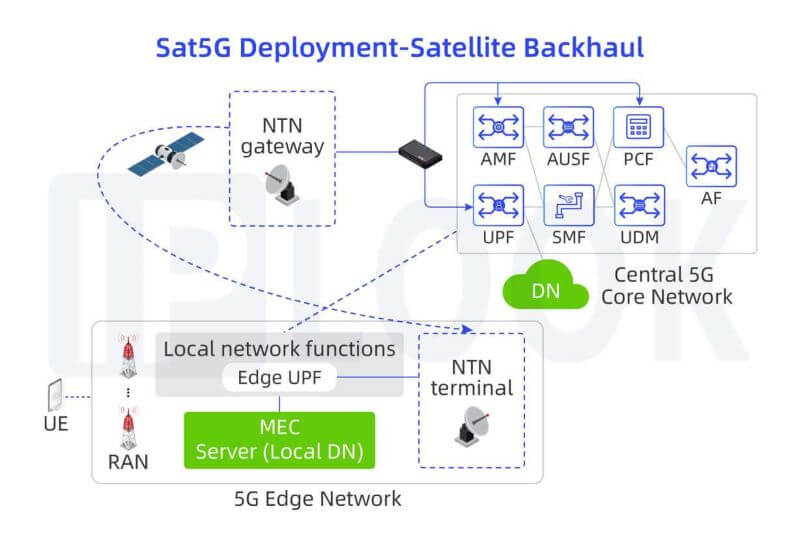
1. Satellite Backhaul
The gNB connects to the 5GC via a satellite link (NTN). Two options exist:
- Non-3GPP/legacy mode: Uses existing satellite modems; delay impacts core-gNB interaction (mitigated via virtualization).
- Native 5G NR over satellite: Full 3GPP compliance; accounts for propagation delay at PHY and MAC layers.
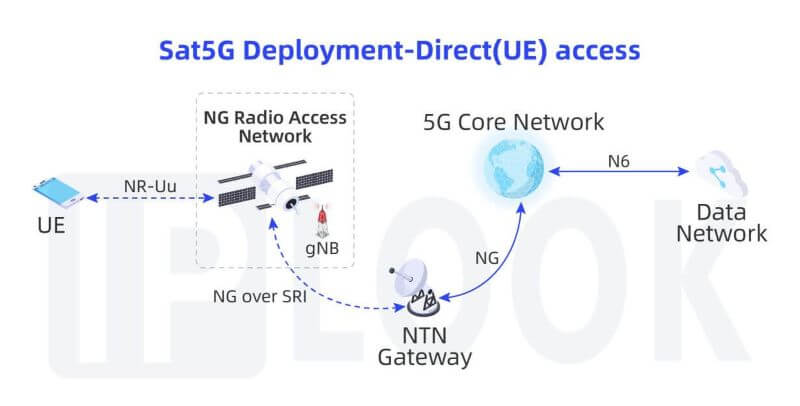
2. Direct UE Access via Satellite
Satellites act as “space-based gNBs,” enabling direct device connectivity. Supports:
- Mobile base stations with timing advance and handover optimization
- Shared RAN across multiple operators in a multi-tenant 5GC environment
The Future: 5G + LEO = Truly Global Internet
While 5G excels in dense urban environments, its economics break down in rural, maritime, or airborne scenarios. Satellite communication solves this with environment-independent coverage. As China and other nations race to deploy mega-constellations of LEO satellites, the fusion of 5G and NTN (Non-Terrestrial Networks) is no longer optional—it’s the foundation of 6G-era universal connectivity.
Orbital Internet will soon deliver broadband to every ship, aircraft, oil rig, and village—powered by integrated core networks like IPLOOK’s.
Ready to Connect the Unconnected?
Whether you’re an MNO, government agency, or enterprise operating in remote regions, IPLOOK offers secure, reliable, and tailored satellite-5G solutions for aviation, maritime, defense, energy, and emergency response.
Contact us today at [email protected] or visit our contact page to learn more.