Open RAN: The Future of 5G Radio Access—Opportunities, Challenges, and IPLOOK’s Role
The telecommunications industry is undergoing a fundamental shift in how radio networks are built. LOTTE CO., LTD. plans to deploy 7,000 Open RAN sites by the end of 2021, signaling strong momentum behind this open architecture. Meanwhile, a coalition of Europe’s largest operators has just released a unified set of technical requirements, paving the way for large-scale Open RAN deployment starting in 2022.
But why are operators embracing Open RAN? What challenges remain—and how can the industry accelerate its adoption?
From Spectrum Efficiency to IT-Driven Transformation
Historically, RAN evolution focused on maximizing spectral efficiency, boosting wireless throughput, and enhancing core network integration. However, the transition from 4G to 5G demands more: operators must now adopt practices from the IT and cloud-native worlds—embracing openness, automation, and vendor interoperability.
With diverse 5G use cases—from ultra-reliable industrial IoT to immersive AR/VR—operators need flexible, cost-effective solutions. Open RAN delivers exactly that: the ability to mix and match best-of-breed components based on specific service requirements.
vRAN vs. Open RAN: Understanding the Difference
At IPLOOK, we clarify a common misconception:
- vRAN (Virtualized RAN): Replaces proprietary Baseband Units (BBUs) with software running on Commercial Off-The-Shelf (COTS) servers—but still relies on vendor-locked interfaces between radios and baseband.
- Open RAN: Goes further by standardizing open interfaces (e.g., O-RAN Alliance’s Fronthaul). This allows any vendor’s radio unit (RRU/RRH) to interoperate with any vendor’s baseband software—like “LEGO blocks” for networks.
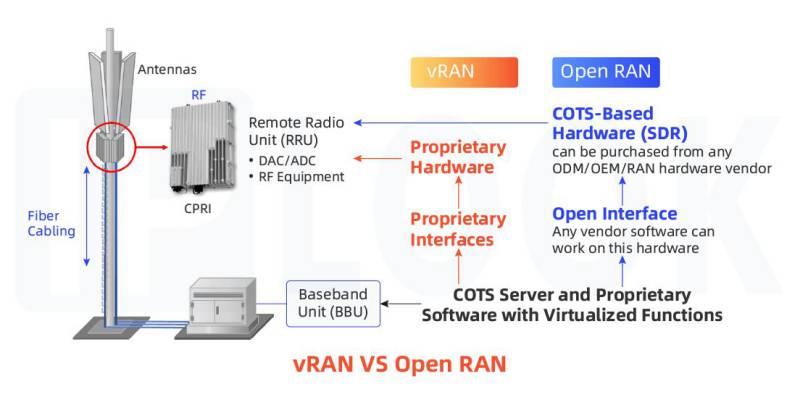
vRAN vs. Open RAN – Key distinctions explained by IPLOOK
Market Momentum Is Clear
According to a mid-2020 Deloitte survey, most operators expect practical Open RAN deployments to scale within two years. The demand is driven by:
- Need for multi-vendor competition to reduce costs
- Desire for faster innovation through disaggregation
- Support for specialized 5G services via flexible RAN slicing
But Deployment Complexity Remains a Barrier
Despite its promise, Open RAN introduces significant integration challenges. As overseas operators note: “Open RAN is the future—but it’s complex.”
Because Open RAN disaggregates hardware and software, someone must act as the system integrator—validating interoperability, managing lifecycle operations, and ensuring performance consistency across multi-vendor stacks. Without this, the “mix-and-match” vision risks becoming fragmented and unreliable.
The Performance Gap: Where Innovation Is Needed
While the market grows, there’s a shortage of Open RAN solutions that deliver both high performance and operational efficiency. True high-performance Open RAN should support:
- 400 MHz instantaneous bandwidth
- High energy efficiency and output power
- Scalability across urban, rural, and private network scenarios
Moreover, the industry urgently needs large-scale MIMO solutions optimized for open architectures—especially as O-RAN’s innovation-driven model promises higher margins and faster ROI.
IPLOOK: Enabling End-to-End Open & Cloud-Native Networks
As a leading provider of end-to-end wireless solutions, IPLOOK is committed to accelerating Open RAN adoption—not just in the RAN, but across the entire stack. Our cloud-native, container-based:
- Core Network (5GC/EPC)
- IMS (for VoLTE/VoNR)
…can be seamlessly deployed on COTS hardware or public/private clouds, complementing Open RAN with ultra-low latency, wide-area convergence, and carrier-grade reliability.
By advancing interoperable, high-performance core technologies, IPLOOK helps operators and integrators build truly scalable, efficient, and future-proof Open RAN ecosystems.
Let’s shape the open future of 5G—together.
Contact IPLOOK today to explore collaboration opportunities in Open RAN and beyond.